↓
 
Header image for PolyWogg.ca mobile view

PolyWogg.ca

The writing life of a tadpole

PolyWogg Astronomy - my adventures hopping from star to star
 
 
  • Welcome
  • Writing and Publishing
    • List of blog posts about Publishing
    • List of blog posts about Writing
    • List of blog posts about #Bouchercon2025
  • HR Materials
    • My HR Guide
    • List of blog posts about HR
    • PS Transitions FP (EN)
  • Astronomy
    • My Astronomy Guide
    • List of blog posts about Astronomy
  • About Me
    • About PolyWogg.ca
    • Privacy Policy
    • Subscribe
    • Contact Me
    • PolySites
      • PolyWogg.ca (Home)
      • ThePolyBlog
      • AstroPontiac.ca

Tag Archives: astronomy

Post navigation

← Previous Post
Next Post→
Picture of a telescope, stars, moon, and a log book to represent astronomy

Stargazing 2019, outing #11 – Star party in Carp…

PolyWogg.ca
August 8 2019

The night of Saturday, July 27th was our attempt at our monthly star party in Carp, suitable for public stargazing. The forecast at mid-day was pretty iffy, but I crowd-sourced some other views, and we said “GO!” hoping for the best. What we got was considerably below “best”.

At 9:00 p.m., we were about 70% clouded out to the North and West. To the South, we had some windows between a few clouds, enough for Saturn to put in an appearance. Oddly, it showed up before Jupiter just because Jupiter was playing hide-and-seek still. A new member needed help setting up a Dobsonian, and I got him going just in time for Saturn to appear and for him to try it. He nailed it first try and by all accounts, seemed pretty happy overall for the night.

I was surprised — sure, we called a “GO” for the night, but generally, most people who are coming look up and change their minds if the weather is lousy. Not last night — we had almost 150 people for the night! I was really surprised. A lot of newcomers, some who had never looked through a scope before, and even if they had, many had never seen Saturn before.… Read the rest

Posted in Astronomy Guide | Tagged astroblog, astronomy, Jupiter, moon, Saturn, scope | Leave a reply
Picture of a telescope, stars, moon, and a log book to represent astronomy

Stargazing 2019.009.1 – Viewing through a lousy scope

PolyWogg.ca
July 21 2019

Almost everyone who is into astronomy as an adult has either experienced themselves or heard the stories about kids getting gifts of department store-quality telescopes and being so frustrated with the scope, and their inability to find anything, they end up giving up on the hobby. Some find their way back as adults, some don’t.

The destruction of interest haunts all amateur astronomers, we want others to share our excitement, and it is the principal driver between so many amateurs setting up their scopes to share the experience with anyone and everyone. Star parties, Scouts and Girl Guides, classrooms, corners, parking lots…we’ll set up almost anywhere.

There are fewer department stores around these days, but that doesn’t mean the crappy scopes are gone. Some even have semi-trustworthy names. National Geographic has licensed their name to a number of low-end toys, not really functional scopes, and you can frequently find them being sold off on FB or Kijiji for $20 or less, evidence of abandoned dreams.

When I was a kid, I was interested in the stars, and my parents got me something even worse — a hand-held telescope for land viewing. Like most of the parents buying them, they didn’t know any better.… Read the rest

Posted in Astronomy Guide | Tagged astroblog, astronomy, Jupiter, moon, Saturn, scope | Leave a reply
Picture of a telescope, stars, moon, and a log book to represent astronomy

Stargazing 2019.007.1 – Trying for Mercury and Mars with a Celestron NexStar 4SE

PolyWogg.ca
July 21 2019

My son’s grandparents have a cottage up in the Kawarthas, and it is relatively dark skies. From the dock area, you have a pretty good view of the sky to the South and West, whereas North and East are blocked by trees. We took our son up for a week, and just took his scope rather than his and mine (mostly due to space limitations in the car). He didn’t want to keep the scope to try on his own through the week, so we were leaving him but bringing the scope back with us. Which meant only one night to try viewing, July 6th.

The Clear Sky Chart was showing great clear skies, but the clouds didn’t get the memo. We set up around 8:00 p.m., and by the time we were set up, the moon was completely covered as was most of the Western sky with dark clouds. It opened up about 10 degrees above the horizon, and we got a great sunset, but that wasn’t my goal. I had updates from the sky trackers that Mercury and Mars were trailing the sun, and it was possible to see them as the sun dipped below the horizon. Maybe they were there, I have no idea.… Read the rest

Posted in Astronomy Guide | Tagged 4SE, astroblog, astronomy, Jupiter, plossl | Leave a reply
Picture of a telescope, stars, moon, and a log book to represent astronomy

Stargazing 2019.006.1 – Testing a Celestron NexStar 4SE

PolyWogg.ca
July 21 2019

My son enjoys looking through my telescope and has been wanting his own scope for awhile. So we went through a number of designs to see what he would like, with me trying VERY hard not to lead him to any specific conclusions about his own preferences in design. He has a few extra mobility challenges over me, and he ended up going for the smaller version of my Celestron NexStar 8SE — he chose the 4SE.

It comes with a couple of advantages and one disadvantage over mine. For the disadvantage first, it’s simply smaller. A smaller light bucket gathers less light, so things won’t be as bright for distant objects. On the advantage side, the 4SE is a slightly different design (Maksutov-Cassegrain design) which will make for crisper images; it comes with a built-in wedge (if he wants to try equatorial tracking for astrophotography); it is smaller and much more portable; it has a sturdier tripod vis-a-vis the overall weight (his scope is light for his tripod, as it is also designed to hold the 5SE model which is heavier whereas my 8SE is on the high-end of the load options for the tripod it comes with); and his alignment worked perfectly right out of the box.… Read the rest

Posted in Astronomy Guide | Tagged 4SE, astroblog, astronomy, Jupiter, plossl | Leave a reply
Picture of a boy looking through a telescope to represent astronomy

Reading Michael Swanson’s “The NexStar User’s Guide II” – Chapter 02 – Astronomy Basics

PolyWogg.ca
June 26 2019

I mentioned previously that it helps me to blog about NF books as I read them — kind of like transcribing my notes into something more coherent that my brain can recognize. Chapter 2 on Astronomy Basics in the NexStar User’s Guide II is a similar outcome. Here are some thoughts:

  • P.12 — Constellations…There are 88 constellations that divide the sky…I always assumed there were WAY more than that. I’m curious if each of them will fit in an EP at 50x magnification which is my smallest / lowest power option;
  • P.13 — Meridian…I knew horizon and zenith of course; I had not heard the term “meridian” to indicate a line going from northern celestial pole to southern celestial pole through the zenith to divide items west and east;
  • P.15 — Magnitude…I wasn’t aware that a 1 magnitude increase in power equaled a 2.5x increase in brightness…I guess I just assumed a flatter linear scale. My son’s 4″ has a magnitude limit of 12.5, while my 8″ has 14, an increase not of simply 1.5 but of closer to 1.25 x 2.5 = 3.125 i.e. I can see way fainter stars. However, I have never figured out what a reasonable limiting magnitude in my backyard is, or anywhere else.
… Read the rest
Posted in Astronomy Guide | Tagged astronomy, NexStar, reading, reference, telescope | Leave a reply
Picture of a telescope, stars, moon, and a log book to represent astronomy

Stargazing 2019.003.3 Observing Saturn with filters

PolyWogg.ca
June 8 2019

It was getting late in the evening, almost 1:00 a.m., in my backyard on June 6th and I was ready to call it a night. But Saturn was peeking out from behind some houses, and I thought, “I already have all my filters set out, why not try them?”.

As I mentioned in the previous log about Jupiter, the seeing conditions sucked, with lots of haze in the sky. Jupiter looked like it was underwater at times. Anyway, it was what it was.

The Hyperion 36mm 2″ lens showed Saturn nice and bright, but no real division other than the main rings around the planet. The 25mm super Plossl showed things clear and bright, but as with the observing of Jupiter, a 15mm Plossl was too strong and anything with my Powermate giving me virtual 12.5 or 7.5 was way too strong. Again, my 17.3mm Delos was the Goldilocks of the night, with power just right. FYI, I was still aligned from earlier on Regulus, Antares and Denebola.

I knew my Ultrablock and OIII would do nothing so didn’t bother. The Moon and Sky Glow filter was too dim, and I couldn’t find a good setting for the variable polarizing for this one (but I was tired, so maybe not a fair test).… Read the rest

Posted in Astronomy Guide | Tagged astrolog, astronomy, imaging, mare, moon, viewing | Leave a reply
Picture of a telescope, stars, moon, and a log book to represent astronomy

Stargazing 2019.003.2 Observing Jupiter with filters

PolyWogg.ca
June 8 2019

I was set up in my backyard on June 6th, trying out various things, and started observing Jupiter around 11:00 p.m. I think. I’m still getting going with my new eyepieces and layouts, so observed with my 36mm Hyperion 2″ lens, a 25mm super plossl, a 17.3 mm Delos, and a 15mm plossl. Just for fun, I tried playing with the Powermate 2x magnifier with it too, but seeing was way too hazy to pull up anything good. FYI, for alignment, I did a simple three-star Sky Align for the night to get going, and ended up with Regulus, Antares and Denebola.

At super low power, the Hyperion 36mm showed Jupiter relatively clear, moons were easily identifiable. The 25mm super plossl showed me good definition in the bands. But I tried the 15mm plossl (by itself) and played with the Powermate 2x to give me a virtual 12.5mm and 7.5mm power options, all three were too much power for the seeing conditions.

Which left me “best seeing” at 17.3mm with the Delos, with the major bands clear, but the image still pretty watery for the conditions. Nevertheless, it’s a good power to play with my various filters at the 1.25″ size.… Read the rest

Posted in Astronomy Guide | Tagged astrolog, astronomy, imaging, mare, moon, viewing | Leave a reply
Picture of a telescope, stars, moon, and a log book to represent astronomy

Stargazing 2019.002.1 Best. Viewing. Night. Ever.

PolyWogg.ca
May 7 2019

I don’t want to beat a dead horse about past problems, but the context is really important for this post. Let’s just say that I have had some challenges with getting proper alignment with my scope. And my posts have reflected that…Finally learning with the Celestron NexStar 8SE led to some success, but then eventual frustration such as Attempt #0 of 5 to save my hobby, and then some more success with Solving alignment problems with the Celestron NexStar 8SE. When I was done, I wrote up all my lessons learned as Best alignment process for the Celestron NexStar 8SE, and it is one of my most popular pages on my website. I don’t however always listen to myself, and if I’m in a rush, I can forget or skip a step and my subsequent alignment is hit or miss. Last year wasn’t a good year, and I am determined that this year, I WILL PERSIST!

My second outing of the year

For my first outing of the year, I did a basic alignment, didn’t really worry about levelling for example, I just wanted to blow the cobwebs out of my head. On Saturday, May 4th, the local RASC Centre was having members-only observing at the Fred Lossing Observatory (FLO) near Almonte and I was hoping to go.… Read the rest

Posted in Astronomy Guide | Tagged astrolog, astronomy, clusters, Jupiter, moon, RASC, star party, star tour, viewing | Leave a reply
Picture of a boy looking through a telescope to represent astronomy

Reading Michael Swanson’s “The NexStar User’s Guide II” – Chapter 01 – Introduction

PolyWogg.ca
May 4 2019

I have a Celestron NexStar 8SE telescope, and I have had some, umm, challenges dealing with alignment issues (Solving alignment problems with the Celestron NexStar 8SE). When I started surfing the ‘net to find some solutions, it didn’t take long to find out about Michael Swanson, the resident online expert for all things NexStar. He wrote the previous guide, he has an active website, he participates in online discussion forums. He’s everywhere you need him to be, except maybe in your own backyard when you’re viewing.

I finally caved and said, “Yes! I need that book!”. And then found out the new edition was about to come out. So I waited a bit, pre-ordered it, waited a bit more, finally got it, and immediately put it on my TBR pile and didn’t do anything with it. Sigh. I have about eight other astronomy books I want to devour cover to cover too, but this one is more practical. One of the few things that works for me with NF books when I’m dragging my feet to read them is blogging as I go, so I am going to try that here. I did it with Jeffrey Kottler’s “Change” – Chapter 1 and the 13 chapters that followed it before doing my final book review ( Change: What Really Leads to Lasting Personal Transformation by Jeffrey A.… Read the rest

Posted in Astronomy Guide | Tagged astronomy, NexStar, reading, reference, telescope | Leave a reply
Picture of a telescope, stars, moon, and a log book to represent astronomy

Stargazing 2019.001.1 Taking stock of last year

PolyWogg.ca
May 2 2019

Usually, I am out of the astronomy business from sometime in October to sometime in May. Last year, I did both April at the start of the year (Kicking off my 2018 astronomy season with two outings) and November for local RASC events, partly as I’m the Star Party Coordinator and I try to show up for all the events. But I didn’t accomplish much last year overall, and April and November were pretty cold.

But I have astro issues, so to speak. It’s practically a saga unto itself:

  • Finally learning with the Celestron NexStar 8SE
  • A sky tour with my new setup
  • #50by50 #05 – Re-start my astronomy hobby
  • Good location, lousy setup by me…
  • Attempt #0 of 5 to save my hobby
  • Continuing to diagnose alignment issues
  • One step forward, three steps back…
  • Solving alignment problems with the Celestron NexStar 8SE
  • Best alignment process for the Celestron NexStar 8SE

If you read all those, you would see me struggling with alignment problems, and finally — FINALLY!!! — getting a decent alignment with a very careful alignment process. And yet, to be frank, even with that “solved”, there have been lots of star party nights where I just can’t seem to follow my own instructions perfectly and I’m back in the world of a bit of hit or miss.… Read the rest

Posted in Astronomy Guide | Tagged astrolog, astronomy, clusters, Jupiter, moon, RASC, star party, star tour, viewing | Leave a reply
Picture of a boy looking through a telescope to represent astronomy

A quick way to understand the basic steps in smartphone astrophotography

PolyWogg.ca
August 10 2018

I’ve posted a few times about my experience with smartphone astrophotography. A person who is active online in this area, Kevin Francis, shared with me a copy of an infographic he did based on his experiences.

You can find the infographic over at:

http://kevinrfrancis.com/2018/07/smartphone-astrophotography-6-steps/

Note that the infographic isn`t meant to give you all the details, but I like his framing:

  1. Choosing your equipment (i.e., pick a smartphone);
  2. Choose a camera app (there are only really two great ones, depends on which OS you`re running);
  3. Use a tripod or mount to make it steady;
  4. Decide if you`re using the phone by itself, marrying it to a lens, or shooting through a telescope;
  5. Capture the image (single shots, long or short exposures, multiple images for stacking, etc.);
  6. Process the images you took.

Is that level of detail going to get you going today? No, but it will tell you the basics you need to know so you can start thinking about what you want to do. Thanks to Kevin for sharing…

Posted in Astronomy Guide | Tagged astronomy, astrophotography, infographic, smartphone | Leave a reply
Picture of a boy looking through a telescope to represent astronomy

Articles I Like: 600 Rule?

PolyWogg.ca
May 16 2018

There is a rule that photographers use to figure out how long of an exposure you can do on a camera before you’ll start to see star trails. This assumes, of course, that you’re not TRYING to get star trails. Instead, you want those lovely little pinpoint stars. The classic rule says you take a set number of 600 and divide it by the effective focal length of the camera lens. If you have a nifty 50 lens, that means you would be able to do about 12 seconds of exposure before streaking occurs.

Most astronomers feel that the 600 number is a little high. More like 500. So then you would say 10 seconds. There’s a small extra factor in there if it is a crop sensor instead of a full-frame, and so for most DSLRs, you have to divide further by 1.6. So the article attached calculates that down to 7.5 seconds.

Perfectly logical, simple math. But as the article points out, that’s not entirely true. The premise is solid though, if you think about it. Let’s say you used one of those big honking 500mm lenses and the rule 500, ignoring the crop sensor. It would say that if you’re going to point it at a small section of the sky, you are so “zoomed in”, that you’re going to see streaks for anything over a 1s exposure.… Read the rest

Posted in Astronomy Guide | Tagged astronomy, astrophotography, guides, photography, rule of 500, rule of 600, star trails | Leave a reply
Picture of a boy looking through a telescope to represent astronomy

Bad astro alignment if I don’t listen to myself

PolyWogg.ca
May 11 2018

So I posted earlier that my astronomy season has kicked off, and I’m good to go. With the news that Jupiter was in opposition this week (the closest it will come to Earth all year, hence LOOK NOW for your best view), I thought, “Well, yeah, I want to set up”. And because it’s a PLANET, not some dark sky object, I can do it from my backyard.

So on Tuesday, I was in a hurry to set up before Venus disappeared behind a house, and I wanted to show my wife and son, so I set up the scope on our deck. Anyone who knows scopes knows a deck is a bad idea unless it’s cement. Otherwise, they jiggle if anyone walks. Hard to get vibrations out, but whatever. Anyway, got it set up, quick solar system alignment on Venus, good to go, showed the family, all good.

Then I did a quick sky tour, realigned on Procyon and Capella, not bad, and then I started doing a quick sky tour while I waited for Jupiter to come up over a house. Not awesome, but then again, I hadn’t done ANY OF THE PROPER ALIGNMENT THINGS I know I need to do.… Read the rest

Posted in Astronomy Guide | Tagged alignment, android, astronomy, astrophotography, house, iPhone, Jupiter, lazy, Venus | Leave a reply
Picture of a boy looking through a telescope to represent astronomy

Articles I Like: Astronomy Calendar for May 2018

PolyWogg.ca
April 30 2018

For those not active in astronomy circles, there is a website called Cloudy Nights for all things astro related i.e. where astronomers can go to talk about astronomy when there are “cloudy nights”. Each month, they publish the detailed Celestial Calendar (by Dave Mitsky). Here are some of the highlights for May (times converted to Ottawa time):

4/5th — The peak of the Eta Aquarid meteor shower (20 per hour for northern hemisphere observers) occurs at 03h00 (May 5); the Moon, Mars, and Pluto lie within a circle of diameter 4.81 degrees at 19h00 (May 5)

May 7: Last Quarter Moon occurs at 22h09 (7th);

May 8: Jupiter is opposition (angular size 44.8”, magnitude -2.5) at 20h00

May 15: New Moon occurs at 07:48; the Moon is 8.7 degrees south-southeast of the bright open cluster M45 (the Pleiades or Subaru) in Taurus at 18:00; Venus is at perihelion (0.7184 astronomical units from the Sun) at 19:00

May 21: First Quarter Moon occurs at 23h49;

May 29: Full Moon, known as the Milk or Planting Moon, occurs at 10h19; the Moon is 8.8 degrees north of Antares at 15h00

May 29/30: Mercury is 4.5 degrees south-southeast of M45 at 03h00 (30th)

For the planets:

During May, Venus shines prominently in the evening sky.

… Read the rest
Posted in Astronomy Guide | Tagged astronomy, calendar, curation | Leave a reply
Picture of a boy looking through a telescope to represent astronomy

Kicking off my 2018 astronomy season with two outings

PolyWogg.ca
April 28 2018

Saturday, April 21 was International Astronomy Day, and while I held out a bit of hope I would make it to one of the daytime / solar star parties in Gloucester, I didn’t actually get going until after supper, just in time to head to the Canadian Aviation and Space Museum where RASC Ottawa was hosting a night-time star party. Not quite the big setup of our monthly summer parties in Carp, but still a decent number of people. In addition, my friend Rennie was going with his family to get used to setting up his scope. He has the same scope as mine, and we’re hoping he can jumpstart his learning and success curve a bit by piggy-backing off my now working alignment process.

As the first time of the season, I have to admit, I was pretty slow setting up. It was like I’d forgotten how ANYTHING attached to ANYTHING else. Surprisingly, I hadn’t forgotten any parts. I keep forgetting to make myself a bullet-proof checklist that I can double-check before leaving to make sure I have the main things (eyepieces, tube, mount, chair, and battery) as well as the extras (filters, bug spray — thankfully not yet!, etc.).… Read the rest

Posted in Astronomy Guide | Tagged astronomy, clusters, Jupiter, moon, RASC, star party, star tour, viewing | Leave a reply
Picture of a boy looking through a telescope to represent astronomy

Articles I Like: How to Take Good Photos of the Moon

PolyWogg.ca
November 11 2017

I’m frequently on the lookout for tips and tricks for astrophotography, although my ambitions are a bit basic to start with — smartphone use at the telescope eyepiece for now, maybe graduating to DSLR and webcam stuff later. And some of the easiest of the early photos are for moon shots. So, of course, I clicked when I saw an article on HowToGeeek.com entitled How to Take Good Photos of the Moon (by Harry Guinness, September 13th, 2017).

He breaks the challenge down pretty succinctly: the brightness and the distance. On the technical side, he recommends a tripod (duh), plus a 200mm lens for full-frame and 130mm on a crop-sensor. The tip, and why I thought the article was useful, came with a rule I’ve never heard of — Looney 11.

Astrophotographers have a rule for taking photos of the moon (it’s more of a guideline really) called Looney 11. The idea is that if you set your aperture to f/11, the correct shutter speed will be the reciprocal of the ISO. In other words, if your aperture is set to f/11 and your ISO is set to 100, your shutter speed will be 1/100; if your ISO is 400, the shutter speed is 1/400.

… Read the rest
Posted in Astronomy Guide | Tagged article, astronomy, astrophotography, photography, smartphone, web | Leave a reply
Picture of a boy looking through a telescope to represent astronomy

Draft Astronomy Observing Log

PolyWogg.ca
October 29 2017

So I’ve put together a draft observing log, curious if people have any other suggestions. I feel like I’ve gone way overboard on the data and details, not enough room for the notes. And I’m not sure I’ll ever get into drawing, but it’s there for now.

Views welcome.

Observing logDownload
Posted in Astronomy Guide | Tagged astronomy, log, observing | 2 Replies
Picture of a boy looking through a telescope to represent astronomy

Best accessories for the Celestron Nexstar 8SE

PolyWogg.ca
October 23 2017

A new owner of an older 8SE asked me what I thought were the priority accessories to get to go with the stock package (mount, OTA, and 25 mm Plossl). I thought it would be an easy answer, and then realized it is almost as difficult to answer as what scope would be best for someone. But I did respond and thought I could maybe turn it into a post too. Obviously it all depends on what they want to look at the most and from where. Maybe even with whom. Nevertheless, here are my thoughts on some extra considerations.

A. A good power source. I have the Celestron Lithium-Ion tank, which seems to work well for me, but I wouldn’t necessarily want to use it for a 12-hour viewing excursion. I have two old Powertanks and I may try to revive them to just use as a backup.

B. Tools to help with levelling. A simple bubble level, or apps like Cliniometer for an Android phone. I need it to make sure the scope is level before trying to align.

C. A tool to help with GPS. If you know where you are going beforehand, Google Maps will give you the coordinates.… Read the rest

Posted in Astronomy Guide | Tagged 8SE, accessories, astronomy, Celestron, NexStar, options, viewing | 5 Replies
Picture of a boy looking through a telescope to represent astronomy

Best alignment process for the Celestron NexStar 8SE

PolyWogg.ca
October 22 2017

I’ve blogged about my challenges and successes (Finally learning with the Celestron NexStar 8SE and Solving alignment problems with the Celestron NexStar 8SE), so I thought I would do a quick summary of the proper way to align my scope in case it helps others.

Here are my “four” options, although the first two are obviously tongue-in-cheek:

A. Give up

Either get a different scope or take up knitting…I actually thought about both.

B. Do it wrong for five years

Or until two people help you figure out why it’s not working (see above two posts).

C. Regular Auto Two-Star alignment – Short version

I’ll give the full write-up below with all the bells and whistles, but this will just be the short process steps.

  1. Setup tripod;
  2. ** If you are using a wedge, add wedge plate underneath;
  3. ** If you are using vibration suppression pads, set them under the legs;
  4. Add mount/arm;
  5. Attach Optical Tube Assembly (OTA), and then retighten the supporting plate on the tripod with the new weight on it;
  6. Plug in the power source;.
  7. Turn on scope, lower tube to a horizontal position, turn off scope;
  8. Level the scope;
  9. Turn on scope;
  10. Align spotter scope or TelRad or red-dot finder;
  11. Press enter to start alignment;
  12. Change to AUTO TWO-STAR;
  13. Hit BACK/UNDO to go back to CUSTOM SITE, enter GPS COORDINATES;
  14. Enter time, date, DAYLIGHT SAVINGS TIME or not, and timezone;
  15. Choose a star from the formal list, centre it roughly in the eyepiece, press ENTER, fine-tune your centring (Up and Right as last movements) by eyeball, reticule or doughnut methods, press Align;
  16. If you used the doughnut method, refocus to a tight star point view;
  17. Choose Star 2, let it slew to near that spot, centre star roughly in eyepiece, press ENTER, fine-tune alignment (Up and Right again) by eyeball, reticule, doughnut methods, press Align;
  18. Wait for “Alignment Success” message;
  19. Test your alignment on the two alignment stars you used;
  20. Turn off your TelRad or another device;
  21. Start looking for new objects!
… Read the rest
Posted in Astronomy Guide | Tagged 8SE, alignment, astronomy, Celestron, errors, NexStar, options, viewing | 12 Replies
Picture of a boy looking through a telescope to represent astronomy

Solving alignment problems with the Celestron NexStar 8SE

PolyWogg.ca
October 13 2017

I had one of those handheld telescopes when I was a kid, and I tried to look at the stars, but well, that went about as well as you think it might have gone. I couldn’t see diddly except for the moon. And even then, I never saw ridges. Then five years ago, I bought a real telescope (Celestron NexStar 8SE below) and attempted to embrace my new hobby without a lot of success.

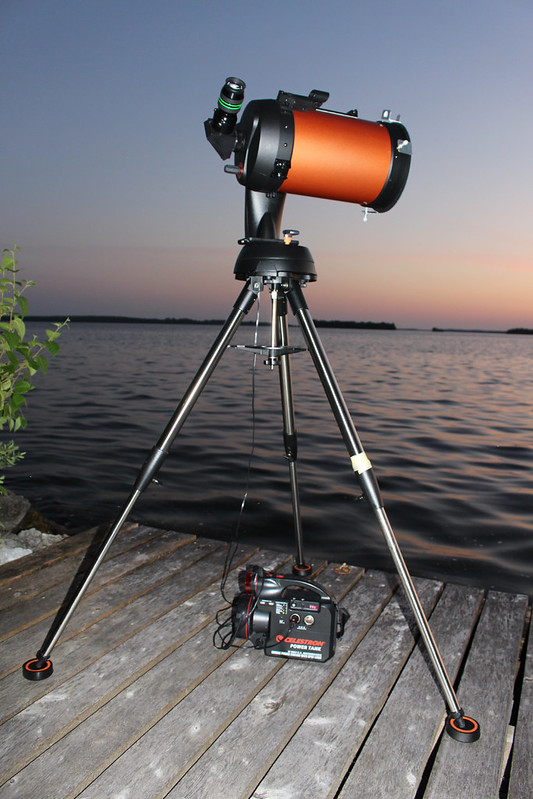
Celestron NexStar 8SE

I’m not a star-hopper kind of learner

Now, I’m going to deal with a giant issue right upfront to get it out of the way. I tried a variety of scopes both before and after I bought my scope, and it was very clear when I was done that I had bought the right scope and mount for me. Easy setup, good value for money, a few steps above entry-level, and a computerized scope to help me get going. I mention this because as I describe some of the problems to come, there is a rabid group of starhoppers out there who think the goto motorized scopes are either a waste of money or the devil’s spawn for learning or just more trouble than they’re worth. It’s a lot like someone who likes baking telling someone who has trouble working a bread machine that they should just skip it altogether and make bread by hand.… Read the rest

Posted in Astronomy Guide | Tagged 8SE, alignment, astronomy, Celestron, NexStar | 22 Replies

Post navigation

← Previous Post
Next Post→
© 1996-2025 - PolyWogg Privacy Policy
↑