- My WIP: Who wants to wrestle 5 Nobel economists?

I don’t have a full name yet for my current non-fiction Work In Progress, but I’m hoping it will be my first book out of the gate once I’m retired. I just have to wrestle 5 Nobel prize-winning economists to the ground, pin them, and steal their moves. Piece of cake, right?
Unfinished business from 2007-2008
Back in 2007, I was working at ESDC in the policy and integration unit of their strategic policy branch. My ADM at the time was considered a policy bigwig in government with one of the largest policy branches anywhere. And he was genuinely brilliant. He had commitments for the year for four files, including medium-term planning (MTP) and an Integrated Policy Framework (IPF), the latter of which was mine.
I never landed the IPF. I think I did 92 versions in deck form, not including about 40 or 50 in which we didn’t iterate on levels. Of those 92, I would say there were about 15-16 major versions, and the rest were incremental minor changes. At the time, I wasn’t quite sure why they didn’t land. I was too close to it.
Now that I’m about to retire, I’ve dusted off the IPF, and I’m building a new one. To my specifications and no one else’s.
The limitations of the original IPF
When I was trying to build it with my team of good analysts, there was no roadmap to follow or foundation to build upon. The department had never tried to create a fully “integrated” version before; they had draft versions of three frameworks in vertical silos, but that was it. If you drew a pretty picture, you could put a title like IPF and then three little boxes side by side. That’s how far you could go.
The goal, though, was not a pretty picture. The real goal was to create an integrated, policy-based theory of change, transform it into a functional framework to aid in setting priorities, and then support discussions in which “varying inputs” would produce logic chains and policy reasoning through to “recommended outcomes and priorities”. Even as I describe it now, I am using a mechanical description of what is almost always an organic process in government.
I kept pitching the machine; they kept asking about the outcome. I spun my wheels for 18 months and burned out. It was the biggest challenge of my professional life up to that point, and I gave it my all for 18 months. When I left that unit, I was crispy. I “ran” to planning and performance to rebuild my ego, my confidence, and my sense of worth as an employee. About six weeks after I left, the ADM killed it. He decided medium-term planning was enough without a full framework. They rebranded another product, declared victory and moved on.
I always felt it was not only a personal failure, but a giant lost opportunity.
Enter the multi-headed dragon
Over the last 20 years, that personal “failure” (which everyone else said wasn’t a failure) has haunted my dreams. Unfinished business to me. And when I started working on a plan to write another book when I retire, I sheepishly mused to myself, “Wow, it’s too bad that I don’t have the IPF to build on.”
Oh dear. Yep, that’s where my head went all right. I actually need THREE tools that don’t exist to write another book. One IPF; one policy coherence framework; and a revised approach to performance measurement that takes existing PM approaches in the Canadian government, reduces them to one lane, and then adds other lanes of alternative PM to the mix. Three tools to drive a later analysis that would be in book-length form.
The PM stuff I can create a short-form tool…sort of like wanting a high-end chisel with multi-grain options and settling for a flat-head screwdriver and just beasting it. The Policy Coherence Framework outline is in really good shape, and I’ll have to decide whether to write it as a longer policy piece first, or as a short version first and a longer version second.
Yet I can’t short-change the IPF. I need to have a fully realized framework if I want to write the more important book afterwards. Any weaknesses in the underlying IPF tool will invalidate the entire other premise. I have to nail the IPF first.
There are about 20 policy challenges that I could flag up front. Political realities. Different bases of analysis between human development (agency and the individual), social capital (the capacity and role of society networks through trust and reciprocity), and learning (processes, supports, and institutions). The fact that no one is paying me to do this, I have no deadline, and I might just be screaming into the void or staring into the abyss, waiting for it to stare back.
Yet that all pales in comparison to the scope of my ego commitment.
I have to wrestle 5 Nobel prize-winning economists to the ground, steal their thoughts, and build an initial framework. Then layer on the subsequent work of dozens of award-winning, internationally renowned policy thought leaders, map all of it, and understand it. (And yes, I know there is technically no formal Nobel prize for economics; it has a different name, Sveriges Riksbank Prize in Economic Sciences, but meh.)
Once it’s built, I get to turn it into some sort of working frame, applied to labour markets in Canada. Why? So I can write the other book.
I have to create a framework that nobody else in the world has successfully landed and merge it into a coherent operational framework. What could possibly go wrong with this plan?
I swear, I keep hearing a modified line from Top Gun in 1986 (Stinger, played by James Tolkan, to Maverick, played by Tom Cruise) — “Son, your ego is writing checks your brain can’t cash”.
And yet…it seems to be working, even though those 5 winners didn’t always agree.
I’m standing my little integrated framework on the shoulders of giants. George Stigler’s (1982) work on capture theory and the role of power in the three domains. Amartya Sen (1998) is the anchor for my consideration of Human Development in general, the importance of opportunity, and the focus on agency. I had the pleasure of hearing him speak in the year he won, when he delivered the eulogy at the UN for his friend Mahbub ul Haq. Douglass North (1993, with Robert Fogel) added the role of institutions, clearly anchored in an economic vein.
In 2000, James Heckman (and Daniel McFadden) won for econometric methods (snooze), but I’m sneaking in through the side door and stealing his work on building links between human development and learning and expanding the entire life-course anchor. And then, finally, Elinor Ostrom in 2009 cemented the social capital domain, with crosswalks to institutions and important lenses such as ecology. There’s a sixth candidate, Gary Becker (1992), who argues for human capital reductionism, and I mostly jettison his work, throwing him out of the ring.
Remember that I said at the beginning that I get to write this while being only accountable to myself? That is a dangerous pit of obsession. I couldn’t be satisfied with just the three domains and what the world thinks the framework should look like there. No, that’s not enough of a workload. What do I really need? Twelve lenses to challenge those three main pillars. The Nobel-winners didn’t go wide enough, apparently, so I’ve kept theirs and added some of mine, to create a home-brew:
- Economics, institutions, and life course as separate lenses;
- Human rights (both a political and civil lens as well as an economic, social and cultural rights lens)
- GBA and Persons with Disabilities for important target groups;
- Culture, ecology/environment, technology, and power to undercut some of the legitimacy, and,
- Indigenous reconciliation to try to break the entire framework with sovereignty challenges.
Are they all clean and properly cited? Nope. It’s a work-in-progress.
What am I doing today? Trying to figure out which elements become automatic cross-cutting issues across all 15 lenses/domains.
- What the “floor” is in every domain…of five levels of possible definition ranging from basic subsistence to full agency;
- The impact of project-funding vs. sustained funding on the stability of systems and participants, and the role of systems in self-perpetuation or even harm;
- Metrics options that range from traditional PM to movement along a spectrum to community-based alternatives;
- The role of politics and agency in design, definitions, status, blame, etc; or
- Where the “individual challenge” is most severe.
You know, typical light summer reading for a Sunday afternoon. The yoozh.
It’s funny, though
For whatever reason, I don’t think I’m going to tap out. Don’t get me wrong; it is enormous work. I won’t win a Nobel prize for butchering the works of giants.
But I have time, the near-unlimited ability to focus on it for a sustained period, and no approvals required except my own.
Will anyone read it when I’m done? I hope so.
But non-fiction is for me, first and foremost. I’m looking forward to the writing and the build. It’s just a wee bit daunting. Sigh. Deep breath. In, out, in, out.
Anyone else trying to scale new mountains today?

- Reputation before reach…a series about blatant self-promotion (BSP)
In last week’s post (Promote or perish…a series about blatant self-promotion (BSP)), I talked about my planned retirement and my next stage of development. I am formally embracing writing as a full-time endeavour!
While I know some of what I need about craft or publishing, I do not have a good handle on marketing. I know that I have to do it; I even know that I’m in charge of it for me (as most authors are these days), the authentic me. Which, if done right, can give me a direct pipeline to readers.
Many business elements compete for attention
It’s easy to get bogged down in “business” decisions that clamour for attention before marketing is considered. One of the biggest? Whether you are going to quit your day job and go all-in, or merely write in your spare time, cajoling the muse to appear on command whenever you have a stray few minutes. I decided long ago that my approach was to dabble on the margins until I retired and could do it full time, which is soon. Other people ask which business model they’ll attempt, from Big 5 submissions to DIY / self-publishing. Do I need help getting set up? A coach? Craft lessons? Editors? They are all important.
If and when marketing gets attention, it is often in the form of “what’s my brand?” (as I discussed last time), or specific tactics like taglines, mailings or swag. Or various platforms to use. There’s often no real strategy involved; it’s just a shotgun blast of marketing into the abyss. I will discuss tactics later in my development, when I talk about various stages such as pre-launch, initial launch, series launch and maintenance.
For me, since I think in frameworks, I know I want a marketing framework, but I hesitate to formally call it a strategy yet. Joyce Spizer would argue that I need the plan 12-18 months before I launch the first book, and while that is compelling, I don’t have enough details yet to call it “anything,” but I often ask myself, “What resonates?” in what I read. I do know that my approach will be predicated on three principles:- Marketing is a line item for my budget: it’s non-negotiable, and it’s going to cost me actual dollars, and, more importantly, time and concerted effort;
- Marketing is a means, not an end: the goal is to help readers connect to my authentic self and my stories;
- Marketing helps build relationships and overcome a transactional focus with readers.
That third element resonates strongly with me across my current day-to-day work. I manage relationships with a set group of stakeholders, aka clients, and almost all of the work is about moving the relationship from transactions to lasting partnerships. I need to learn to convert that approach into marketing as a writer. I found the first item resonates, too, about needing to budget for it. Writing the book isn’t enough. Some writers even earmark part of their advance from a publisher just to ensure they have a budget for their own promotion.
As time goes on, maybe I’ll get to the stage where it is budgeting per stage of each book (as Kristine Kathryn Rusch suggests) or building the structural assets of email lists before the posture (as Kevin Kelly might suggest), where your marketing tools become assets of the business you are building as a writer. I’m not there yet, I know. Nor am I even ready for Dean Wesley Smith’s advice on sales copy and what I should include on the back cover of my future books, where it’s okay to SELL HARD, rather than the constrained approach everywhere else. As long as the spending is legitimate and battle-tested, not falling for pie-in-the-sky or snake-oil promises. And I do like the idea that having a budget is also a sign that you are serious about investing in your own career, as Jeffrey Marks once argued for attracting cost-matching investments in the print era.
The marketing division of Me, Inc.
There are many people in publishing who believe that commercial success depends more on coordinated marketing / publicity than on writing quality. That good books don’t find best-seller lists; best-seller lists find books that have been marketed well. Some even want to embrace a full-on P.T. Barnum approach to marketing, in which publicity takes precedence over quality. While that may have hidden grains of truth, it is far too cynical for my tastes. If it was true, there would be no reason for anyone other than James Patterson, John Grisham or J.K. Rowling to write books, and every advertised book would be a giant success. I will agree that successful writers have to know the appropriate genres, emerging trends, and at least the basics of marketing’s impact.
But while marketing might help get you the first sale, it is quality and word-of-mouth that will likely drive the second. Just like the best way to increase the sales of your first book is to write a second one. And a third. Or as Michael Connelly said in an episode of Castle (S03E21 – The Dead Pool):“Know what I did after I wrote my first novel? I shut up and wrote 23 more.” Of course, frictionless sales and continued access as a business approach make a big difference, even if they aren’t part of marketing.
As I work through these issues for myself, I find myself thinking of the classic idiom that 50% of all money spent on advertising, marketing, and the like is wasted. Except nobody knows which 50%. 🙂 Most experienced writers agree that effective book promotion requires strategic thinking about which tactics to deploy and willingness to test and adapt, not merely maximizing effort expended.
Perhaps a simpler way for me to interpret it is that outcomes are not guaranteed and everything we try is an experiment of sorts. Paid advertising can be very high-risk and costly for writers, as most types of marketing available to us “normal people” are hard to target to the readers that we’re trying to reach. A recent post on Threads was from a woman who was experimenting with social media ads for her books, and after spending the money (several hundred dollars), and running the experiment for most of a month, she had precisely one targeted sale she could point to as directly related to the marketing.
By contrast, free alternatives such as press releases, social media, and podcasts might seem more “efficient” simply because even one sale won’t be offset by a counter-investment. Most examples of online efforts suggest that author-pay promo platforms rarely earn back their fees, at least not directly or immediately. The long tail of sales may pick up, particularly for ebooks, as many readers add books to their TBR lists now and read much later, but there may be no bump in sales. Free giveaways cause jumps in product movement, but not always in actual book sales.
There’s a third popular refrain. “There’s no such thing as bad publicity.” That any coverage, any visibility, beats none. And there is some evidence to support that…early on in the Kindle days, even BAD reviews on books tended to boost sales. A study back in 2010 showed that new authors, those who were still unknown, could see a 45% increase in sales after a negative review, simply by raising awareness of the book. The first step to sales is that the buyer has to know your book exists. A real book by a real person. Hard to say if that negative review option is true anymore; the evidence is more mixed now and harder to come by with multiple sites hosting reviews.
In the end, though, it comes back to the earlier point. In most businesses, you can’t control outcomes, only cost and process. But there’s one aspect I can control as a writer where I am the brand, the product creator, a solo practitioner, and an entrepreneur, all rolled into one.
I can control myself and build my reputation
With much of the result out of my control, my performance measurement background starts to kick in. If you can’t control the outcomes, you focus on inputs and outputs.
When you research the field, it’s easy to find things you shouldn’t do. Don’t use paid reviews or keyword-jack rivals; when you’re found out, the backlash will be swift and harsh. Don’t pick online fights, particularly if someone left a negative review. Chalk it up to your book simply not being right for that reader. Just as not everyone likes the same brand of orange juice. Don’t market yourself in a way that looks like you’re piling on or exploiting a tragedy, like promoting a story about a school shooting just after a Columbine-like incident. In fact, not only shouldn’t you use real people, but you shouldn’t make it look like you’re basing it on real incidents that would make someone think, “ewwww”. That also extends into writing advice like don’t put kids or pets in harm’s way, either. If it’s only gratuitous or sensational, leave it out.
Why for all of those? Because you don’t want to look like a schmoozy self-promoter who will use any hook to sell a book. At times, that is simple. Think about every bad experience you’ve ever had with someone pushy trying to sell you something, where you rejected the product because you weren’t ever going to buy something from THEM. They could have had the greatest product in the world, but their behaviour turned you off. Don’t be like them. Don’t over-promote, don’t over-hype, don’t over-sell.
Ultimately, I have found in conversations with experienced authors that it takes a while before the “don’t” rules start to quiet down. The noise lessens. Lessons learned start to emerge about what worked, over things to avoid that didn’t. Shakespeare himself might have written, “All that glitters is not gold”, with a lot of the “don’ts” focused on the bright shiny objects that pop up quickly, rather than the “dos” representing the slower dull lustre of a mindshift.
My first and best asset is my potential reputation. If I reframe promotion as relationship-building instead of pushing transactions, most of my anxiety lessens. Back in my youth, I tried to sell circus tickets by telemarketing. It was depressing as heck. Some people were good at it, most were not, and I hated it, so it’s not surprising that I wasn’t very good at it. I lasted two days. Throughout my normal career, I have preferred to deal with direct partner clients over the open public.
I like the advice about seeing it as joining a larger writing community rather than simply entering an industry. A global community of creatives trying to manage the commercial side of their business. Like most good communities, I will focus ideally on long-term loyalty to the group, contributing before looking for a return or short-term profit, and mutually helping and learning. The quieter lessons learned suggest that readers are like most consumers — they can detect a money-focus over a relationship focus.
Instead, I need to focus on my professionalism, respect for others, and warmth. In my nonfiction writing, I can build off my credibility of thirty years of lived experience as a policy and program analyst, as well as a large, deep platform of prior blog posts. I don’t have that on the fiction side, yet! But I hope to let restraint and quiet confidence lead readers to develop interest in me and my stories naturally rather than pushing sales.
I will pay a price for that choice, as C. Hope Clark would suggest, of choosing my comfort zone over being actively visible, perhaps an introvert in an extrovert’s clothing. However, that move would never feel authentic to me. In the beginning, I will likely prioritize a small number of simple approaches over several channels to see what works in general. Start small, experiment, learn.
Mostly? I need to be me, find what works for me, and I need to be present. One of my guiding principles in life is that I believe there is no such thing as a casual conversation or encounter. Every moment is a constant interaction of you with the universe. It is the hardest lesson for me to remember and to remain present. To respect the encounter first and always.
As a new writer, I welcome those new encounters with a plan in my hand and respect in my heart. For readers, writers, booksellers, librarians. For the larger creative universe that I’m embracing.
I’m not quite ready to say, “1, 2, 3, ready or not, here I come”, but I’ll practice my announcement once I get a frog out of my throat. (This is why I write, I couldn’t make it on the comedy circuit.)
I could close this post with a question for other writers about which parts, if any, resonated with them. Instead, I am asking readers. What do you look for when you engage with an author? What works for YOU?
- Promote or perish…a series about blatant self-promotion (BSP)
It’s no secret that I’m about to retire, nor that I’m going to do a lot of writing when I do. Many of the things I wanted to write over the years were incompatible with my job as a public servant. Equally, having a full-time job was not conducive to becoming a full-time writer. But to be clear, I’m not complaining. I had a good job and a good career. I’m just making a bold leap into writing with intentions at a later age than most.
In my daytime job, I have primarily been an analyst, with a subspecialty in frameworks at different points in my career. I see frameworks, I think in frameworks, I live in frameworks. Much of what I have written in the non-fiction realm so far, or at least that is public, is tied to some framework that I have created to help me understand my world — I see something, I want to understand how it fits into a larger system, and I write about it as I construct a box around it. It is a prerequisite for my voice as a nonfiction writer.
Today, I’m starting that leap forward into being a more official member of the fiction and non-fiction writing communities. And one of the biggest gaps in my toolbox is the one that everyone has to do. Being comfortable with marketing myself and my work.
Some call it blatant self-promotion; some call it simply marketing. I don’t have much experience with it, but I am not without exposure to the field.
Over the last 25 years, I have been following discussions in places like Murder Must Advertise (thanks to Kate Derie and Jeffrey Marks), ThePassiveVoice.com (former home to lawyer David Vandagriff, aka PassiveGuy), Dorothy-L back in the distant past, and consistently for the last fifteen years, the business stylings of Kristine Kathryn Rusch and Dean Wesley Smith. Add in Joanna Penn and Jane Friedman too. Saving emails. Noting tips. Considering options. Oh, and collecting 65K emails before they disappeared into a digital black hole back in the day, which I have just used Claude to help sort in ways far faster than my manual reading process.
I also went to Bouchercon for the first time this past year, enjoying the food, sights, and sounds of New Orleans while dipping my toe in the world of conferences and hoping to learn from others. When I came back, with all my notes in hand, feeling like I had learned so much, Kevin Kelly then dropped a great tome on Substack with all his lessons learned about self-publishing, making most of my notes about the business side of writing and publishing redundant. Yet marketing remained somewhat nebulous.
With twenty-five years of planning, and blogging on the side, I know what’s right for me for most of the business model, and I know what I’m going to do on the writing and publishing side.
Yet the gap has always been the answer to the original question…how am I going to handle the marketing side?
Apparently, I am in charge of marketing
All the way back to the turn of the millennium, authors have consistently said the same thing. The old and mostly mythical days of the Big 5 publishers wining and dining new authors before sending them out on giant book tours, handling all the publicity decisions and mostly giving authors addresses to show up at are gone. The model has shifted slowly from big publishers starting to focus only on high-end books/authors and even that dwindling over time; the efforts of smaller presses and indies trying to show they could get in on the digital revolution and do more for authors (even with smaller budgets) that rose and then shrunk in the 2000s and 2010s.
Now in the 2020s? Publishers and agents want to know what YOU are already doing, what platforms you are on, and how they can “add incrementally and strategically” (aka cheaply) to what you are already doing and planning, before they even consider taking you on. How are you investing already? Admittedly, the pressure points divide by type of work … fiction writers can get away with saying what they’re GOING to do tied to the author and the book (not a general “sparkles and balloons” description), but they still need a killer book; non-fiction writers have to say what they’re already doing and how the material is the platform.
Obviously, if you are self-publishing, you already know that you are in charge of EVERYTHING in your “business” of being a writer. That’s part of the decision as to what publishing path you chose or ended up in by default. I remember talking to authors in the late 2000s who were still with big publishing and them saying, “Oh, I would NEVER do any of that, that’s *sniff* not a job for real authors!”. And they were right, they wouldn’t and didn’t do that…which is why, after they got dropped by their publisher and their agent, their writing career ended. They never pivoted.
Even at the 2025 Bouchercon, I was surprised by the continuing undercurrent that the only world that matters is that of big publishing, and MAYBE you could consider “small or indie” because they COULD be chic or hip in some way. But never self-publishing, of course.
Yet it doesn’t matter because, regardless of the path, they all agreed on a certain almost inalienable and timeless truth.
Nobody else will market you or your books for you; the job is yours by default. Promote or perish.
Self-published, print-on-demand or indie might have to fight harder to overcome industry biases and perceptions, but every author has to blatantly self-promote (themselves or their books) SOMEHOW. Publishers won’t do it for you; agents won’t do it for you; booksellers won’t do it for you. It is a business necessity if you want a sustainable writing career.
Which has always been a giant mental block for me. I am an analytical introvert. I don’t want to be out doing readings and trying to sell my books at fairs, bookstores and markets. Blech. It isn’t because it seems “unseemly” (no pun intended), it’s just not FUN for me.
I know enough not to be fooled by the scammers out there who advertise themselves as “promotion/marketing consultants” who, for a few thousand dollars, will do everything for you (always check Writer Beware, the ALLi watchdog, or Reedsy, although even Reedsy has issues; I’ll come back to this in a later post as some of the scams don’t feel like scams). Ninety percent of them make the other ten percent look bad, and even the ten percent will act like the traditional consultant. If you hire them to tell you the time, the first thing they do is borrow your watch.
Or, in this case, they’ll mine your social media, want to see your website, ask for your mailing lists, etc. — all the things you could do yourself, except you’ll be doing it to give to them, in order for them to turn around and do it “for you” and charge you the cost of the ongoing subscription service.
I know that I have to do what is right for me…the authentic me, not the imaginary me I might have thought was out there leading the life of an extroverted author.
Authenticity is not simple sincerity
There’s an old business adage about sincerity: The key to success is sincerity…and that once you fake that, you have it made in business. And that kind of cynicism does show up sometimes in tips and tricks about blatant self-promotion (BSP).
I have to remind myself sometimes that writers are surprisingly cooperative about telling others about what they think works or not. At Bouchercon, I overheard an ex-military intelligence guy talking about how he had planned in advance for the conference to identify ways in which he might persuade participants to talk to him, and to open up about the secrets of the writing and publishing industry. Adapted interrogation techniques that would help him infiltrate and glean intelligence from recalcitrant sources, so to speak. He was amazed that the solution was to walk up, say hi, tell them he was a new writer, and listen.
Every group out there seems to have a healthy number of Nike writers in it. The “Just do it” crowd. They’ll say, “Here, just do these four things.” Doesn’t matter to them that it’s a totally different audience. Doesn’t matter that it isn’t you. Doesn’t matter that you’d rather be intimate with a rabid ferret than join a writer’s group. They often believe “this method worked for x, it works for everyone”. While I gently call them Nike writers, it’s also the self-help guru Anthony Robbins’ approach to self-improvement — find someone getting the results you want, do what they do, get the same results. The advice works for some people because that’s how they already think. Except that’s not me. It probably isn’t you either if you’re reading this post.
As a result, though, of the prevalent advice of Nike writers, many writers assume that marketing is a necessary evil that has to mean cold calls, schmoozing, networking, and a ton of face-to-face work, faking sincerity where they can, despite the fact that many writers are introverts. They don’t want to do ANY of that stuff. Meet people? People you don’t know? Ewwww!
I’ve read enough alternate approaches to know that I simply don’t need to do it and that not all techniques work equally well for everyone. Sorry, Nike. Good thing you don’t make typewriters.
Which led in a sort of backward way to a key realization for me…I need to be authentic in three dimensions.
First and foremost, the synthesis of all those other non-Nike writers’ opinions is generally this…we all make choices to start writing and what business model we will run. We’re in charge. So we each get to decide what WE are comfortable doing and NOT doing. If being in a room with 500 other authors scares you, don’t go to conferences. Focus on things that you can do from the comfort of your own home. All your choices are YOURS. If it doesn’t feel true to you, you aren’t going to do it well and people can tell. If you hate public speaking? You’ll probably suck at it. And readers will be turned off. On the other hand, if you’re witty as heck in short blogs? Go NUTS doing THAT.
Which means I have to lean into my strengths and comfort levels. With mild self-nudging, of course, so that I can’t simply say “Oh, I don’t know how to do THAT, therefore I can’t”. I can learn. I just need a framework for my marketing. Ah, now we’re in my wheelhouse. Hence this series. I’m going to build myself a framework of “options” and choose the ones that I think might work for me.
The second part of the authentic spin from my readings is that readers want to see YOU. They want to know about YOU, the writer. Enough about your life so you seem real and not just a cardboard cutout or a face with a book blurb. Your writing experience, process, views on your characters, etc. The Rick Castle complaint of S01E01, “It’s all the same. They all ask, ‘Oooh, where do you get your ideas?’ Nobody ever asks anything new.” Because most just want a glimpse inside your world. So be yourself. Share appropriate bits. Put a favourite recipe on your blog if you want.
Me? I practically live on my blog. There are over 2M words about me and my thoughts in the two websites, and the framework for them works. Writing on Polywogg, personal on ThePolyBlog. With enough interaction between the two to keep things interesting. I know that I did some of that “build” for my website content with a bit of an eye to the future. I already know my boundary lines, and what I’m willing to share or not. I’m not looking for an agent or a big publisher, but if someone wants to know about my platform? I have 20 years of data, my friend. I’m good.
If I’m totally honest with myself, I’m leveling up across all the categories already with the primary intent of ensuring each category on both websites is the “authentic me”, not a generic version of myself.
The third dimension for authenticity, if I put more of an “entrepreneurial” hat on for a second, is adapting the various business model elements, including marketing, to what is right for me. Not Nike solutions if I’m not an athlete.
Nor am I going to get suckered into trying to farm everything out to others. Not the least of which is that it all costs money and ROI is shaky. Back in the mid 2000s, some estimates were that the average book sold less than 500 copies, and in some genres, less than 100 copies. The estimates used less than stellar math or methodology, yet even a long-tail build to say 3000 copies sold is not compatible with early outflow of cash for doubtful marketing “help” or because you think “you have to spend money to make money”. You already spent a lot of money — your time writing the book, and you didn’t farm that out. There are places where you can farm stuff out efficiently and effectively; I don’t think marketing is one of them, particularly if it is farming out the control. You can’t delegate being you. I’ll willingly spend money on improving the product, not the after-market upsells.
But I would be remiss if I didn’t honour the hard-won lessons of authors who went before me and came to the conclusion that you absolutely must write what you love, rather than chasing the latest fad or market trend. If you’re not passionate about what you’re writing, if you don’t feel compelled to write it even, the subsequent enthusiasm to sustain book quality and reader connection will fall short of authentic engagement. And in the end, I have to be me. My voice is all I have to offer that’s unique. I have to make sure it is always my real voice.
With great responsibility comes great power
I know, I know. That is NOT the line from Spider-Man movies. Yet the inversion is apt.
There are benefits to being in charge of everything. Rusch, for example, has got her rights back to a number of books, and she has rebranded them, updated them, approved them, and deployed them. With no one at a marketing or publishing company telling her to wait six months. Huge percentages of authors over the years have complained that one of the downsides to support from a publisher is that it is rarely “cooperative” support — they aren’t consulted much on cover design, marketing schedules, or even publishing plans. That’s “the company’s job”, and authors are encouraged to stay in their lanes. Until after it is published, when the company wants them to do more, more, more marketing and engagement.
You also have a greater chance of directly controlling any contract rights to the terms YOU care about rather than arguing about standard boilerplate from larger publishers with significant default rights grabs that always benefit the company, not the author.
Yet the biggest change over the last 20 years is the viability of self-publishing…more tools, more platforms (albeit in a dominant-player market), and almost all of it digital work you can do from your house with no human interaction required. And self-publishing gets higher royalties.
You now have a direct pipeline to readers. You are marketing directly to readers, not through a corporate entity that gatekeeps and hides behind a wall of mystique and so-called respectability. People can run marketing experiments, they can target sub-markets and niches, and they can write books that big publishing wouldn’t take a gamble on. Steampunk mystery with a cat as the protagonist? Kind of niche, and no publisher will touch it because it won’t earn out the cost. But you can write it and put it up for sale yourself, with your own marketing. I’ve talked to more than a few authors over the years who were quite happy with their sales, thank you very much, of 1500 copies of a book with a significant portion of the royalties. That’s them writing authentically about a passion-driven topic. And able to reach the cat-loving steampunkers looking for a good mystery.
Marketing is more important than ever if self- or indie-published, but that extra work and tradeoff — the great responsibility — comes with far more power and control than you would have with a large traditional publisher.
An obvious conclusion
You make all the decisions.
You need to be marketing you, the authentic you, over a single book or product.
And the increased responsibility comes with greater power for you to reach your audience directly.
Where does that leave you? The popular conclusion of the 2000s and even the 2010s was that
YOU are the brand.
A sharper 2020s conclusion, and a stretch of the word brand, is that
MY brand is what MY audiences recognize as ME.
I know my authentic self — a single frog with multiple writing personalities. I just need to find my audience. Or since I have multiple “product lines”, my audiences, plural. Or if I’m quoting Kelly and Rusch? Find the real / true fans. I have readers, sure, but I haven’t converted them into “owned fans” from Kelly’s perspective.
Like many of you are or once were, I’m new to this “real” writing life and figuring it out as I go. Feel free to tell me where I’ve gone wrong; it’s all grist for the mill as I start my new life.
- Using PACE for writing goals: My to do list (part 2 of 3)

In my last post (https://polywogg.ca/using-pace-for-writing-goals-general-application-part-1-of-3/), I talked about the new goals methodology that I’m considering aka P.A.C.E.: Primary, Alternate, Contingency, and Emergency. I had already run through it previously for general methodologies on my ThePolyBlog.ca site (https://www.thepolyblog.ca/pace-goal-setting-and-burning-through-letters/) and so in my last post, it was more about seeing what it would look like for writing stages, volume, choice of genres/form, tools or approaches to writing. None of them exactly landed, so I want to apply it aggressively to my real writing goals.
Which means I have to first identify / inventory my various writing goals with more precision before force-fitting them into the PACE model.
Let’s start with the blogs
- PolyWogg.ca
- My learning: Publishing approaches
- My learning: Writing techniques
- My writing – Figuring out promotion
- My writing – New metrics
- My writing – Dashboard
- ThePolyBlog.ca
- Who do I owe in life
- What I learned in …
- Book reviews — reach 500
- Travel writing
- Galleries and stories
- Music reviews
- Recipes
The PolyWogg Guides
- Government
- HR Guide #1 — Be the Duck: PolyWogg Guide to Competitions
- HR Guide #2 — Be the Swan: PolyWogg Guide to Managing Your Career
- HR Guide #3 — Be the Sheepdog: PolyWogg Guide to Managing from the Middle
- HR Guide #4 — When things go wrong
- Dive guide #1 — Horizontal skills review
- Dive guide #2 — Simplified performance measurement
- Dive guide #3 — PM for libraries
- Macro guide #1 — Introduction to Public Administration
- Macro guide #2 — If I ran the zoo
- All the Fish — speed cameras
- Other
- PolyWogg Guide to Astronomy
- Astronomy: Drake equation
- PolyWogg Guide to Music
Fiction
- Mysteries with legal investigations
- Cal Clarke
- Moot Point
- He Said, She Said
- DJ story
- Sealed court
- Feast or Famine
- Nuke
- Grandmother
- Kat
- Mentor’s wife’s murder
- Sarah
- Actress with cold feet
- Uncle Vic
- Legacy combined
- tbd
- Cal Clarke
- Fantasy
- Series of 12 books
- 1. War
- 2. tbd
- 3. tbd
- 4. Water
- 5. tbd
- 6. tbd
- 7. tbd
- 8. tbd
- 9. tbd
- 10. tbd
- 11. tbd
- 12. Desire
- Series of 12 books
- Science Fiction
- Lost contact with outpost(s), miner’s history
I don’t know if that list particularly helps me or not, yet, but that’s my “big list”. I have more granularity in places, like my Astronomy Guide might be 4-5 smaller books.

- PolyWogg.ca
- Using PACE for writing goals: General application (part 1 of 3)
For those who read my previous post about goals in general, over on ThePolyBlog.ca site (https://www.thepolyblog.ca/pace-goal-setting-and-burning-through-letters/), you’ll know that I’m talking about the military acronym:
- P (Primary)
- A (Alternate)
- C (Contingency)
- E (Emergency)
And as I’m obsessed with any tried, tested and true methodology for planning, I wanted to see how it would work for personal goals and writing in particular.
Stepping back for a moment, for the writers in the audience, you’ll likely recognize a form of PACE…. It is also a way of escalating tension in manuscripts for TV, movies, books, whatever. Sometimes it is something simple, like you have a big problem (goal) and a big solution (primary), but then you get to the implementation stage — and your primary solution fails. Like in Star Wars, when the hyperdrive doesn’t work. You have to move to an alternate option, even if it’s not your fault. In Jurassic Park, they tended to go the opposite way — the solution partially worked, but it either immediately resulted in the dinosaurs forcing them towards an alternate plan anyway OR creating another problem immediately requiring a new solution to THAT problem. The scripts using PACE approaches keep doubling down on the challenge of achieving the goal and burning through letters.
And so while that is a viable way to increase tension in thrillers, that’s not what I’m talking about in terms of writing. That’s using PACE as a plot device; I’m talking about using it to track and achieve writing goals.
I started playing with ways to apply it to my various writing goals and projects, and well, as I noted in the last post, it is not a one-sized-fits-all methodology (even though it is billed as such).
I went through several iterations, but none worked completely. I’d show the various steps of the analysis, but, well, it’s kind of boring. The outcome was that you can sort of use it, but you have to redefine your goal in certain ways, and you STILL don’t quite achieve the goal unless you twist it so far it isn’t recognizable. Let me show an equivalent table to the one in the previous chart, adapted for writing.
Typically, you’d talk about a writing goal like “Write a book” or, more pointedly, “Write 50K words”. Except when you then look at various ways to get to those goals, you start to see the flaws in PACE for this type of goal.
P
PrimaryA
AlternateC
ContingencyE
Emergency
(comment)Writing stages Writing Editing Researching Outlining Stages, not alternatives Writing volume 5000 words 3000 words 1000 words 500 words Volume metrics Writing choices Fiction book Non-fiction book Blogging Curating or journaling Different but unrelated choices Writing tools Desktop Laptop Phone Long form A bit of “where” with a bit of “how” Writing approaches Solo writing Write with a partner Rely on tropes Add in AI tools Kind of rough headings For writing stages, some people would really like a PACE-like set of alternatives. You can write today, that’s the primary goal. But if you can’t write — because of block or timing or other deadlines — then maybe you do some editing of previous material as your alternate approach; or researching as your contingency; or, in an emergency, some outlining. Except…that isn’t how PACE works. In the original COMMS example, you ONLY do one of the four. While they are hierarchical, or at least prioritized, you never do ACE if P works. In this case? You’re prioritizing writing, but you could do any of the four. Yet if you were really prioritizing, wouldn’t research or outlining come first? They would for your stages, but on any given day, perhaps writing is your real goal. Butt in seat, typing away. Great. But then your goal isn’t really which stage of writing you’re doing, maybe it’s more that you’re just producing volume against some metrics (row 2)…on a good day, you’ll do 5000 words. On an emergency day, you may only get 500 words. But, again, that’s not really a PACE approach — that’s “I’m typing, how much can I do today”. Not really about choosing them hierarchically where one fails before you try the others.
For row 3, it’s more about choices. Your primary goal might be working on a fiction book; the alternate might be non-fiction; the contingency might be blogging; and curating might be the emergency option. So, they are not stages, nor volume-based — they clearly represent clear and different options. You might accept that those are also the four priorities. But, like with stages, are they really something where you’re only doing non-fiction, blogging or journaling if you can’t write fiction? What if fiction works? Does that mean that you only write fiction forever? Under the true method of PACE, it would indeed mean you do your primary if you can and ONLY move on to the others if the primary fails. Not really PACE.
I thought some more about the originals. And one thing that the movie and the comms examples have in common is that they all represent different ways to achieve the identical goal aka the “how” it is achieved. So, if we say the goal is to write, it could be that you have your desktop as your primary tool. Then, perhaps, if your desktop is not available (down, someone else using it, or you’re not near it), your alternate could be a laptop. That’s similar to the comms technique, just a different how, with slightly lower efficacy. If you go towards a contingency plan where you can’t write on your desktop or laptop, maybe you write on your phone or a tablet. And if all else fails, in an emergency category, you could use a pen and piece of paper and write long-hand. If I go back and compare it to the original examples, it works. Great, done, right? Except, well, in the original comms examples or the movie, P and A, and even C, have a non-zero risk of failure hence needing a primary and three other ways to achieve your goal. Failure is not an option. Except, if I look at the above example, it is transforming the goal of “writing” into an “avoid a technical risk” goal.
Which is not nothing, honestly. In the original comms, the risk is that the three PAC options will fail technically and stop you from communicating. In the movie, it’s more robust, and Pierre has four different ways to get his cousin out of jail. With increasing risk. It is hidden in the background, i.e., that the PACE approach works best when the focus is on avoiding binary risks that will derail success.
And yet.
When I look at the example of a technical “block”, it looks great on paper. But it has NOTHING to do with the real risks for writing. On the list of ten things that will stop me from writing my book(s), which computer I use is barely a blip. If my desktop dies? I’ll replace it. If my laptop dies? I have other older models AND I’ll still replace it. Will I get down to writing by hand? Probably not. Maybe with some journaling, curating, or brainstorming, sure, but that is not a technical gap that I’m filling.
I took a crack at seeing what would happen if I thought of it more like “I can’t get it done”. That **I** am directly the failure. So perhaps I could consider working with a partner, or involving a writing group to keep me on track (I didn’t include that in the options). My contingency was to go more formulaic, relying heavily on tropes, or in an emergency, letting AI have a go at some of my research or summarizing my prose.
There is SOMETHING there, I can sense it
What if I view some of them as a mix-and-match? Or equivalencies?
In a lot of fitness examples, I see references to the equivalent of “one cardio” activity in each of the primary, alternate, contingency and essential categories. And so they rank their cardio activities as perhaps swimming, jogging, bicycling and walking. Except the swimming, jogging, and bicycling might be just variations on the primary — one “large” cardio activity. There would be no efficacy drop to jogging or bicycling, just to the last one.
I think, but am not 100% sure, that the primary might allow for multiple equivalent buckets. I’m going to try tackling that in my next post…seeing if I can translate my direct writing goals into a mix-and-match semi-hodgepodge.
Wish me luck.
- Quest of the Quill 2025: 25,000 words in days 4-14

For my new Quest of the Quill goal of 30K words in November, I have written some more blogs.
For November 01-03, I had three posts for a total of 6,077 words.
For November 04-14, I have 6 posts (not including this one):
- Quest of the Quill update — 155 words
- All the fish? Photo radar use in Ontario — 4437 words
- Arguing for a wage increase: The rack rate (part 1 of 3) — 1345 words
- Arguing for a wage increase: The commute rate (part 2 of 3) — 5397 words
- Arguing for a wage increase: The Labour rate (part 3A of 3) — 4950 words
- Arguing for a wage increase: Alternatives (part 3B of 3) — 9154
That totals to 25,438 words for this update. And my working total for the month is now…dun dun dun…31,515!
Don’t look now, but I’ve reached my initial goal of 30K. I wasn’t sure I could reach my goal only by counting my blogging effort, but apparently I was inspired by the topics this month. I have more to write, and I’ll see where that gets me by the 30th.
I have “quested” under the quill, and achieved my goal. Tappety tap tap.
- Quest of the Quill 2025: 6,000 words in days 1-3
I replaced NaNoWriMo with a quest of my own, and I’m calling it the Quest of the Quill. The goal is to write 30,000 words in a month. I even have my graphics ready:

I’m only 3 days into the month, and I’m already confused a bit on my numbers. I wrote a bunch of post content, and then I decided to split it into several different posts. So, it’s written, but not finalized or posted yet. So I’m ahead of the curve a bit, and thus I’m only counting the ones that are “done” so far:
- No, I don’t think everyone is a f***muppet — 3568 words
- Replacing NaNoWriMo as a writing challenge — 1352 words
- Someone as crazy as me about goals — 1157 words
Which means my working total so far is 6,077 words, not including this post. A pretty good start.
- Replacing NaNoWriMo as a writing challenge
If you’re not living under a rock, or even if you are but have done creative writing in the last 25 years, you’ve probably heard of NaNoWriMo. National Novel Writing Month or National Novel Writing in a Month.
It was created in 1999 with approximately 20 participants as a writing marathon to complete a first draft of a 50,000-word novel in a month. You didn’t have to polish it; you just had to finish writing 50K words. Over the years, people tweaked the rules to fit their needs:
- The 50K gave way to personal choice in length of writing goal, with some going longer, some going shorter;
- The “novel” gave way to novels, non-fiction books, plays, poems, blogs, cookbooks — literally anything with words and a wordcount;
- The “write every day” gave way to focusing on just the wordcount;
- The “share your work” online gave way to share your wordcount, talk about your work-in-progress, connect with other authors online, join mini-writing groups to motivate you, etc.; and,
- The “month of November” gave way to “mostly November”, with some variation by users.
About the only thing consistent throughout was that it was a sprint/marathon for one month, with a focus on word counts.
My involvement with NaNoWriMo
I did some stuff back in about 2015 or so but not really very focused or tied to NaNoWriMo itself, just that month. I didn’t register on the website or anything like that, nor even blog about it (which is a bit weird for me). But I didn’t sustain the effort, call it maybe 15K by the end of the month.
I put a lot of effort into my HR Guide in 2017, although I didn’t formally clock it as part of NaNoWriMo. Maybe about 60K words over a slightly longer period.
Then, in about 2019, I started writing a mystery novel with one of my main characters. If the character is a series, as I intend, this would have been about book 4 or 5 in the series. I got about 4 chapters in, and kind of went off the rails. I didn’t know the characters well enough yet…in essence, I chose something to excite me, but not something I was ready for yet. Call it about 12K in total before setting it aside. I’ll definitely still use it one day, but I needed to start with something else.
I continued my engagement in 2021 and chose to focus on updating my HR Guide. I started off really strong, hitting more than 30K words by the midpoint. Then life intervened, and I crossed the goalline just over the 50K metric, but far from done updating the Guide.
In 2022, I dragged Jacob and Andrea into the sprint. Jacob was writing a fantasy novel, Andrea wrote stuff about her cancer journey that she posted on FB and used some in ToastMasters, and I focused on blogging plus polishing my HR guide. We all dropped out long before the mid-point of the month. Jacob and I did get t-shirts to help motivate us.
And to be honest, that was really what I was doing. Setting a goal to “write more” and buying t-shirts as souvenirs and motivation. I did the same in 2023 and 2024. I like the premise, but it is more an individual, internal activity for me than a group, external activity. I wish Jacob and Andrea were more interested in it or had the time, energy and/or bandwidth, but really that’s just an excuse on my part. My quest, my challenge.
The NaNoWriMo organization died after last year
So, it’s hard to say precisely why NaNoWriMo imploded or at least not a single solitary cause. There were certainly financial issues of hosting a very active and expensive website with limited ways to monetize what was basically a social network to some writers and nothing more. Equally, though, they did have a lot of disparate threads going on, making it hard to see their ongoing vision outside of November’s annual sprints — sharing, posting WIP, small groups, links to other groups, online stuff, camps for teens, etc. And while the writing stuff for teens seemed great, they ran into issues with moderators being accused of both inappropriate behaviour towards and failure to protect teens in the groups.
They shut down in March of this year, and so writers seeking a replacement have found other trackers online or created their own. Some obvious pretenders to the throne are:
- Commercial companies trying to pivot their core writing tools / services to include NaNoWriMo-like springs, including Reedsy Novel Sprint and ProWritingAids Novel November;
- Writers’ communities with little fare, including NewNoWriMo for fan fiction and NoQu (Novel Quest which is pretty close to NaNoWriMo); and,
- A bunch of variations like AutoCrit (90 days), 4thewords (gamification), Shut Up & Write (all year), Order of the Written Word (different types of writing or editing goals), StoryADay (any month really), and Pathfinders Writing Collective (team goals, rather than individuals).
Yet I feel almost no interest in any of these. Maybe I just want my own writing challenge.
What do I want in a writing challenge?
Initially, I want something similar to the writing goals of NaNoWriMo. A clear “target”. Except when I think about the 50K total, while highly ambitious, it’s also not “universally” appropriate for different types of writing. For example, maybe I want to write a blog today or a short article for an online magazine. Obviously, I could eschew breaking the big goal into 1667 words a day, so that perhaps one day I go above, the next below, etc. And different forms might have different lengths. Yet, as someone with a deep background in performance measurement, I don’t particularly like wordcounts as an overall metric.
So, for example, lots of writers in the past were paid by the word. Which means some of their novels are dreadful. Obviously, I’m not trying to produce 50K camera-ready words in a sprint, but I also don’t want to feel like I’m padding some of my writing to up the wordcount. I’m already wordy enough.
Instead, I like the idea of something like 30K worth of usable writing. Part of a chapter, a blog post, some research summaries, whatever. But basically 1000 words a day. The challenge is that I can do 20K in four hours if I’m writing certain types of non-fiction, and 1000 words in my sleep. I don’t know if it is enough of a word count to still feel like a challenge. I can always up it in future years.
But the 1000 words also encourages “write every day” to hit the goal of 30K in a month.
I also know that the format is not important to me — novels, non-fiction guides, blogs, it’s all good.
I also may not share everything online immediately, but I will maintain some accountability with regular writing updates, as I have in previous years.
And interestingly enough, since it isn’t about an international/national campaign, I can really do it any month. I just happen to be targeting November right now.
My kingdom for a horse! Or at least for a name for the challenge!
Obviously, ‘Na’ is not part of it, i.e., not national, more “personal”. It is for writing, so ‘Wri’ could stay. ‘Mo’ for a month? Ish. ‘No’ is out for novel, as I’m taking multiple type of manuscripts and documents.
I do, however, also like the idea of it being a “challenge” or a “quest” even, clearly defined. ‘Creative’ could make the cut, but well, that could be anything…music, art, sculpture, anything really, but I’m talking writing.
I played with some ideas to combine a quest or challenge, and something to do with writing.
So far, the best I can come up with is:
Quest of the Quill
Or something in french, like Défi de clavier, if I could find a good french idea starting with “c” to keep the alliteration with clavier, but I didn’t see anything, so nah. QQ2025 is growing on me. A little bit of artwork later…and voila.
- Was attending #Bouchercon2025 a success for me?

That’s a bit of a strange question, isn’t it? I went to a book conference; I was NOT looking for an agent or to promote a book; I had no real defined goals in advance. I didn’t ask “Did I enjoy it?” or “Was it fun / interesting / illuminating / horrible / terrible / no good very bad 4 days?”
I asked if it was a success.
It wasn’t cheap…registration was fine, $250 or so. But staying in the hotel for six nights at $179 US plus my flights plus all my meals, taxis, and minor souvenirs isn’t pocket change. I haven’t added it up completely but it’s probably between 3.5K-4K overall, Canadian. Which I knew in advance, not whinging. Food was a bit more expensive than I expected, with fewer cheap options in the area to get to, but I’ll come back to that.
But with the cost, and the experience tied to it, I find myself wondering of course if it was worth it. Particularly as this wasn’t a family trip, it was just me on my own doing my own thing.
And the trip was a bit of a test for me in three different domains. So if I ask if it is a success, I guess I have to ask if it was worth it in those three areas. If you want to know how it was for personal, I’ve left my original post over on my sister site at https://www.thepolyblog.ca/was-attending-bouchercon2025-a-success-for-me/.
Professional development
The conference ended upfolding a bit different than I was originally expecting. I had never been to a BoucherCon before, and so I didn’t completely know what to expect. I knew there would be technical panels, book signings, meet the author speaking engagements, some gala-like festivities, and awards ceremonies. But I also had seen in past years panels where people talked about genres, favourite villains, etc. Stuff that would appeal more to “fans” of mystery fiction than to “writers” of mystery fiction.
I was interested in all of the above to some degree, and thought I would go experience it all. When the full panel came out, I was pleasantly surprised that it had more of a technical bent to the panels, more about craft than fans, and relatively shocked that there were so many breakout panels. There were over 650 speakers across the four-ish days (mid Wednesday to mid Sunday), with about 18-19 breakout sessions, 6 panels per session, and 1 moderator and 5 speakers per panel.
Normally, when I look at conferences — work or fun — I often look at the breakout sessions and get annoyed. Frequently, I see that two people I want to see are on at the same time, even though there are other opportunities to see them, and then some sessions where I have no interest in any of the guests.
As an aside, I approach the Ottawa FanExpo/pseudo-ComicCon with a very set formula…I go through the full list of guests, I give one point if it is someone that interests me and/or is on a show that I watch(ed) regularly. They will have stories that I will enjoy, no doubt. If they are semi-interesting, but not people I would worry if I missed them at a conference aka not a “must-see”, more of “could be good”, I’ll give them half a point. Then I total up the points, and if it isn’t at least above 5, I pass.
I didn’t really have that goal for this experience, I was going no matter what, although there were some “must-sees” for me for panels. Michael Connelly, for example, was someone I saw three times during the conference (rare to have multiple appearances, just the nature of his status). I really wanted to see Lee Goldberg, which I did.
But the real professional development measure is in all the different panels I went to, against four broad themes:
- WRITING SERIES: Ensemble casts, kick-ass female protagonists, avoiding the pitfalls, maintaining storyline silos, romance in crime fiction, and tips and tricks for keeping a series fresh;
- TECHNICAL ASPECTS OF WRITING: Avoiding the info dump (handling exposition), make ’em laugh, forensics, hooking the reader with great first lines, suspense + action + conflict in mysteries, writing legal mysteries/thrillers, dialogue matters, protagonists with flaws, PIs, reporters as protagonists, and writing action scenes;
- WRITING/PUBLISHING AS A BUSINESS: Overview of the business, publishing undercover, the impact of AI, marketing and promotion, choosing the best publishing path, beyond the conference for learning/networking/developing, and taking a book to screen;
- FAN TOPICS: How writing saved me, the series created by Edward Stratemeyer, interview with Michael Connelly, and Sherlock Holmes and his effect on the genre.
From the perspective of a “learning absorption” metric, either of the first two was worth the price of admission. I learned a lot about managing series, albeit not necessarily the answers to some key questions that I struggle with, mostly because of my poor networking skills. The technical aspects of writing? Awesome list, a bit uneven, but overall fantastic. However, the “business side” was uneven and a bit disappointing in places (although I have a future post on this that more than makes up for it) and the fan topics, while interesting, were all just light desserts in comparison with the initial feast. If it was just the last two, my professional development would be really low; I feel however that the first two did jump-start my muse. So, overall? Technical aspects were a success, even though I couldn’t have predicted that when I first registered.
Professional and personal engagement
On almost any metric except one, my engagement was dismal. I didn’t make any buddies for the conference, I didn’t have coffee or drinks with anyone, I had very superficial engagements with people throughout the conference. This was not unexpected. I hate large groups where I don’t have a defined role. And, to be honest, the first two questions for the conference tend to be:
- Are you a writer?
- Do you have a card with your book information?
Well, no. I’m not in that space. Yet. Nor was I trying to be in that space. I was there to learn, not self-promote (even though there are quite a few people who are in the same state of development but are promoting the heck out of themselves anyway). I mused in previous posts about answering the first question as a blogger, occasional unpublished short-story and play writer, non-fiction writer, and wannabe fiction writer in the future.
I didn’t find a tribe, I didn’t meet a writing partner or soul sister/brother, which is not a slam against Bouchercon. That is about me and my introverted nature when I don’t have a pre-defined role. I can blame some of my anti-social choices at the conference avoiding certain activities on the fact that a cold was kicking my ass, but well, I probably would have bailed on most of the same events anyway. I feel like I would have gone to the WW II Memorial though, that one was mostly the cold. But some of the others? Nah, that was me being a hermit crab.
However, there were three things that I learned about myself that I didn’t know, as a writer going to events and stuff.
Apparently, many new writers are afraid to show their work to other people. I thought that zeitgeist was mostly about people not sharing for the very first time with friends, and later, the fear of submitting to an agent. I didn’t see it as paralysing, perhaps because I did a writing course and was part of a writing / critiquing group. And I have to share my writing around at work all the time. We don’t “own” our text, it is almost always a function of a drafter with multiple inputs / suggestions coming.
I have never balked at sharing my personal writing. No fear, no reluctance. Not really. There were times where I thought, “Oh, I wish it were due Tuesday instead of Sunday, I left myself too little time to do a last fresh read before submitting”, but that was more about my wanting to get feedback on my best version, not on some aspects that even I knew needed to be more polished in the end. But, one of the panels talked about that fear, partly in terms of “where do writers go next” after the conference. Huh. I don’t have that, I thought.
Secondly, apparently, a lot of writers are reluctant to ask questions in large groups. Such as the panel sessions themselves. I never thought about it. I don’t have any problem asking questions. I paid my money, I was going to get my money’s worth, was likely kicking around in my head. But just about EVERY panel, I asked a question. Call it about 15 Qs overall. And I would say about 12 of them “landed” in the sense that it gave them something else to talk about that was a bit different. They had to think for a moment. Even Michael Connelly, who has probably been asked a billion questions from fans, answered my question about whether seeing his books go to screen, and being involved in the experience had made him “write differently” and he gave me a thoughtful answer (about it causing / allowing him to pace his books a bit differently and let the story stretch out a bit more than previously).
I have no reservation, though, about asking questions in large groups. Which is true at work as well, and maybe is carry over, or just a deep arrogance on my part. People at work joke that I regularly do CLMs — career-limiting moves. I have even been in a big session of 400 people, they open it up to the floor for questions, nobody is jumping forward, and an ADM has spotted me and said, “Hey, Paul, you’re not shy, and you usually have questions. Ask away!”. Which I did. I have insecurities, but that is not one of them.
Lastly, the panellists also talked about how some people are afraid to talk to the authors and panellists in the room. Basically, too inhibited or intimidated. The weird part is that such an inhibition is actually bifurcated in my case. Talking to a panellist after the panel, while they’re still up at the front of the room is really easy for me. Sure, I’m intimidated; sure, I’m nervous. But it doesn’t stop me from going up to introduce myself and ask a follow-up question. Defined roles work for me as I’m an analytical introvert by nature. You are panellist with info, I am attendee with questions, let’s talk! But if it was “You are random author at event”, then I suck at the small talk aspects to chat about you, your writing, what you find interesting, etc. I can exchange pleasantries about the weather, or which panel was good, but after that, meh. My social battery starts ringing alarms of needing a charge. 🙂
Now, if I divide the above descriptions into “professional engagement” for the learning and “personal engagement” for the socializing and networking, well, I passed the first with flying colours above what normally afflicts new writers and generally failed miserably on the second. Of course, for others, they probably were the inverse — great at socializing and sucking at professional engagement in panels.
It’s stupid, a bit amateurish, but I actually set myself two goals for the socializing aspect. My first was that I would introduce myself to Lee Goldberg and say “hi!”. I was really hoping David Morrell (of Rambo fame), Elisabeth Wheatley (aka BookGoblin) or Laura Burrows (audiobook narrator) would be at Bouchercon. I follow them online, and although David had responded to say he wouldn’t be there, I was curious if the other two might be. Alas, it was far more technical and mystery focused for either of them, I’m sure, but I had a goal that for any of the four that were there, I would introduce myself. In BookGoblin or Burrows’ case, it would have been simply to thank them for their online content. I quite enjoy their posts even if I don’t read their work. For Morrell, I read his thriller fiction and I love the story of a Canadian writing First Blood as part of his MFA program aka the equivalent of his thesis. And Goldberg, I read lots of his stuff.
I balked at Lee the first time, he seemed busy, I felt like a Grade 9 kid wanting to say hi to a senior. I chickened out and drifted away. The next day, I saw him standing in the conference hall, talking to two other authors, and I waited for a lull and simply introduced myself, thanked him for his panel the day before, told him who I was aka we interacted a few times on his social media as I’m the avatar of a frog, etc. Just brief intro and handshake and then I was off. But I did it.
My second goal was to do SOMETHING more social than what I would default to (aka nothing). So, after the end of each panel, I usually wandered by the podium, and if there was an author that nobody was bugging at that moment, I would interact briefly, just to say, “Hi, I’m Paul from Canada, just wanted to say thanks for the panel, I really enjoyed the discussion.” Or even several someones, including if I wanted to ask a follow-up question. I did it at least once for about 75% of my panels. Yeah, I know, it’s a pathetic attempt at socializing, but it is more than I would normally do, and forced me not to simply fade into the woodwork.
Now, I can’t claim that my personal or professional engagement was a success. But it was interesting to realize that several “weaknesses” that new authors have are not in my head. That was rewarding, I guess.
What was the question again?
I asked myself if Bouchercon 2025 and the trip to New Orleans were a success for me.
- Professional Development — an easy yes;
- Personal and professional engagement — mostly a no, BUT I did learn that it isn’t a complete crapfest for my other abilities in this area; and,
- Personal autonomy — the first day was an easy yes, the second day was still good, but the rest of the week was not so much.
If I am truly honest with myself, I will say that it didn’t go as well as I hoped on the professional front but still better than I expected. And to be honest, pretty much the same for the personal side, even if I couldn’t sustain it for seven days straight.
So if I was worried I would implode and it would suck, I guess it was a success that was not the case. Next year’s conference is in Calgary, followed later by Washington, Minneapolis, and Miami. I doubt I will attend another. It was good, but I’m not sure it’s my pathway for the future for writing.
I recently found an article by Kevin Kelly about publishing that blew me away for the content curation. Free compared with $4K Canadian for the conference. That’s a pretty good return on investment. Stay tuned.
- Day 4 of #Bouchercon2025 in New Orleans
Friday was a late night for many attendees, I understand, and things lasted until the wee hours. I was not part of those shenanigans, I am old and boring. And I don’t know anyone nor do that kind of thing anyway. I digress. If you want to read about my non-conference aspects of the day, check out my personal blog at https://www.thepolyblog.ca/day-4-of-bouchercon2025-in-new-orleans/.
There was an early morning “Debut Mystery Author Breakfast” where a number of attending debut authors would get a chance to speak about themselves for a minute and introduce their books to the audience (if they haven’t been on panels already, for instance). The list included Brian Tracey (aka J.B. Abbott), Tom Andes, Faye Arcand, Valerie Biel, Andrew Bridgeman, Elise Burke Brown, Hunter Burke, Chelsea Conradt, John Dingle, Laurie L. Dove, Leigh Dunlap, Wendy Gee, Amran Gowani, Walter Horsting, R.L. Carpentier, III, Elle Jauffret, Georgia Jeffries, Christy J. Kendall, N.L. Lavin, Andrew Ludington, Josh Mendoza, Jennifer K. Morita, Mark Nutter, Mark O’Neill, Joe Pan, Ryan Pote, Jenny Ramaley, R. C. Reid, Michael Rigg, Jennifer Sadera, Diane Schaffer, Amie Schaumberg, Rob D. Smith, Suja Sukumar, and Mark Thielman. Tracey, Walter Horsting, Ryan Pote, and R.C. Reid were on panels I attended, and I’ll get around to checking out all of the new authors’ offerings, in lieu of actually getting up early enough to attend breakfast.
I was hoping to attend Panel 14-4: Marketing and Promotion: Getting Exposure, moderated by Jeff Circle with panelists Valerie Biel, Maddee James, Riley Mack, Julia O’Connell, and Sonya Sargent. I used to be part of an online group called “Murder Must Advertise”, which eventually died as a newsgroup, but it had a really good base for ideas in the pre-digital world on how to promote yourself as a writer. Lots of physical ideas like bookmarks, business cards, postcard covers of books. All of which were in evidence throughout the conference. But recently, Kristine Kathryn Rusch posed the question of “What would a 2025 full-court press promotional blitz look like?” and there aren’t many lists out there. I was hoping to go and pillage the brain trust assembled.
Instead, I attended a panel that I thought was much more important: Panel 14-5: Traditional/Indy/e-book/Hybrid/Self: Choosing the Best Publishing Path in an Evolving Industry. It was moderated by Shawn Reilly Simmons with panelists Joe Brosnan (editor for small press), Nik Xandir Wolf (writer, editor), Kirstyn Petras (writer), Zelly Ruskin (writer), and Jessica Tastet (writer). The room it was set for is not that big, and I thought, “Hmm, this will be a popular panel, I should be there early.” I need not have bothered, as there were only about 35 people there, including myself.
I thought it was a great panel. The moderator is a publisher from an earlier panel, and she did a great job walking them through the advantages and disadvantages. And the panel didn’t exactly dig in on the definitions…for one, anything that is not the Big 5 is “indie” to them, and for most, they include any form of self-publishing as indie, although that is conflating a wide spectrum of offerings from “mini” press that pays advances to a la carte services. I confess that I really liked Kirstyn, Zelly and Jessica’s experiences that they shared with different ways of trying to go the traditional route, then going a different way. Zellly paid for a bunch of services that she knows she won’t make back for those specific books, but feels it is setting her up further in her career for future launching points. Kirstyn by contrast has found success through a podcast where her and her friend interview indie authors writing more darker tomes; she joked that her first book was a dystopian novel that she finished in February 2020 just before the pandemic hit when NOBODY wanted to read dystopian proposals. Jessica elaborated more on the long tail of her book sales (my term, not hers), that now she has 10+ books, they generally are turning a profit and still selling, which she finds surprising given that they have a very strong local/regional appeal. I tried pulling them up on Amazon, and it did NOT show anything, so I may have to do more concentrated / expanded searching. I chatted with Jessica and Joe a little bit after the panel about the long tail equivalent, and Jessica is aiming for 20 books before she thinks the long tail will tip over for her. For Joe, it was interesting; he said that he normally would only buy a book from an agent/author if he thought he could sell at least 5000 copies. But he didn’t say “by when” or over what timeframe in his presentation. With a little poking afterwards, he said five years was probably about right, although it wasn’t anything hard and fast.
I’ve had more time today to think about my expectations for the panel, and I realized that part of it was just my mindset. I think all authors should know all their options, always. To use Joe’s numbers, for example, let’s say that a press sells 5000 copies and hands you 15% on the sales. By contrast, self-publishing can get you much higher returns, with more challenging distribution of course, but might be 75% after some expenses. Which means you only have to sell 1000 copies to get the same revenue stream. So, for me, I think all authors should know those numbers before they sign their deals. And I talked to one person at the conference who works for a press, is in charge of many of the contracts that the authors sign, and she wouldn’t sign it if her life depended on it. People make money, and it ain’t the author.
So why weren’t more people at the session? I forgot. The vast majority of Bouchercon are published authors who were published traditionally. Of course, they have no interest in the alternative models, at least not now. I’ve been studying the market and the business model for almost 20 years now, actively engaging and poking people. And I saw one author who listed on one of her slides at a presentation the results of her publishing efforts. Her first 10+ books were rejected, and I have no issues with that, per se. But then she published two or three, and then had another rejected. Then she published another and had the next two rejected. Then, it was relatively good for several years before another was rejected. I think she had 19 published and 12 listed as rejected. Leaving my brain wondering, “What did she do with the other 12?” Did she decide that because they were rejected, they were now just “dead”? One of the biggest laments online, and in writers’ communities over the last 15-20 years, has been the midlist author who published 3 or so books in a series and then their big 5 publisher dropped them. And after that, most other presses won’t touch you. But they often seem to just “take it”. Oh well, the publisher said it won’t sell, so it won’t sell. What? You know that if you do a bunch of it yourself, you only have to sell 20% of what they would to make the same profit?
Now, today’s session was great at showing the pitfalls. Namely, that all the same things have to be done to get your books into readers’ hands. But, you really have three choices for every activity:
- Have a publisher do it and take the costs out of your sales (most people often don’t realize this is happening, but it’s built into the business model);
- Pay someone else to do it, either through the press or on your own; or,
- Do it yourself.
A lot of people hate the idea of #3. They literally want to hand it off to someone else and protect the purity of their muse. They don’t want to sully themselves with the ugly production side of the business. I kid you not, there are some who think it is tantamount to sweatshops that are better not seen.
I should clarify that I seem a bit hostile and I am, but not for the reasons people think. I am not hostile because they denigrate the indie route; I am hostile because I don’t like people assuming there is only one model nor showcasing their approach as the best approach when the majority don’t understand any model except the one they used.
For me, it is like someone saying you should never buy a used car, and that the only “business model” that makes sense is to go to a dealership, buy whatever they have in stock, and pay whatever the sticker price says you should pay. It is obviously not the ONLY business model nor arguably even the best. However, I may do that, or at least I have done something similar. But I did it knowing there were other options, what they were, and how they worked. And I didn’t pretend it was the best option for everyone. It was just the option for me right then.
I’m not rabid about it, though. This is not the crowd to expect that, umm, enlightened discussion of all possible opportunities. 🙂 There are a number of independent writers’ groups, and they have conferences too. And if you go to one, you’ll likely hear that there is only one model, DIY, never consider anything else. People find their own tribes.
I’m agnostic about which model, although I know where I’m likely to land. For me, it’s entirely circumstantial. Anyway, I’m digressing. Good panel, like the three writers’ voices a lot. There was something odd going on with one of the presenters, and I would be curious if it was related to the overall approach of the conference. It is, by and large, about corporate entities running the publishing world. And he said, quite openly, that a lot of what he writes about, edits, and even writes music about is more ethical objections to capitalism. Yet, of course, he was there to talk about other options of getting your stuff out there but contributed very little to the discussion. I would have loved to go off and have a chat with him, to hear more of his perspective, but ’twas not to be.
Moving into the next batch of panels, my interests were starting to branch off in all directions. I’ve covered technical aspects of writing; I’ve covered aspects of the business model; now it was time to tackle aspects of the community. Panel 15-6: Beyond the Conference: Write, Learn, Connect was moderated by Kathleen Antrim with panelists Allison Brennan, Harry Hunsicker, Shirley Jump, DP Lyle, and Douglas Pratt.
So. Let’s see. How to describe the vibe? I’ll use the general thrust that almost everyone else does in the community. Basically, the writing community is very “open and sharing” beyond what you might think of as simple networking. There are lots of people in the industry who have tread the same path and trails you are on, and they are happy to share with you their map and locations of handholds to help you climb to the next level. I overheard two guys talking later while waiting for a panel to start and the one guy was flabbergasted. He said that he had come for the first time, he was looking to get into writing, and he was a Type-A hard core ex-military guy who expected a bunch of backstabbing / office-politic-playing civilians. Instead, he met a ton of people who said, “Hey, you sound cool, you have ideas, how can we help you?” They gave him their time, they chatted with him, they encouraged him, and said, “Soooo, have you met my friend Dave yet, who is writing in a similar genre too and who will be happy to tell you what he did?”. In short, he was expecting gatekeepers of publishing, not the open community of writers who would tell him where to start, what to read, how to get going, all for free with no expectation of anything in return. They were just happy to talk to ANYONE who wanted to know what they had done. He didn’t have weasel his way in, or do extensive interrogation of conference goers — he just had to say, “Hi!”.
Which is generally true for anyone at the conventions. But the panel was more about what you can do in between conventions. Obviously, they push people towards local writers groups who hopefully meet in person. Mystery Writers of America, Nashville, Sisters in Crime, etc. For me, it is the Crime Writers of Canada in Ottawa, Capital Crime Writers, of which I am a dues-paying but frequently-absent member. In addition, they suggest people find critiquing groups too, if they can. Albeit with the potential for any critiquing group to be hit or miss.
For the panel, Kathleen, DP and Douglas are all active members of the Outliers University, which offers a lot of courses about writing. They were a large and active sponsor of Bouchercon, with part of their unofficial mandate to occupy the space for training with credentialed teachers so people don’t get scammed by people who self-published one book that was poorly edited and marketed and really don’t know what they’re doing, but offering to teach others. Outliers is not free, of course, but for those interested, they offered a huge discount on membership and courses. I’ll figure it all out when I’m back home.
Another strong resource they suggested even before Shirley arrived at the panel was Shirley’s own Youtube channel where she goes through and deconstructs writing elements. Basically, free tutorials and tips/tricks etc Things that she has learned that she’s passing on to others. That resonates pretty strongly with me, since that is the same model as my HR guide (well, except I blog it, I don’t put up YouTube videos. Yet.).
Now, if you go back a paragraph or two, you see me hesitating on how to describe what looks like very simple and straightforward approaches. It isn’t that I don’t think they’re legit; it’s more that they fit very well with specific types of personalities, and not necessarily so much with others.
Let me digress for a moment. I love the Insights Discovery model of personality profile types for Analytical Introverts (Blue), Analytical Extroverts (Red), Intuitive Introverts (Green) and Intuitive Extroverts (Yellow).
Conferences, by and large, are huge gold mines for the extroverts — the type A reds and the sunshine yellows. Clear goals to panels and events, lots of interaction, they’re in heaven. Analytical introverts (blues) do okay as they like all the info options, although they’d prefer a transcript or more consistent form to the panels. And emotive Greens? They’re in hell because everyone is running everywhere, and they don’t often feel like they have time to meet someone slowly one on one.
When you come to online training, the blues love it, especially if the material is circulated in advance and they can turn their camera off; the yellows and greens don’t feel engaged; and reds will only measure it by the outcome and if it is practical.
For the various writing groups, greens are often first in line, except that they can find it intimidating if there are more than about 3-4 people, and they don’t particularly like receiving or giving negative feedback. Yellows want more people, blues want to just share it by email, and reds want to run the group.
Those are all gross exaggerations, of course. And based on stereotypes of broad personality traits, of which we have all four colours at once. However, the point is that I feel the “push” to find your tribe seems to think you can or should consider all of them, that they are all good, and it is more about what’s easiest for you. Not necessarily at times what is RIGHT for you, as it assumes all formats and approaches are good. That’s a hard nuance though to convey, as they (the proverbial they) all say, “Find what works for you.” I just feel that they often assume that all of them are good and all of them are interchangeable. And I really don’t think they are.
Take me, for example. At some point, in the next week or so, I’m going to ask myself, “Was Bouchercon worth it for me?”. And that will generate a very complicated answer. I came to observe, and I did. Maybe I should have had a slightly different approach than just “sit and see”. I talked to people, but I didn’t make any connections. I doubt anyone that I spoke to would remember my last name, for example, and I had no card with me that I was trying to promote such a connection. Which is stupid in a way. I have PolyWogg business cards. Sitting on a shelf at home, rarely used. I could easily have brought some, never really thought about it. Cuz I feel like I’m two years away. Yet I digress. I’ll answer that later.
The point is that I will not be the only person who would potentially feel far more overwhelmed by the conference, not an opportunity to network that they would embrace. I mentioned yesterday that I didn’t introduce myself to Lee Goldberg even though we’ve interacted on social media a few times, etc. A few comments here and there. But I felt like a kid with the adults, and I might be bothering him somehow. I chickened out. Except today, I saw him standing with Ace Atkins (I didn’t realize it was him, the guy who took over the Spenser series!!!!!!), they were heading to the airport but killing some time first. So, when there was a lull, I introduced myself, said hello, mentioned who I was (Paul from Canada, the guy with the frog avatar on social media), asked him about a conversation we had earlier in the week, thanked him for the panel, and wished him well. Nothing big, I just wanted to say hi. And I did. Yay me.
I would love to put Ace Atkins in a leg trap for a couple of hours, though and interrogate the crap out of him. He is living a version of something I want to do at some point, in the way the Spenser series works, but there wasn’t time to tackle him today. Next time, I hope.
Now, where was I? Oh, right. Explaining that I love the way the community says “Participate with us!”, except that for introverts, it would be great if they had a handy-dandy one-pager that said, “Here’s what you can do!”. It must exist somewhere, and if not, over the next two years, I’m going to build it. A framework of sorts (says the guy who thinks in frameworks) that anyone could look at and say, “Oh, yeah, well I can’t do THAT, that’s too scary or painful for me, but I *could* do THAT over there to accomplish the same thing in a different way”. Not surprisingly, there isn’t that nuance in a short 50-minute panel. But without it, it’s just a brain-dump for me. I’m not explaining it very well, I’ll have to noodle it. I did find it interesting that the panelists assumed two things about newbies that are not actually true for me. Two “weaknesses”, perhaps, that I don’t have or at least not in the form others do. I hadn’t thought of that in my noodling so far, but I’ll come back to it in future weeks.
After lunch, I wanted to go to a session called Panel 16-3: The P. I.: A Different Breed of Character. It was moderated by Nora McFarland with panelists Cheryl Bradshaw, Marco Carocari, JD Allen, Delia Pitts, and John Shepphird. I have plans for an extensive series of novels, and they are PI-ish, if not PI-like in most of them. I would have enjoyed the topic immensely, but it is also a question of priority. I feel like I’ve been researching PIs for most of my reading life, I don’t feel uninformed on the genre. 🙂
And I really wanted to go to Panel 16-4: Book to Screen: Worth the Journey? It was moderated by Jeff Ayers, who did a fabulous job in my view, with Michael Connelly, Tony Eldridge, Craig Johnson, Michael Koryta, and Dennis Tafoya listed as the panelists. MK had to bow out due to illness (I think) but Alafair Burke stepped in.
It was a highly entertaining panel, although I confess I didn’t take much in the way of notes. Mostly they shared their experiences with Bosch, The Equalizer, Better Sister, Longmire and Dopey. I found it interesting that in almost every single case, none of them wrote the series chasing the screen money. Not for TV, not for video. In most cases, it happened long after the fact and took a considerable amount of time, with many false starts. Although Connelly had talked somewhat about Bosch two nights ago, he elaborated on some of the experiences a bit more. Burke talked about two very different experiences, one for TV and one for a movie that eventually fizzled, but may still be able to be a TV show at some point. I really loved the Longmire story where Johnson met with the producers wanting to make the TV show. He said, “Okay, you realize that this is the lowest population town with a sheriff in the lowest population area…and you want to do a procedural with murders as a TV show? At what point is that going to start to look ridiculous?” (I’m paraphrasing, I didn’t do a transcript).
At the end, I asked a question that I intended for the whole panel but seemed to go to Connelly only by accident. I wanted to know, after seeing their stuff shot and going through that process of having it filmed, did it change the way they write? I guess I was wondering if it made them think more in “scenes to shoot” than scenes in a book. More pedantically, perhaps, did it make them write TV-friendly books to chase the TV money? Connelly answered in a way I didn’t expect. He said, yes, he DID write differently now. After having written for the screen, and seen stuff stretched out over several episodes, he now spreads his story out more than he had previously. I found that fascinating. As did someone else, apparently, because another audience member nudged me after the panel to say he thought it was a fantastic question and he loved Connelly’s answer as much as I. Umm. Okay then.
The last panel of the day was also the last one of the conference for me. I go home in the morning. So I thought about attending Panel 17-5: Who? What? When? Where? Why? How? Solve and Report or Report and Solve? The panel was moderated by John DeDakis with panelists Cindy Fazzi, Lori Duffy Foster, Elise Hart Kipness, Thomas Kies, and Lawrence Light. I wanted to go to hear what Kipness had to say. I have never met her, and I’ve never even heard of her before the conference. I saw her in passing at one point, and overheard someone say something about sports mysteries. I looked her up and now I want to try her books. She’s writing stories with a sleuth who is sports reporter-turned-amateur detective. I swear, it sounds like Alison Gordon’s books from the late 90s, early 2000s. I would have liked to ask her afterwards if she had read them, had modelled anything after them, never heard of them, whatever. They are a few of my favourite books, perhaps in part because I got to know Alison online somewhat before she passed away. We weren’t friends or anything, more just friendly acquaintances, which led me to read her books. Not a good look though as a potential conference goer, “Hey did you model your books after a dead author?” I didn’t think that one through but it didn’t matter. I went to another panel.
Panel 17-4: Don’t Pull Your Punches: Writing Exciting Action Scenes was moderated by Brian Tracey, with panelists Bruce Robert Coffin, Parker Jamison (aka Ox Devere), John Gilstrap, Ryan Pote, and Brad Thor. Two of the panelists have written 25+ books each, almost all with action. And I’m interested for two big reasons. First and foremost, the first book of one series I’m working on ends with a long fight scene. Kind of like a long boxing match that is a bit more MMA. And I have no idea how to make it work. I’ve never written anything like that before, but I know how about a third of it goes in scenes, not the mechanics. Secondly, for the other series, there are going to be some physical scenes. Not long bouts or huge fight scenes, but some physicality at times.
I took a LOT of notes. My notes include references to visualizing the scenes; less is more (in John’s case as he likes to end fights quickly, as does Brad in terms of finding ways to cheat and end a fight before it starts, using anything, even a car door); how to raise both the stakes and the tension beforehand; the limited thinking space during the fight, a monofocus on what’s happening; the terrifying nature of having a relentless villain who keeps coming, even if you already broke their arm; in a big battle, can’t really comprehend it on the page, but you have individual mini-vignettes / POVs that are certain characters and what they’re doing; use of dark humour within the action; ways to improve action just with format of shorter sentences and pacing tricks (this was in follow-up to a question I asked where Brad said he liked to throw away his first four obvious ways to solve something as too easy, and I asked if others had ways to improve the action if it seemed too soft or easy…Parker went to a technical writing solution which was awesome); and the extensive use of improvised weapons aka Jason Bourne fight scenes but particularly for women who can’t go toe-to-toe with bigger stronger heavier men. Ryan noted too that this was often driven too by a decision tree — fight or not; attack or wait; weapons or no; in close or stay wide; go fast or go slow. I really liked that idea.
However, I was REALLY surprised by the answers to another question. Brian Tracey was filling in for James Rollins, but using James’ questions. And one of them was what sort of good examples do they find in other people’s writings that they think is strong. I expected them to mention any number of good top writers. Robert B Parker did a great job with some boxing scenes early on in his books. I always liked all of them in fact. Clancy always did well too, imho. However, one suggestion was a book about a pilot shot down and all the stuff that went on in it (named Durant? I’ll have to look that up). Another was anything by Joe Abercomby. No clue. For gunplay, someone said they really liked Stephen Hunter’s books, which I think I have one of somewhere in my large TBR pile. Another suggested Mark Rainey. Again no clue. And the last one I didn’t hear (someone named Simon???).
I really liked the panel. I got a lot out of it, and I enjoyed their take on things. It dovetails with the physical side of the panel previously about kick ass women in mystery novels.
Soooo, that took me to the end of the panels for the day. And for me? The end of the conference, really.
The Anthony Awards were being tabulated today and awarded tonight. But I don’t know any of the writers, and I only voted in one category. I could have voted in others, but I have the same ethical musings that many Academy Award voters have — if you haven’t read all the nominees, should you really vote? I skipped all the categories except the anthology, as I did enjoy Tod Goldberg’s Eight Very Bad Nights.
There was also a late-night movie and music option in the ballroom, but it is not my cup of tea. Plus, I’m tired, and I am ready to go home. Even though the conference continues on Sunday.
I confess, I would like to stay for parts of Sunday. Or at least, I should say, if I was still here, and I had any energy left, I would do two of the agenda items. There is a set of panels left starting at 8:00 a.m. in the morning and another set at 9:30, and I didn’t get a chance to really hone which of the first four would have made my pick out of six nor which of the three of six would have been my pick at 9:30:
- Panel 18-1: The Appeal of the Amateur Sleuth
- Panel 18-3: It’s All About the Story: Deciding What Works and What Doesn’t
- Panel 18-4: Marketing and Promotion: Podcasts, Websites, Social Media, and More!
- Panel 18-6: Mystery or Thriller, Historical or Modern – Spies Spice Up the Plot!
- Panel 19-1: Location, Location, Location: Place As Character
- Panel 19-4: Crafting Surprises Without Misleading the Reader
- Panel 19-5: Lawyers, Judges, Juries and Witnesses: Legal Thrillers and Mysteries
I would probably have listened to Marketing and Promotion and then gone for Crafting Surprises. However, what I would have liked to stay for was the 11:10 a.m. presentation of the Canadian delegation hosting next year in Calgary. I met the team at the table, and I was a little surprised by something. When I met them, I made mention of the fact clearly that I’m Canadian, and thinking about next year. But without really thinking about it, I mentioned that I also used to run conferences for the government aka I was a logistics guy at one point (I was talking about how I have tried to get Waterton in the list of considered options regularly). And in the back of my mind, I thought, “Shut up! Shut up! They’re going to rope you in to volunteer!” Nope, no pickup. Maybe cuz I did say I wasn’t sure if I was going or not yet. Either way, whew.
I think the one after Calgary is Washington, then Minneapolis, and then Miami (that was decided on Saturday but I didn’t hear if there were any alternative offers). Some people were very excited that the American dollar would go further in Canada and that things would be cheaper in Minneapolis. Nobody seemed thrilled about Washington (huh, I assume they mean DC!), although I heard the Miami organizers were pushing that they had a great rate locked in (4 years ahead!) and the hotel is right on a great beach. Sounds nice. I don’t know what I’m doing next month, let alone anytime in the next four years!
I survived Bouchercon 2025. I’ll let the dust settle before I decide what to do about future years.
- Day 3 of #Boucheron2025 in New Orleans
My cold limited some of my conference going for the day, but if you want to read about the non-conference portion, you can over on my personal blog at https://www.thepolyblog.ca/day-3-of-boucheron2025-in-new-orleans/.
But if today is Friday, it must be day 3 of #Boucheron2025 in New Orleans!
The ninth set of panels started at 9:00 a.m., and I was all set for Panel 9-1: Multiple Series: Maintaining Storyline Silos. As I mentioned yesterday, I have plans for one pseudo-fantasy series and it will not interact with anything else. However, I am interested in a second series where a bunch of the characters WILL intersect, and there might be three or four mini-series within a larger series universe (yeah, kind of like the Avengers movies without superheroes of course). So, I was keen for the topic. But I also stalk Lee Goldberg online and I was really looking forward to what he had to say about his various series — Monk, Diagnosis Murder, stuff with Janet Evanovich, three active series now, TV shows out the wazoo, he’s got it going on. And his Facebook posts are frequently amusing. This week’s was about the word benippled. 🙂 A little fanboy-ish, I suppose, on my part.
Lee set the tone for the panel; he’s very articulate and way more type-A than I expected. For him, he very clearly couched most of his answers to almost any question from the lens of “It’s a business”, and the answer is invariably “whichever option helps you sell more books and make more money.” So, for example, when talking about various series and the potential to keep a series going on your own if your publisher didn’t want to support it anymore, he basically asked back, “Why would you waste time doing that?”. If it isn’t going to sell, you have more lucrative things you can be doing. It wasn’t exactly his terminology, but it comes to RoI on his time. He wants to spend it on the most lucrative series of the moment, or if necessary, the hottest deadline he has. The rest of the panel agreed with him, and, as most of the traditionally published authors in the building, who are all published, generally hold the view that whether to continue a series or not was never up to the author, they feel that they have almost no say in it. If you have two series, A and B, the publisher will inform you which series they would like another book for and when.
Some of the other topics in the session included concerns about time between books being a pressure while you’re working on a different series (aka the cadence between book drops); that historical novels generally take way more research and thus take longer between books; cross-promotion between books such as Lee has done recently (I asked if that was hard for PoV, and he said no, it was fun to write Eve Ronin but not from Eve’s point of view); sometimes there is pressure to go back to the old concerns about saturation or brand confusion and thus the usage of different names for different series.
I think I like one particular quote from the moderator, perhaps quoting Connelly, that the “character doesn’t work the case, the case works the character.” There’s a deep nugget in there, and I’ll have to give it a lot more thought.
I confess that my introversion today was at an all-time high. I wanted to go up and quickly introduce myself to Lee, “Hey, I’m the frog avatar that interacts with you occasionally online from Canada”, but there were other conference goers who wanted to network and get signings, etc. For many of the panels, I’ve gone up afterwards to at least one to say thank you, almost a mini commitment from myself that I will not just be a lump of flesh in the cheap seats having no more interaction than if I was at home. Anyway, I chickened out today and just drifted away as they headed to the book signing area.
As an aside, I have a dirty confession to make. (Looking left, looking right). I don’t want to get books signed. Do you know why? Cuz then I have to keep them. I’m also trying to be a paper-free household. I have way too many books still in my house; I vastly prefer the smaller physical footprint of digital copies. So I’ll read them and pass them along to someone else; if someone signs it, I feel a bit more invested in keeping it. Even if I didn’t like the book. But I digress. It was a good panel, and their views helped a bit with my conundrums. Gave me some direction…
As one of my series is legal-based, I would have loved to check out Panel 9-2: Objection! More Courtroom Drama, Please! It was one of the few panel sets where I was torn. Lee was an obvious draw, so I went that way, but would have been more conflicted without his presence.
The tenth panels started at 10:30, and I was a bit conflicted again. I considered Panel 10-3: Dialog Matters: Slang, Concise, or Verbose? as I need to improve my dialogue skills, and Bruce DeSilva was part of the list of panelists. I like his work a lot.
However, I decided to make a non-technical, totally emotional commitment as a fan. Panel 10-6: Elementary! The Sherlock Effect had Liese Sherwood-Fabre as moderator, and panelists Elizabeth Crowens, Kate Hohl, Kathleen Kaska, and Leslie S. Klinger. They did a great job, good background for the conversation, but let’s be honest. I was there solely for the fifth panelist — Nicholas Meyer. In the panel, sure, he’s the author of the Seven Percent Solution, one of the first truly successful non-original Holmes stories. Add in his other writing, directing of Star Trek movies, and a long career of creative pursuits, almost all legendary in their own right, and hell yeah, I had to go to that session.
The overall intent of the panel was to talk about what effects Sherlock Holmes as a character had on the genre of mystery writing, and there were lots of questions about who played him best, who was the best Watson, did Sir Arthur Conan Doyle know what he was creating when he started, etc. As you can imagine, there are differing views on all of that, and Meyer was hysterical with his very dry wit about certain aspects. Then, he would follow up his humour with an elegant reference to how Holmes and Watson were really just a reimagining of Cervantes’ characters, or how Oedipus was really a detective. I confess that I took very little in the way of notes; that was not my reason for attending. It was just to watch and be entertained. And to watch how the rest of the crowd and panelists reacted to Meyer, too. Such an icon.
I did find something interesting, almost unrelated. They were talking about whether Holmes’ “flaws” were important to the character, and arguably made him human. And I got to thinking about the classic issue in personal development for careers…how every strength can become a weakness due to over-reliance and every weakness a strength. And I started to wonder if they are indeed separate traits…was his hyper-cerebral deductive skills merely the strength that leads to his weakness with people skills? Could you have one without the other? On a completely unrelated note, it got me thinking in part about management styles. I’ve always believed that whatever traits a manager displays in crisis are their natural traits aka their natural management style. For me, I stop delegating, I stop trusting, I focus on what needs to get done and a lot of the time I focus on doing it myself, even when I have a team member standing right there who could help. I don’t think of delegation in the same way as I do when I have more time, or am less pressed. But in that strange unrelated consciousness, I was wondering if that is a natural state aka your minimum / reduced management style or is it just either a reflection of your strength/weaknesses in other situations or even unrelated, just simply the style you use in a crisis. I don’t know why a discussion of Sherlock Holmes’ flaws would lead me there, but that’s where my brain went.
After lunch, it was time for Panel 11-5: Publishing Undercover, moderated by Clay Stafford. I love this Texan’s voice and mannerisms. He is incredibly smooth and soothing to listen to, so I was happy to realize that he was the moderator. The panel was a bit of an echo to the panel yesterday about it being a business, and this was a discussion with professionals in the industry in non-writing roles (although they are also writers). The panelists included Juliet Grames (editor), Joshua Kendall (publisher, who arrived late because of flights), Neil Nyren (retired editor), Brian Sweany (audio acquisitions), and Helen Thornton-Gussy (editor).
I liked this session, for the most part, better than yesterdays so-called business panel. They had a general philosophy that publishing is a business run by non-business people. And so many of the internal stuff makes no sense to anyone. I confess I didn’t take a lot of notes, I would have skipped except as I said it was Clay moderating and he kept them on track.
There was an interesting perspective or idea shared by Juliet that was intriguing about early work by an author. Connelly had noted the other night that his first two novels were in a drawer, never to be read, because he knew they weren’t good. It’s a popular trope in the biz, that you should write a book, finish it, and then deaddrop it so you can move on to the next one. That it was a “trial” run at writing a book, and most people’s first books (not first DRAFTS, but first BOOKS) were not publishable. Juliet used the idea of Malcolm Gladwell that you build your expertise over time, the proverbial 10,000 hours of work, so that you know what you’re doing.
But I also found a few of the anecdotes interesting — from Neil, stories about books that they didn’t get and went on to be huge successes while others were books they got that nobody else saw the potential for and they subsequently went big. Juliet and Helen backed each other up as editors, with similar stories about intimate relations between authors and editors that have to go untold; Juliet summed it up as the in-baseball language of “We work for reviews, we live for acknowledgements”. Yet there’s a huge disconnect in the framework. Brian openly trotted out the classic “we are gatekeepers, hear us roar” mantra that they ensure quality, while Neil, Helen and Juliet basically showed that they don’t care much about the initial quality as they can fix that if there is a sense of control from the author, they know what they’re doing, they can build rapport with them, and that they show signs of a sustainable passion that will provide sustenance through all the
For the twelfth panel set, I loved the premise of most of them. Getting Forensics Right could be cool, and useful, although few of my books will contain much in the way of forensics. Another was on Damaged Heroes: Protagonists with Flaws, which could have dovetailed nicely with my thoughts about Holmes. My one series has a main character with a flaw that isn’t terminal or fatal, but it is mild compared to the trauma he’ll experience in book 1. The other series has a character with some hidden stuff going on, and that will generally remain unexplained for 12 books by which time he will have processed most of it off-screen, so to speak, or at least not in an explained on-screen way.I was really curious to see what they might have had to say in the panel on AI – Enhancing or Replacing Human Creativity? Except I’ve read a ton of stuff online from the mainstream publishing industry and, well, I think they totally get it wrong. I didn’t want to waste my time having people complain about AI using LLMs that weren’t licensed, or people using it to simulate their style, or infringement of future copyrights, etc. That’s whitenoise compared to the real work that AI is going to just get better and better at doing.
I’ve written a bit about my experience before, but one of my series involves a really complex world-building component. So much so, that I almost need to plot out the arc over 12 books to make sure it will hold together. I feared I would never write it, as that much research before I ever write word 1 in book 1 is daunting. But about a year ago now, I was playing with an AI tool that had just been updated and released, and I gave it the basics of my world structure. Then I had it do some research summary against some of the parameters. It looked pretty decent. So I tweaked and played, tweaked and played. I had no intent at the time other than to give it a real world test to see what it could do. It blew me away. In about an hour of work, maybe less, I had condensed about a year of solid research into probably a day. Now, it’s not perfect, I’ll have to fact-check the crap out of all of it. But it let me test my “world-build” to see if it would hold together, and it did. It won’t replace all of my research, but it will give me a way to further test and poke the world to see if it will be sustainable over the series, letting me go back to researching book 1 and writing it, researching book 2 and writing it, etc. I don’t need to spend a year or two of full research just to get to book 1. It won’t write anything for me, never that, but it allowed me to test something in a way that never existed before.
Equally, I use it regularly to brainstorm. I work alone on a lot of my stuff, rarely interacting with others in the development stage. I haven’t found the right tribe yet. But I had an idea for something small a while ago, and I tested it with the AI prompt. I basically described what I was trying to write, gave it some good parameters, and asked it to give me back a logline equivalent. In fact, I asked for 25 logline options. Of the 25, I’d say about 10 were pedantic and pedestrian. Another 5 to 6 went in really weird directions that seemed almost like a language / translation issue. But of the remaining 10 or so, some were half-way decent. More importantly, though, a snippet from #3 could be merged with a snippet from #17, and another from #24, and voila, I had a logline that was camera-ready. Could I have got there on my own? Well, to be honest, I did. But instead of using thesaurus entries and a series of weird google searches, I had the AI tool give me some ideas to work with. It wasn’t enough to get me all the way there, but it was enough to fire off my original synapses and get me to see, “Hey, THAT’s a great element to highlight”, for example.
I would like to think there were more examples of that type of positive usage, but I haven’t seen any of it online in over 200 stories about authors and AI, so I wasn’t optimistic.
Instead, I went sideways. One of my series has a “will they or won’t they” romance component. I know how they meet, I know how their romance will develop over several books, I know how it will initially simmer over, I know the right turn it will take, I know the trauma that will follow for both of them. And I have absolutely no freaking clue how it will be fixed, but I know it will have several false starts. That’s a lot to know, right? So, why was I so interested in Panel 12-4: Romance in Crime Fiction: Essential or Distraction?
Mainly because I wanted to know about false starts and wrong directions. And who better to talk about that than Charlaine Harris, author of the Sookie Stackhouse books that served as inspiration for the TV series, True Blood. The moderator of the panel was Teresa Michael, and the other panelists were Mary Dixie Carter (yes, the daughter of Dixie Carter), Celeste Connally, Jenny Dandy, and Jenny Milchman. I’m unsure why I know Jenny Milchman’s name. None of her books are ones that I have read, I’m not even sure I recognize their titles or the series, but her name is very familiar to me. Maybe she’s in my TBR pile, but I digress. I really wanted to hear Charlaine talk about what happens when a meet-cute goes badly afterwards.
Cuz Sookie Stackhouse? She’s a disaster. My characters are NOT that damaged or cursed, but any insights there would be welcome. Alas, Ms. Harris was ill today and unable to attend. Well, fudgicles. I was very disappointed, I confess. Although the moderator at one point referred to Bill and Sookie as a “meet cute” and the transcription service translated it as “meat cute”, which is a fantastic image for the Stackhouse books.
Without Charlaine, I expected the panel to be disappointing but it wasn’t. I liked the way they talked about a number of issues that my characters will face. For example, they quickly noted that romance may or may not be the right term. Partly as for some books, it is more of a spectrum almost of intimacy. Extrapolating from what they noted, sometimes it isn’t romance, it’s just sex. Or sex with a goal or end in mind (blackmail, seduction, manipulation). Or maybe it is a distraction, literally and figuratively in the plot. Or something that is “extra” in the book, but delightedly so. Or a core element that is integral to the plot.
Another idea was that you could also see it as either two plots (A and B), where one stream was the main story and one stream where it is the subplot that might continue in the series. Or that it is the backstory that reveals character development rather than simply who they are at work. Alternatively, it could be a plot device to drive a story…protagonist A loves character B, and B is put in jeopardy and must be saved aka the heightened motivation. Intriguing too was the idea if there are two plot streams, they have totally different goals…plot A is almost always seeking Justice, while plot B might be hopefully/happily ever after (Romancing the Stone’s Joan Wilder, a hopeFUL romantic at the end).
Finally, they also noted something incredibly empowering. Since it isn’t a romance novel, it can use any of the romance tropes, and then completely bust all of the rules of that trope. Cuz it’s a mystery, not a romance. TBH, I never even thought of it as following any trope, let alone knowing the difference between Grumpy Sunshine (?), Frenemies to Friends, Golden Retriever (?), Meet Cutes, Sexual Tension, etc. I need to do more research on that to help me fleshout what rules I’m breaking and why.
My last panel of the day was Panel 13-3: Tips and Tricks for Keeping a Series Fresh. It was moderated by Deborah Dobbs with panelists Anne Cleeland, Marcy McCreary, Jeffrey Siger, Charles Todd, and Tessa Wegert. As much as I was interested in their various stories (including some series with 20+ books), this was more of a smash-and-grab — I was willing to pillage to steal any ideas I could from them since one series will have a minimum of 12 books but with a set of 12 villains that almost write themselves (hah!), but the other series will run about 10 books or so and I’m not entirely sure about the crimes in each of those. So I’m looking for ways to keep any series fresh.
Here’s what I pillaged as ideas — change locations in the book (one in Greece is all over Greece; one in England is all over England); change the initial setup so new characters can enter and exit (one is a child advocate); change and modify the family dynamics over time (mother in book 1, father in book 2, mother and father in book 3); stretch some element of the backstory and dig into it in a future book (mining for hidden gold!); add a prequel; do a flashback with multiple storylines; or go the opposite way and freeze time (so they don’t age at same rate as publication, like Sue Grafton with Kinsey Milhone). One element that struck me as risky was experimenting with different sub-genres. I get the premise, and it will keep the books fresh, but it also seems to me like a really good way to tick off a bunch of fans who come for the “noir” and don’t want a “cozy”, or came for the mystery and got a humourous rom-com subplot instead. Jeffrey Siger talked about knowing what your audience wants and giving it to them, in a different point, otherwise you’re wasting time writing what won’t sell (sort of like Lee Goldberg’s point earlier).
I skipped Murder Mystery Almost Dinner Theatre hosted by Heather Graham with a cast of mystery authors putting on a soft whodunnit, mostly cuz I hadn’t decided if I was going or not — one of the guaranteed social interaction events that I suck at anyway — but I ended up sleeping well past the start of it.
There was an underrepresented authors’ dessert / cocktail at 9:30, and I had planned to go. I wanted to show support, of course, and I am particularly supportive of gay and lesbian representation, it seems to resonate more with me (perhaps because of my time at Trent or UVic, I don’t know). It’s a little weird as a white male, but some of the groups resonate cognitively, like colour, others don’t resonate at all like disability as I see that as more individualistic than a group (mostly because of greater involvement with health issues for my own family, I think), and then some that resonate emotionally like gay and lesbian. There’s something perhaps more insidious to me in that, like discrimination combined with gaslighting or something. I can’t really explain it but it resonates more strongly for me. Some of my favourite mysteries are Tony Farrelly books set in New Orleans itself with gay protagonists, and I’m disappointed that she doesn’t seem to be writing anymore Margot Fortier stories. Now, if I knew SHE was going to be there, that would have been full-on fanboy time. Instead, I was still tired, and I just wanted a quiet night to read and regroup for tomorrow, which is my last day here.
Let the good reads roll…I’m a bit conferenced out. There were times today when I had my introvert response of “Ewww, people.” It’s time to wrap it up and go home. Is it cheesy to say I miss my wife and son? Oh well, I’m cheesy, nice to meet you.
- Day 2 of #Bouchercon2025 in New Orleans
I had a slow start to my morning. I had missed Tai Chi (yay), some sponsorship rooms, morning speed dating sessions to link people in Column A of the industry with people in Column B of the industry, and alas, half of the fourth set of big panels. I had hoped to catch “Hooking the Reader” with great first lines, but I needed breakfast first. You can see the non-conference portion of my day on my ThePolyBlog site at https://www.thepolyblog.ca/day-2-of-bouchercon2025-in-new-orleans/
I made it to the fifth set of panels at 10:30, and went to Panel 5-4: Kickass Female Protagonists: Prince Charming Is Out of a Job. The panelists were Steph Cha, Tori Eldridge, J.T. Ellison, Taylor Stevens, and Nina Wachsman. I knew of J.T. Ellison’s work in advance, and my brain is mush as I didn’t realize Tori Eldridge writes the Lily Wong Ninja series (I’ve only read two of them). Steph Cha was new to me but she’s written the new series called Butterfly (Amazon Prime). I’ve heard of the show as it has Daniel Dae Kim in it, but I haven’t checked it out yet.
So, I’ve been thinking about something over the last two days of being here. People ask me if I’m a writer, and my answer is generally no. I blog, I’ve written my HR guide in web form, but I don’t consider myself entirely a writer. Not by MY standards, at least. I have written short stories, was in a writer’s group, honed them, and even submitted a play for a contest. By some definitions, that is enough. I wrote something, I submitted it. But it’s not really what I consider true writing. Which is more a question of degree for me. I don’t mean I’m not a writer until I sell something. Writers write. That’s the defining situation. But until I complete a whole book, fully packaged, where I say “It’s done”, I won’t consider myself a writer.
And when I talk about writing anywhere, I generally do not admit to many about my fiction goals. I have strong plans for writing in my retirement related to non-fiction, and I’m completely open about that. However, I am not normally open about two fiction “universes” or “worlds” that I intend to create. The first is fiction in a modern world, and I thought I would never be able to do it. I had a big breakthrough mentally last year, and now it is on like Donkey Kong when I retire. The second world is an interconnected one, centring around a lawyer turned investigator for a law firm, a friend from elementary school who dances on both sides of the law “line”, and two women they interact with during their investigations. Both are bad ass, in my view, but in totally different ways. One will be very physical while the other will be more methodical and cerebral; one is a rookie cop, one is a local P.I.
Sooooo, extrapolating back to my interest in strong women characters, I wanted to hear what they had to say about women who kick ass.
They talked about physicality being one component, but also how they focused on work ethic, importance of family, perhaps subterfuge of hiding skills and abilities to fit in, the importance perhaps of redefining it in terms of empowerment or more particularly agency and choice. They also discussed the importance of getting the tone and motivations right, particularly if they are amateurs, otherwise people are left wondering, “Why aren’t they deferring to the police?”. Tori Eldrige had an interesting take about how she saw Lily Wong as a combination of Skills (huge skills) + Motivation (strong) + a moral code (which drives choices but in turn also shows the impact of the choices made). The moderator asked them if the goals of their characters change throughout the series or even a book, and they framed it more as a layer of goals, with some staying static over several books, some being more dynamic, and some just being more narrowed/defined with sub-objectives for the problem-of-the-episode.
I confess that I have not spent as much time on one of the women characters in the series as the other three are in it from day one, and she doesn’t show up until book 4 probably. It’s a long way away, I know, but I also am a plotter, not a pantser (i.e., I will plot the arcs in advance, not write by the seat of my pants). For the one series, I have to plot out a 12 episode arc before I can even write a word as I have to be sure I have the rules of the world right from book one before I risk getting to book four and realizing I screwed up. It’s hard to describe, and I don’t need ALL the details plotted, but there are two serious issues that could go either way, and I don’t know which is the right answer yet. For lack of a better transparency, think of it like deciding in Harry Potter if all spells have a visual component or not or require verbal commands — can you “think” a spell and have the result happen or does it have to be verbal and a “spark” will fly from the wand to the destination? There are no spells in my plans, but you get the drift.
Anyway, I found their approaches to their characters interesting for not only the second woman, but gave me ideas on how to re-“form” the first one with more depth and backstory. A really interesting panel, and I like the sounds of some of their characters enough to check out their books soon.
At 12:30, the sixth set of panels started, and I opted for Panel 6-5: Suspense, Action, Conflict: Prime Elements of Mysteries and Thrillers with Colin Campbell, Bruce Robert Coffin, Audrey J. Cole, Jeffrey James Higgins, and Carter Wilson. Their moderator was a no-show for some reason, so they just did a bit of winging of the session. Carter raised early on the frequency of forms of violence in this type of writing, and he said it frequently drove him nuts when someone would get shot in the leg and then kept running. He recommended STRONGLY that anyone writing fight scenes etc to get Violence: A Writers Guide from a correctional officer to talk about what really happens during violent encounters. I’ve added it to my wish list from Amazon.
I confess that I didn’t really get what I hoped for out of the session. Audrey came closest at one point. She talked about how in one of her books, she did a flashback to an event 20 years before, and how people remembered it differently or at least had told it differently officially. But when she was done, she reviewed each section separately to see if the two stories were “complete” on their own. Extrapolating from that, I was wondering about mysteries in particular…if you took out the suspense and the action, does the mystery still work? Because if it doesn’t, the book doesn’t work for me. My books won’t be thrillers, and while one of them might have some suspense, the core is mystery and problem-solving. There might be some physical conflict situations, particularly for two of the characters, but they aren’t action films.
Instead, they talked more about the thriller aspects. This included the interesting consequences that can come from violence, the goals of the protagonist if they choose violence (hoping to achieve something), the nature of remote locations as pseudo-locked-room mysteries, extending suspense for the last 25% of the book with tone and psychological or emotional suspense more than physical, etc. Audrey also talked about the idea of not protecting your characters — put them in big, challenging situations, otherwise you’re not really taking risks with them or for them.
I confess that I was very disappointed with my next two panels, although not for any fault of the participants. They were all informed and helpful, just not in my areas of interest.
I attended Panel 7-2: Writing a Series: Avoiding the Pitfalls, moderated by Diana Catt, and including panelists Michael J Cooper, Margaret Fenton, Danielle Girard, Sulari Gentill, and Jon Land. As a future writer of two series, I was hoping for a list of things to avoid. Instead, it was more about how they handle their series, and often, the strengths of the form. To the extent that every strength is also a weakness, or a pitfall, I will be able to use some of it, but I took only a handful of notes. They talked about the need for episodic books to both standalone and propel the series, the risks of long series going stale if the main character can’t grow or overcome anything (not their example, but there’s a reason why sequels to Superman rarely do as well as the one where Clark becomes Superman), the time between books in series requiring some exposition to catch up the old and new readers vs. standalone books not needing that extra layer, and experiences with prequels (which were more often easier as the framing often built itself to include some things and exlude other things, particularly people they haven’t met yet). Even for historical fiction, both writers who wrote HistFic saw it as a strength not a pitfall, that the constraints of history helped them more than hurt them.
I was also disappointed with Panel 8-4: Need to Know: The Business of Writing, moderated by Marty Ludlum, Leslie S. Klinger, R. C. Reid, Shawn Reilly Simmons, and Alice Speilburg. I really liked the opening line by one of the panelists, I forget who, who quoted another that you either think of writing as a business or you let someone else spend your money. Like most of the sessions, everyone is in good humour, everyone is trying to be helpful without being potentially rude to anyone else, and I confess the tone wasn’t working for me. They talked about taxes or the need to be involved in promotion, but I found two things particularly disturbing. First, as someone else pointed out, all of this assumes the person is agented and going through traditional presses with contracts; nothing on self- or independent- publishing. Fair enough, the whole conference suffers from that complaint, it’s part of the Bouchercon world. Even 10-20 years ago, members were arguing about whether non-traditionally published authors could be on panels. That is an old issue, and while some want to raise it, it doesn’t really matter to me. I don’t care how THEY (the authors talking) got published, I know what my route will look like in the future. Second, something one of the writers said was indicative of some assumptions in the business world where I vastly prefer the teachings of Kristin Kathryn Rusch and Dean Wesley Smith. He noted that his wife was a she-wolf looking over his shoulder with his contract, protecting him, but she relaxed when she got to know the people. KKR in particular has written about this recently with digests — it doesn’t matter if the person you’re dealing with is a good person and would never abuse the intent of the contract against your interest; it only matters what the contract says. Because that person can die or get bought out, and suddenly the next person through the door decides to exploit that clause in ways you thought it would never be used. Every contract should be scrutinized from the lens of “How can this be used against me in the future if something goes catastrophically wrong?”. It’s a risk analysis, although that isn’t how KKR describes it, that’s my term. Probability is half of that analysis, sure, but the other half is “if this happens, how big an impact is it?”. Yet I think the biggest piece I found disturbing was that I tried to put the cat amongst the pigeons and start a rumble, so I asked what they as lawyer, writer, publisher and agent thought the other groups didn’t understand well enough about their piece of the business. Everyone laughed, as they should, but it is a serious question. What bothered me most though was the round-up that they are all part of the team supporting the author, which is great, but then they said the agent should be in charge of relatively minor negotiations and the lawyer just tells you what it says, but don’t worry too much because it’s all boilerplate and it “ain’t going to change much, if at all.” Yep, I can see why authors get screwed if the three entities — publisher, agent and lawyer — all agree that the author cannot negotiate any of the terms. The old “trust us, we’re publishers and we’re here to work with you” mantra is alive and well. I know that’s harsh, but I went to law school, I studied business at university, I read KKR’s blogs, the disasters at Romance houses, and I used to follow ThePassiveGuy when he was blogging. Plus I saw what happened to Paul McCartney, 1000s of other musicians, and most visibly of late, Taylor Swift. All people who sold their souls for standard language contracts they couldn’t negotiate. Not a good look, and a dangerous world to encourage people to embrace with their resting trust face on. They were all nice, I liked all of them, I would work with any of them in a heartbeat, but I would absolutely negotiate the contract clauses I care about, and if they have rights grabs, as most do, they wouldn’t be in any version I would sign. Even if that meant no deal. But it also most likely why I will never go that route for my business model. I would rather have no deal than a bad deal. To quote Lawrence Sanders’ Archy McNally, my flabber is gasted that anyone in 2025 thinks that’s a practical business model for any author to accept.
I was hoping for more insightful comments than general hopeful comments. However, one thing I really found interesting was the agent’s view about taking authors on who do not have social media platforms. For fiction, her view was that was okay; for non-fiction, they really want to see that right away and know where, how much, if you’re blogging, etc. I never realized that the NF side was so interested in that. I have mentioned that I have great plans for NF when I retire, and I have a decent following on my guides to date. I assumed no one would be interested in my musings in a publishing house, but perhaps I should explore before I take alternate routes.
At 5:30, Alafair Burke was doing an interview with Michael Connelly in the big ballroom. I was a bit surprised that it wasn’t even more full, but there were a fair number. She did a great job, and at the start, I had a brain fart. First, I didn’t even remember Michael Connelly had also done the Lincoln Lawyer…I remembered Bosch, of course, but my brain blocked Haller. And then when they were first talking, Michael mentioned that he liked to read series too, including those of Alafair’s father. Father, huh? Who is her father? Oh dear. How did I not register that Alafair Burke is the daughter of James Lee Burke and the king of Louisiana mystery fiction? Sigh. I will blame the antihistamines.
She did a great interview, obviously comfortable with him and with the loveletter style interview, walking him through much of his career. I knew very little of it, which is common for most authors I read. I read their books, not their bios. I found four things really interesting in the interview.
First, he had been taking engineering and not doing very well at it at school, and he decided he’d rather be Raymond Chandler, so his father advised him to switch to journalism to get on a crime beat and see how crime really worked. Second, he had some cute Hollywood linkage stories…He saw a movie at age 19 starring Elliott Gould that started him towards becoming a writer, and then with the Lincoln Lawyer show, Elliott Gould is playing in it. Equally, the real guy that gave Connelly the inspiration for a lawyer working out of a car said that he did well and lived in Malibu near Matthew McConaughey, only for MM to play the Lincoln Lawyer in the movie version. Third, he regularly stated over and over that he isn’t that creative. Much of the examples he used are almost 1:1 inspirations from real people. Lastly, as a softball question from me, I asked if he had any other acting plans after his cameo on Castle, where he seemed to be having fun. I had hoped he might talk about that a bit, open up a bit more. He did respond to say that one interesting thing from Castle was that he got to be a member of the Screen Actor’s Guild for playing himself, which he found amusing.
However, I think the most interesting thing he talked about was working as a screenwriter on the TV series. Alafair asked if he felt he was “exercising different muscles” and he said, “No, it was more like he was missing a muscle.” He found the inability to write what Bosch was thinking a huge challenge to write in just about every scene he did.
The night concluded with a Second Line Parade to the WWII monument, followed by opening ceremony remarks and the launch of the conference anthology. I didn’t feel up to going, so I spent a quiet evening at the hotel.
And just to prove I was there for the interview tonight, here is a terrible shot of Michael Connelly and Alafair Burke.
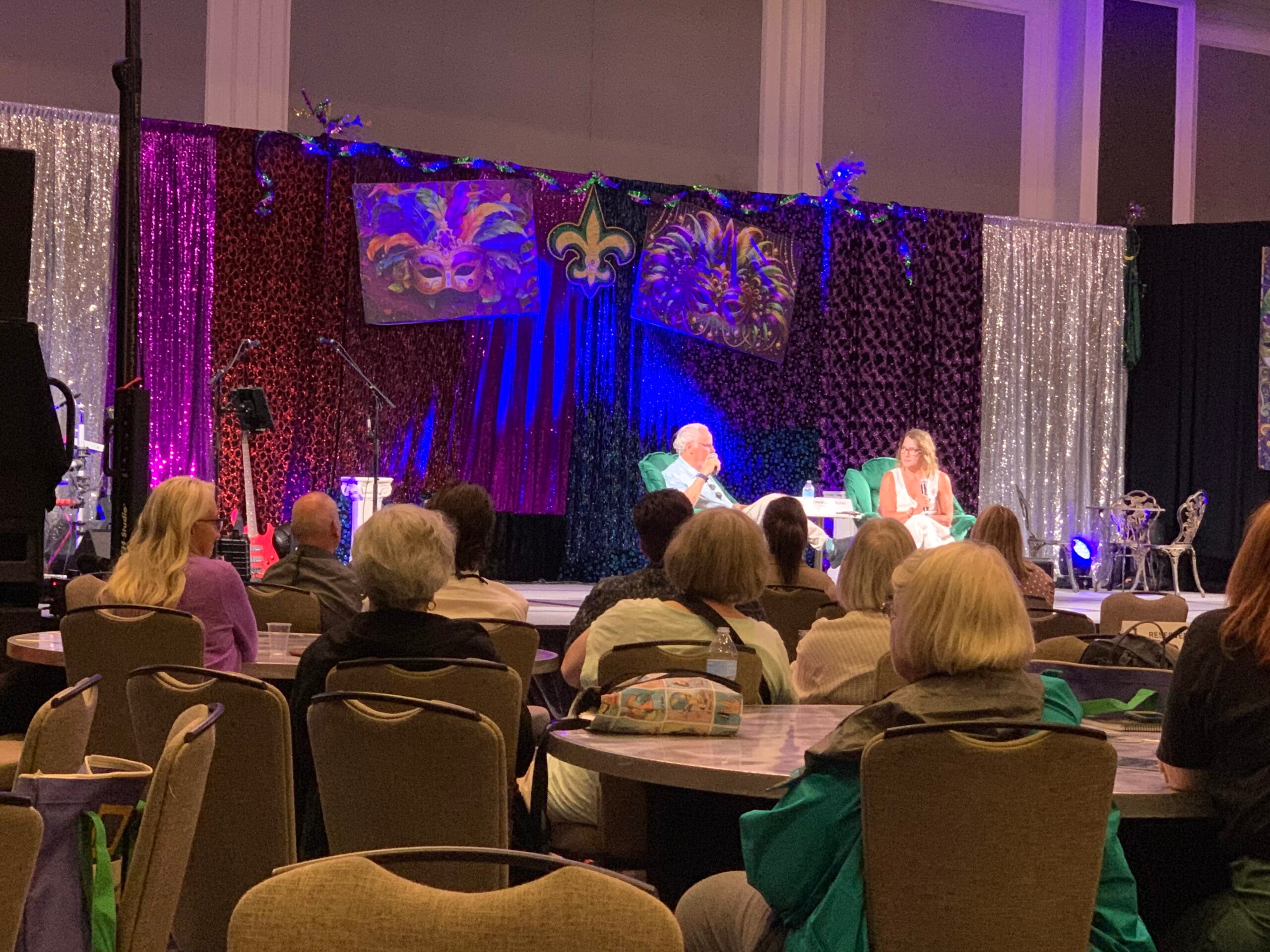
Let the conference keep rolling…
- Day 1 of #Bouchercon2025 in New Orleans
Today was Opening Day for Bouchercon2025 in New Orleans, and my first Bouchercon ever. The non-conference bits are covered on my other site, ThePolyBlog, at https://www.thepolyblog.ca/day-1-of-bouchercon2025-in-new-orleans/.
I registered at 9:30, picking up my conference bag, program, t-shirt, badge and lanyard, and four hot little tickets for books in the Book Bazaar.
There are over a hundred books to choose from, and you only get four. I picked up two by Heather Graham, the chair of the conference, entitled Legacy of Blood (part of a series called the Blackbird Files) and The Rising. I’ve started reading The Rising already, but I’ve only read about 35 pages so far. I would have loved to spend hours browsing the tables, but my cold is still kicking my butt, so I opted for a Scarpetta novel by Patricia Cornwell as book #3 and Calico by Lee Goldberg, which has been all over his Facebook feed for some time, as #4. The fact that I don’t have any room in my carry-on for the return flight home in no way impedes my bookgoblin tendencies.
I chatted with Devlin Chatterson from Montreal on the way to the first panel, as he’s here representing Crime Writers of Canada. I’ve been a member of CWC in Ottawa for various years at a time, but not currently. They’re partnering with the Calgary delegation planning next year’s conference so it was nice to meet a Canadian face. I’ve heard of his Dale Hunter series but I don’t think I’ve tried any of them yet. https://delvinchatterson.com/ will help me keep it on my radar for the future.
I had signed up for what was called Bouchercon 101 hosted by some of the organizers, including Heather Graham, and it was designed to operate in two parts. For newbies, it would give an overview of the week and what to expect, how things worked for things like signings, logistical details for out-of-building events, etc. And then they would be paired with “conference buddies”, based on a previous request when registering if you wanted a buddy. I didn’t, but I was expecting a bit more in how the conference worked, perhaps a little more formal presentation. It was very casual, which was fine, with a lot of stories about previous conferences or various people who were in the audience that they wanted to introduce, etc. The conference itself looks great, and the detailed program is extensive. Having put on conferences in the past, I was impressed with the initial machinery. Less so for the 101 presentation and I got very little out of it. I tend to think in frameworks, so I decided I’d stick with the program outline instead. There was a nice story about one of the hosts having been proposed to at the museum we’re going to tomorrow, though.
For the first set of panels, there were some good ones available in the set of six starting at noon. I opted for Panel 1-3: Room for More: Great Ensemble Casts. The participants included Steve Stratton (Moderator), Baer Charlton, Leslie Karst, Vera Kurian, DonnaRae Menard, and Melinda Mullet. All of them were new to me.
Part of my interest is that I have in mind a fiction series that has three main characters, as well as some supporting cast members. The panel discussed how to give ensembles equal time / weight, a distinct voice, time spent developing the characters before starting to write, how ensemble casts in series differ from standalones, decisions to eliminate characters, feedback from beta readers, location as a character, and how to get into each character. I’m not sure it answered many questions for me, but perhaps laid some groundwork for better questions in the future (I’m aiming to retire in 2 years and will likely start fiction writing around that time, although I have a number of non-fictional titles planned too). One of the panelists mentioned reading 101 Things I Learned At Film School to help with scene setting (as well as the standard Save the Cat series, which I have).
For the second set of panels, I planned to focus on Panel 2-2: Need to Know: Avoiding the Info Dump. Similarly, for the third set, I was aiming for Panel 3-6: Make ‘Em Laugh: Wise-Crackin’ Through Crime, although it wasn’t a “must have” for me. It didn’t matter, though, as my cold knocked me out. I crashed back in my room for three hours and missed the charity event for the local library too.
I was back on my feet for 6:00 p.m. in time for Clay Stafford’s session entitled The Story That Saved Me. I had heard his name before in conjunction with Killer Nashville, but that was about it. I loved hearing his background, growing up in East Tennessee, and wanting to become a writer after reading The Shining by Stephen King. In that respect, it would seem like any other background to a rural-raised writer.
However, his pitch was more about “writing as a form of / alternative to therapy” in a way, and he challenged people to make a list of all the things about themselves they are afraid to tell other people, and to slowly over time, write about those things in our stories as supposed fiction. He suggested writing as a form of confession, holding a mirror up to our own life, to create a sanctuary for ourselves and others, to give ourselves permission to feel and to experience empathy. An intriguing challenge.
However, I found myself wondering about the epiphany reading Stephen King. For me, it was a two-step desire to be a writer. I was first a reader, of course, so the idea of being a writer was some general ideal. But I saw no path to that world. I couldn’t come up with stories about war or spies, for instance. Yet I then read some fiction from Warren Murphy with a modern sleuth who was not some grand Sherlock Holmes or a hardboiled detective. He was a regular schmo in many respects. And I thought, “Hey, I could write THAT type of character.” I wonder if other writers had that dichotomy of experience … a two-part of “desire” and “possibility”. For Clay, I asked him afterwards if it was joined, and it was for him.
I followed that session at 7:00 with a presentation by forensics expert Lisa Black, who is nearing retirement in just 21 days. Not that she was jumping for joy or anything. 🙂 It was a good semi-technical briefing, and I got a lot of valuable nuggets I can use in my first detective story without going too far down a forensics rabbit hole. I’ve narrowed my focus, shall we say. Plus, she was just plain entertaining to listen to for over an hour.
I missed out on the Cozies and Cocktails session which was in full swing when I went by on the way to Lisa’s presentation. I was a bit late leaving Lisa to get to a presentation by Don Brun on Edward Stratemeyer. Don himself said he’s not an expert on Stratemeyer, but wanted to give an overview of how the guy invented the genre of a ghostwriter writing mainly children’s stories including the big names like The Hardy Boys, Nancy Drew etc. and created pen names where multiple people wrote under those pseudonyms while Stratemeyer held the copyrights, sold series left right and centre to publishers, and paid the writers about $200-250 a book. But he had famous names long before they became famous including L. Frank Baum of Wizard of Oz or Victor Appleton for the Tom Swift series. Over 1000 books in total, 160 series, and most people never knew who the authors were, except Stratemeyer.
For the Hardy Boys, one of the first writers was Leslie McFarlane. His daughter shared with Don a fun story of how her dad kept his office at home locked, as nobody could know that in his spare time as a reporter that he was writing the Hardy Boys. One day, his 12yo son got into the office when Dad wasn’t home, and apologized to his dad but couldn’t wait to say that he was so glad his Dad loved the Hardy Boys too, as there was a full set of them on his shelf in the office. Millie Worked had similar stories, apparently, for Nancy Drew, and it wasn’t until a lawsuit about IP in 1980 happened that a bunch of the details came out about how many ghost writers there had been back in the day and who many of them had been.
I was hoping to wrap up the day with Jon Land and Terry Rogers talking about Paranormal investigations for fact and fiction, but I was physically done.
Back at it tomorrow for Day 2. I haven’t seen Lee Goldberg yet. Although I might see Michael Connelly tomorrow. Is it silly to want to thank him for his guest appearances on Castle more than his actual books? 🙂
- The speed of disruption in book piracy
When people think of piracy, they often immediately think of movies or software. Rewind to the ’90s, and your thoughts would have been about music with sites like Napster. Almost all of the previous significant industries went with alternate business models that put a huge crimp in piracy. In some ways, at least. Music was the first — they created the online platforms with unlimited streaming for a fee, aka the all-you-can-eat buffet. They also created distribution models where most major stars are available on all platforms, so you CAN still pirate music, but it’s a lot of work that is easily waived with a simple tap of your payment card. With way more benefit than you have time to do with pirated music. You don’t OWN the music, but if you have access to it generally whenever you want, why care?
Software has gone all-in on subscription models. Even if you can hack the current model or version, it won’t connect to a bunch of the online validation tools, and it’s only good for a certain amount of time. Game systems have moved to online platforms where the software does little more than give you access; without the subscription, there’s no point. So the software companies give free downloads of the access software, decreasing the benefit of hacking anything. It’s not zero benefit, but the traffic is way down for major packages. Meanwhile, Microsoft gave away new copies of Windows 10 and 11 for free to get people off the old versions and into the new monetized subscription versions.
Movies have a huge market overseas for pirated first-run movies that are still in theatres, although the early copies are often terrible, handheld copies taken on phones. If you’re desperate to see something that won’t reach your region for another 3 months, well, you can find it online within 2 days of the release. Movie company executives act terrified, but they also know the reality…the people who pirate are not those who pay, and those who pay, probably are only pirating to see extra stuff they wouldn’t pay for or will pay again when it finally hits their area.
There are even studies, kept heavily under wraps, where they have tested to see if releasing a poor quality version actually increases or decreases box office revenue, with mixed results, where those who have seen it say it’s hard to interpret since there’s no way to segregate the market. If you release it in LA on a Tuesday morning, people are downloading from Chinese servers by Tuesday afternoon. If you assume that “similar” movies should have “similar” revenue patterns after staged releases around the world, you can point to abnormalities where the profit from Movie 1 had a slow drop over time, while Movie 2 that was pirated had a sharper decline; which then makes no sense when Movie 3 shows a sharp decline with no piracy (aka the movie just sucked) and Movie 4 had a spike AFTER the piracy (suggesting any publicity is good publicity). In short? There’s no way to know.
But pundits and moviemakers argue it’s a huge business loss — with zero evidence of actual loss tied to piracy. The more detailed analyses point to another cause — streaming movies in high definition. Current movie releases no longer compete just in the current market of active releases; they now compete against every blockbuster of the last 40 years available at home with zero friction. Those same analysts also point to another revenue-killer for movie revenues: the insanely high cost at the snack bar. A high ticket price plus high snack bar pricess combine to keep families out of the running. Sure, they make tons AT the snackbar, but in the same way that cable audiences have died, so have movie audiences.
If you take revenue out of the equation, and only look at attendance, the change in business models translates into LOWER piracy after market. DVD sales, digital copies of any kind, are following the dinosaurs. The new subscription-based platforms are the real killers of piracy, just like Apple Music and Spotify did for music. All-you-can-eat buffets are popular for a reason.
Wait, weren’t you going to talk about books?

Yes, I am going to talk about books. Books have some similarities with music and movies. First, people generally have always liked OWNING copies, not just borrowing, renting or viewing. They want something tangible that they can go back to later and watch / listen to / read again. But is there no real Netflix for books.
Oh, sure, services like to ADVERTISE that they are the Netflix of books. Take Amazon’s Unlimited, for example. For a book to be in Amazon Unlimited, you need to first realize that it is for DIGITAL books only. Yet, ebooks are only 17% of the market. In addition, the author has to guarantee that it is exclusive to Amazon. You can’t sell a Kobo version, or on any other ebook platform. While they advertise it as all-you-can-eat, it’s like going to a buffet restaurant and finding out that the all-you-can-eat part is just a salad bar; no meat or desserts are included in that option. It’s not NetFlix. It’s Olive Garden.
Do you want to consider another platform? Well, you CAN, but Amazon makes up 80% or more of the ebook market (with variations by country and continent). Kind of like Apple TV compared to the other big platforms, others are a rounding error on the market.
Amazon has had a digital ebook problem for quite some time, and without a viable solution, they have faced heavy piracy. The issue is that unlike movies, which are huge files, ebooks are relatively small and uncomplicated. And if one person has a copy, in most cases, it isn’t too difficult for them to share that file with someone else. They have some mechanisms in place to try to reduce piracy, but they’ve mainly been ineffective. The tool is called Digital Rights Management, or DRM.
So let’s focus on file types for a moment. The current main types of files are either EPUB format (that has no security built into it), MOBI (also no real security), Adobe Digital Editions PDF (which has decent security in it), and/or AZW or AZW3 for the latest version (which comes with DRM as the security).
The Adobe Digital Editions PDF is tied to your account, in theory at least. You buy the file (or borrow it from a library), it ties the file to your account, and when you open it, it verifies your account information by using your account info to open the file and let you see it unencrypted. If you send the same file to your friend, and they try to open it, Adobe Digital Editions will balk. They are not you, the software will not open it. If you give them your account information, all good. They can open the file on their computer as if they were you. Works fine with family members or friends you trust, but you’re not going to give your account info to random people on the internet so they can open your file.
Amazon’s AZW/AZW3 format does almost the same thing, but instead of using your account information, it issues a specific serial number for your device (either Kindle or PC if using Kindle for PC software or phone if using the app). When you try to open the file, it uses your Amazon account to transfer the file to your device, tied to whatever serial number you have on your account. If I downloaded a file for my Kindle, I can’t simply copy that over to my son’s Kindle and have it work. I would have to redownload it on his Kindle with his serial number embedded. The device opens the file, compares the serial numbers, and if it matches, it will let you see the unencrypted file.
As a side note, some security experts have argued that both Adobe Digital Editions and Amazon are not technically using encryption in the normal sense. Encryption would normally translate every word or group of words or letters into other gobbledy gook and it just looks like gibberish. Sometimes, however, these files have entire sections and subsections that are actually readable still for small snippets. As such, some experts argue that it is more like half-encryption and half-jigsaw puzzle. To their mind, it is more like slicing and dicing the file, jumbling most of it up, using the serial number or account info to encrypt the algorithm that created the jumble so it can’t be undone, and voila, one file.
Up until recently, people have needed three things to get around the semi-encryption easily. I’ll deal with them in reverse order of obviousness.
First and foremost, there is a collection of software tools bundled together called DeDRM. Yep, that’s sort of what it does — it removes the DRM from files. But it isn’t a “cracking” tool. The way it works is you tell it your serial number for your Kindle, it uses that serial number to “unlock” the file, and then creates a new version without the DRM included. It’s really no different than removing a password protect from a locked Word document that you created. You open the file, enter your password to unlock it, tell it to remove the password protection, re-enter your password, and then save a version without the password protection enabled. Voila, one password-free file. No hacking or cracking involved.
For Adobe files, it’s relatively the same process, it just uses your account info to unlock it and then creates a version without a password enabled. I’ll come back to this tool in a paragraph or two. While Amazon and Adobe constantly iterate their anti-piracy attempts, they are limited in what they can do — if you can enter a password to open the file, then once it’s open, it’s vulnerable to being copied and used in other ways. There’s no way to end that usage. And DeDRM software is constantly iterating to combat the latest tweaks. It might take a week or two, but it will catch up relatively fast. Up until this last issue, it seems to have generally adapted within 3 weeks or so at the outside.
Second, you need a way to actually manage the eBook file. Of course, Amazon gives you their Kindle software, but we’re talking something else. You need to be able to edit elements, move things around, add metadata, etc. The biggest non-proprietary tool for managing ebooks is called Calibre. It has a somewhat dated interface, looking like something from the ’90s, but the thing has power to spare. Most people who are beyond “click and read” have some sort of file manager for ebooks, and Calibre probably has about 90% of that market. Why? Because it works, has been around forever, and mainly because it is free. It not only manages ebooks, including direct transfer to and from ebook readers, it lets you CONVERT books that have had their DRM removed from one format to another. Have something that only reads MOBI and your file is in EPUB? There are lots of little one-off tools that will do that conversion for you, but Calibre has it already built in. Every time a format is tweaked, Calibre is tweaked. It’s a bit annoying to constantly update to the latest version, a little more manual process than it should be, but lots of people leave it un-updated for months, even years, with little lack of functionality. But here’s the fun part. Calibre allows third-party plugins.
I know, I know, you’re like, ummm, what? It means that Calibre itself does NOTHING wrong. It is a vast program, and all it does is give people a way to manage files. It’s like a file manager with extra interface options, similar to a lot of music programs out there — it adds buttons to help you automate certain things, will let you open the file in the program, and enables you to move it around, create groups, etc. If you tell Calibre what your serial number is for your files, it will open them up and let you read them. But DeDRM can also be added as a plugin, and if you tell DeDRM what your serial numbers are, Calibre will open the file AND give you a chance to convert to another format, removing the password/encryption. That’s relevant because while everyone uses Calibre to remove DRM, the program isn’t about DRM. If you happen to add a separate plugin created by someone else to his program, well, that’s not his business. That’s yours. Calibre is a file manager, that’s all. Adding DeDRM as a plugin makes it easier, but you could use it directly as a separate tool (like in Linux).
So, what does Calibre do, and why do you need it? Calibre will read Epub, Mobi, AZW, and AZW3 books and allow conversion between them if the password has been removed by DeDRM. AZW was Amazon’s attempt to use Epub as a ubiquitous file format and add password protection to it as basic DRM. Over the years, Amazon has upgraded from AZW to AZW3 and, more recently, KFX and KPF. Each time, Calibre has added the ability to read those new formats IF/WHEN the protection aka DRM is removed. Once removed, you can do whatever you want with it.
Third, you need the file itself. That sounds easy, right? I buy on Amazon, I download the file (*), and I can read it, right? The asterisk is what makes the previous sentence end with a question mark instead of a period.
How/where do you get the ebook file?
Up until recently, you generally had two ways to get the Amazon or Adobe Digital Editions file of the book you just bought.

First and foremost, you downloaded the book directly into the Amazon or Adobe tool you would use to read it. If you were on a Kindle, you opened up the Kindle, it looked at your Amazon library, saw that you had a new book, and downloaded it to your Kindle (note that the file is IN YOUR LIBRARY and now ON YOUR KINDLE, nowhere else). If you were reading on a PC or a phone, you would open your Amazon App (Kindle for PC or Kindle App on iPhone or Android), it would do the same as the Kindle and access your library, see that you have a new book, and download it to your app for reading. Some would do it automatically, some would do it when requested, but it would be available in your app. It might be on YOUR PHONE or hidden in the FILES ON YOUR COMPUTER, but primarily either way, you would have the file in your Amazon library and available within your app. If you delete it from your app or the Amazon library? Gone. It would delete it. Adobe works basically the same way, you can access it through the app.
Now, here’s the kicker. If YOU delete it? Gone. Understandable. If Amazon or Adobe deletes it, or your access expires? Also gone. Wait, what? Yeah, you don’t OWN the ebook. You own a license to the ebook, and Amazon or Adobe can change your license at any time. This is what drives a TON of people nuts. Not the reality of it in most cases but the potential risk. There are lots of anecdotes available online where “owners” of books got bitten. Potentially myself included, at least hypothetically.
Way back in 2007 when the Kindle stuff got going, they used to have huge promotions on. Free books were available EVERY SINGLE DAY and like many people, I said, “Sure, I’ll take your free book.” Having no idea if I would ever read it or if it was any good, I swiped right on free books. Not for long, but maybe six months to a year or so. Literally 100s of books. Some people went all-in and downloaded thousands of books. So think of it as you believing you have 1000s of books in your personal library. And then one day, some people tried to go into THEIR library, and it was closed. For whatever reason, they had been locked out of their account. Maybe they said something rude on an Amazon forum, maybe somebody thought they were pirating books and complained, didn’t matter. Amazon has a history of blocking accounts with almost zero recourse to getting back in. Now, you might think, “Well, you’re out free books.”. Nooooo. They’re out of ALL their books. All gone, inaccessible.
In any other digital endeavour, the first rule is to have backups. But you couldn’t backup your account easily. If the software wouldn’t recognize your account, or you couldn’t get into your account, you were dead in the water. And if your device did a synch, you could literally lose all your downloads even if you had any.
There are also anecdotes about people who went into read a book only to find that Amazon had some sort of legal skirmish with an author, the author’s books were removed from Amazon, and guess what, yes, the books were now GONE from your library. You paid for them, Amazon got their money, and 2-3 years later, they revoked your license and it was gone. No warning, nothing. Gone. It was the first time for many users to realize that they didn’t own their ebooks, they only had a license. It was also news to some US states and foreign countries, who did not recognize that universal licensing arrangement. More skirmishes happened, often around forcing Amazon to return the purchase price they had collected. Most of which was buried in administration, while Amazon discussion boards when nuts from both users who had lost books to authors who had been banned with no appeal process evident.
Enter the attraction to a second way to get your file. You could go into your Amazon library, click on options next to the book, and there was an option designed to let you transfer your ebook files to your Kindle without internet. Since the beginning, Kindles had an option to use wifi or even free wireless if it could connect to transfer your file. Amazon ate the cost for free wireless connections, as it literally had to — you had to be able to get the file to your Kindle. But for people without good cell reception or wifi, there was an option to download the file manually and then transfer it to your Kindle. Or potentially to any ereader that could read an Amazon file.
For those people who were beyond the “click and read” crowd, this was a godsend. They could download and backup their files. For Adobe, they would copy the files out of an Adobe Digital Editions folder and back those up too. All good, right?
Well, not quite. If all you had was the original file, you were still going to get caught with password-protected versions that may or may not work when you went to enter them.
But let’s reverse the order. You have the file. You have a regularly-updated program like Calibre that lets you open the files. You have a regularly-updated decryption plugin like DeDRM. If you take the file, use Calibre, and use DeDRM, you now have the potential to create a protection-free file that you can backup, read forever, and if Amazon deletes files from your account or kills your whole account entirely, you’re still golden.
Do you see the lynchpin for that system? Amazon did.
Amazon removed the ability to download the file

I said above that there were two ways to get the file. Direct transfer between devices using the Amazon apps OR download to your PC and manually transfer the file. Amazon announced in early February an upcoming change, and as of the end of February, you could no longer use the second option. They removed the option to download the file manually.
So, as of March 1st, if you buy an ebook, the ONLY way to read it is directly on your Amazon app on your phone, through Amazon app for PC/MAC, or directly on your Kindle. You have no file to work with, at least not directly. And if you have another type of ereader that is not linkable directly to your Amazon account? Well, good luck with other sources for ebooks, Amazon would no longer work for you. If you ask Amazon, they’ll tell you to buy a Kindle. Nice.
Yet, at first glance, those wanting to do something manual with the file, this removal of an easy way to download doesn’t seem to change anything really, as of course the other apps still have a “file” to work with, right? Yes, but not the SAME file. A few years ago, Amazon introduced what they call KFX. Instead of a single ebook file, it is now more like a set of interlinked HTML files. Quite complex, actually. Almost all of the apps use a form of AZW/AZW3 format but it comes as a download in KFX-ZIP format, for the most part. Previously, when you downloaded to your PC manually from your library, it came as a SINGLE file. Now, if / when you can find something, it’s a bunch of files.
To put it bluntly? The “click and read” people use the apps, never realizing any of the risk they have in their account until there is a problem. It works, they’ve never had a problem with their account, don’t ever expect to, they don’t care. They got over their Luddite phase enough to use ebooks, or at least 17% of the market did, while the rest do audio or paper. Audio is growing, but the stats vary from 10% to 20% for market share, and then there are ludicrous studies in some areas saying audio is now 80% (mostly due to methodological issues with calculating the use of all-you-can-eat subscriptions).
The next tier of users were the digitally-enabled users who could download things well enough, and use a file manager. This group of people are screwed. If they were doing downloads before, they have NOTHING now for doing either easy backups or DeDRM+backup.
The third tier are those who are mostly concerned with using the tools for their own backups. While industry lobbyists want to argue it’s people wanting to pirate, they’re really confused with the methodologies. They twist the term piracy to include anyone who removes a DRM protection option from a file, even if they own it. The law isn’t as clear as the lobbyists want to make it, but that is not the same piracy as they then use the term when they refer to people trading files.
Unlike the image of massive numbers of people hacking and cracking encryption, I can only unlock MY files, the ones that I have legally purchased and have access to, aka the ones that I have the password to be able to open. I can’t download 5000 files and crack them; that’s not what this software does. I can only open MY files and save them in a format that doesn’t have protection. That doesn’t immediately mean that I am going to share it with someone else, upload it to the web, or spread it around to the masses. The vast majority of the people who use DeDRM do not use it to upload files to other people. They do it to be able to back up their own files. Most of them are rightfully scared of uploading files to other sites. A huge portion of them have no idea how a VPN even works, let alone creating fake email accounts, hiding their IP, etc. I’m pretty tech-savvy, in the top 10% of average users, and it is at the top of my user ability to think I could do it safely, if I were so inclined. I’m not. Nor are most of the users. They don’t mind removing password protection to make a copy, but they aren’t going to pay $10 for an ebook and then upload it to the web with the potential to be sued later. That’s not their risk level.
The people they need to worry about who ARE uploading books available for the masses have 1000s of ways to get to the files without the download button on Amazon. Removing it hurts the average consumer, while doing virtually NOTHING to stop the active pirate.
Reactions after the removal
There have been four fully expected reactions in the community.
The first by Amazon is absolute silence. They are not commenting on it, and they will not comment on it. They’re not stupid when it comes to Communications. They also have a really strong track record of NOT commenting on DRM nor listening to anyone but internal people who say, “Hey, let’s lock it down,” even though their own staff know it will do nothing for anti-piracy efforts.
The second from the Kindle readers is generally a mix of “I never used that feature, who cares?” (aka the “click and read” crew) and the “This is an absolute outrage, I will never buy another book from Amazon!”. People who knew about it and used it for backups are not homogenous in make-up. Some care, some don’t. But there was a strong reaction in forums with many people arguing for digital boycotts of Amazon. Yeah, right, let me look at that market share again? Oh, yeah, 80%. They don’t care if you order books from Kobo instead. It’s a rounding error. Except, it hit at the exact same time the Orange Noodle in charge of the US started ramping up anti-US sentiment around the world. Dozens of countries have pushed for “buy local” initiatives in response to tariffs, and guess what? The two together seem to have had an impact on Amazon digital sales. A large number of tier 2 and tier 3 Authors who publish on Amazon reported huge sales drops in March. JK Rowling, Lee Child, and John Grisham won’t be affected, but everybody else? Buckle up, buttercups. It’ll be interesting to see quarterly earnings reports and sales figures for ebooks, but the book market is always in chaos, so who knows if it will show anything resembling a trend.
But another group responded too.
The hackers have entered the chat

Now, as I said, every time that someone changes their DRM methodology, the real actual hackers figure out what they did and create a response that undoes it. While it might look like magic to the casual users, any software that can encrypt and decrypt something can be copied to see what it does as it works. It’s not like an Enigma machine, where it was hard to get a copy of one in WWII. Amazon’s and Adobe’s Enigma machines are software that you download for free AND you know the keys you have to enter to unlock and use it. That’s a pretty big head start for the hackers.
Except in this case, it wasn’t even a real change in the software. It was more like Amazon trying to hide their lips while they talked, so you couldn’t steal their plays on a football field. Amazon apps still have to download the files, though; they still need something to open. They just made it harder for you to get to the file.
The DeDRM and Calibre people separately looked at the problem and tweaked the existing methodologies for the file. Right now, the file (AZW3) or files (KFX-Zip) is being downloaded to three possible places automatically:
- A storage area on your phone for the Apps to open and read;
- A file area on your PC (or MAC) for the Kindle for PC (or MAC) to open and read; and,
- Directly to your Kindle.
Phones are often a pain to work with and move files around, particularly if they contain multiple files. There are options available to try and do something on your phone, but most tools and users don’t bother. There is too much friction and variation.
Apps on your PC are a viable input source, but to be honest, they tend to have more complicated options than they did about 4 years ago. Most of the advice on this method has started with an approach that had you turn off the updates to the app, use a version from 2017 that would only download a format with a single file (same as what you would download manually), and so it would work to get the file. But it was a lot more painful than simply just saying DOWNLOAD manually, so few people seemed to bother unless they had a reason to regularly use the Kindle App. And about a year ago or so, the old version of the app that would give you that simple file format stopped reading new DRM titles. The methodology was tweaked, but it seemed to be hit or miss if people could get it working.
However, in the last six weeks, people have revisited the methodology and added extra steps that work with more recent versions of the software. Amazon added friction; the tweakers for DeDRM and Calibre found ways to reduce the friction. Most people choosing this method to get a new file or files seemed to feel that it was closest to the old method — either way, you were downloading directly to your PC. It was a very different methodology, though, and many of the tier 2 users bowed out fast, with tier 3 users struggling to make it work reliably across various configurations.
While I’m primarily talking about Kindle, this method with apps on the PC is exactly what people do with Adobe Digital Editions files, like the ones they get from libraries. They put themselves on a waiting list, they eventually get to the head of the queue, they go to their library website, log in, check out their ebook, and it downloads to their PC. When they open it, it opens in Adobe Digital Editions. This essentially “unlocks” it. If they copy it over to Calibre, they can then transfer it to their Kindle. There are a lot of people who use this method to get the file from their library to their Kindle ereader (and other ereaders) because it simply ticks them off that their library has ebooks in formats that aren’t easy to use. There are a lot of librarians who agree with them. They think if they could find a way to get books directly into the Kindle, they’d be able to boost ebook usage dramatically.
Except here’s the kicker. The books from libraries through Adobe Digital Editions or that are tied to textbook editions (another popular market for Adobe) all come with strict licensing. For libraries, there is usually a very clear time limit for their use. While the book is checked out to you, nobody else can sign it out (just like a physical book). The library bought, say, ten copies, and therefore, ten people can use them at once. When your loan period is up, it automatically expires in your library. It won’t open any longer. At least, more accurately, it won’t open in your APP anymore.
If you removed the DRM to get it to your Kindle, you ALSO removed the licensing controls. This means you now have a DRM-free copy of the file sitting in your Calibre library or on your Kindle, and when the next person goes to read it at the library, they can do so. Your copy stays with you. Because the system didn’t give you an easy way to get it to your device, your transfer looks like piracy. Even if you delete the file from your device and your library when you’re done, so that it seems more like the original intended usage, it’s a hard sell to say it wasn’t piracy.
Hard-core techies came up with an alternative solution that was a bit more radical, which has come up in the recent reactions to the Amazonian change: they hacked their Kindle operating systems so they can side-load software that will read other books like Adobe books with their DRM intact. It’s sort of like they installed the other apps directly on the Kindle, which it wasn’t really designed to do (at least most Kindles; I’m not talking about Amazon tablets). The only two downsides? It’s for hard-core users only in terms of their comfort levels, and if you do it wrong, you brick your Kindle. Oops.
Many people reported a much larger success rate using a physical Kindle. The way it works for the Kindle is that, like the App version, the Kindle downloads the file directly from Amazon. Then, when you plug your Kindle into your PC, and load Calibre, you can use your file manager (NOT Calibre, apparently) to copy the DRM-protected file from your Kindle to Calibre (drag and drop rather than importing). I recently took a test file from an ebook creator that was properly password-protected and ran the tests to make sure it looked like a full Kindle file, but “normal processing” failed. I redid it, dragged it, and dropped it to Calibre. It found the KFX-Zip file it should have, copied it over, removed the DRM, and left me a KFX file. It opened fine in Calibre. I converted to EPUB, opened it in another app, and it worked fine.
A bunch of the metadata was lost in the process, and a colour image was converted to black and white, but that’s relatively just details. Most Calibre users know how to update metadata on a file already…you basically right-click the title, tell it to edit metadata individually, it opens a “info screen” about the title, and it has an option to go out and get metadata about the title. Mainly this is for the correct title wording, author’s name and order, if it’s part of a series, ISBN numbers, year published, publisher’s name, genre if available, etc. There are a dozen+ sites from which it pulls info, including the World Catalog, Amazon, Google, and GoodReads, and downloads it. And it will even look for covers…if yours was only in black and white previously, and it finds the book online, it will show you other cover images you could import (like from Amazon, Google or GoodReads) in varying resolutions and in colour.
So, where does that leave people?
The “click and read” crew are still in the same place. They have no idea what people care about or why, and won’t until the day they find out that their thousands of dollars in book purchases are gone from their account with zero recourse from Amazon. The only response Amazon gives people is to create a new account — which doesn’t retrieve all their previous purchases. Content creators who rely on their book purchases can literally go out of business with a stroke of a digital pen by an Amazon employee. Some have had to have lawyers contact Amazon on their behalf, and the only “correction” is access to their old account. Until they get another complaint about something else the next time, and their account is locked again.
For the tier 2 types, they seem to have split pretty evenly. About 40% joined the “click and read” crew uneasily. Another 40% figured out how to use the new method. And 20% have permanently moved to other vendors if they can (some authors are only on Amazon).
Overall, the larger digital ebook community responded to Amazon’s disruption of casual piracy and came up with a solution within 4-6 weeks of the change. They even found ways to automate it so more people could do it easily. That’s pretty significant timing.
But it’ll be interesting to see if sales remain down. A potentially significant revenue hit if it kills the market for something that does nothing to combat intentional active piracy.
All it did was make it harder for some basic users to make backups.
/reading
- FFF: Managing in the public service like a Sheepdog

As you can see on the PolyWogg.ca site, I have a PolyWogg Guide to HR competitions in the Canadian Federal Government. I cheekily called it Be the Duck as an extended metaphor, and I wanted something similar for another book in the same vein about being a manager. So this week’s FlashForwardFriday project is my future guide on being a manager, called Be the SheepDog: Managing from the Middle.

I went with the idea of a sheepdog rounding up sheep. It’s cutesy, a bit whimsical, maybe, and the dog is cute. The challenge is to know what to cover in a general guide to managing in the public service. I could, for example, talk about all of the different parts of government, but that gets to be more like an “introduction to public administration” than a management guide.
I could do something spunky like the 7 Habits of Highly Bureaucratic People, but I hate the term, and it’s not what I’m about.
I could do it like a business case study and talk about five or six complicated examples where features are added just to complicate the scenario, and after going through it, you feel good that you unravelled the mystery (that all started with the Big Bang).
But those business cases often seem very artificial to me. Yet there are two thoughts I have that resonate with me as the basis for an approach.
First and foremost, managers are not hired to manage when it is easy. Good portions of our year may be consumed by keeping steady hands on the console to keep the trains running on time, sure. But it is when things go off the rails, so to speak, that you earn your salary as a manager. Prevention, disaster management, and recovery are more challenging than when things work. Using the sheepdog example, sure, it’s great when all the sheep run into the pen together. But the sheepdog has to chase wayward lambs, watch for predators, and keep everyone together, too. If it were easy, not only could anyone do it, but you probably wouldn’t even need the manager.
Secondly, managers are not needed when the solution is obvious. If you’re having a problem where things are being done where one group has info that impacts another’s functioning, well, sure, it’s apparent that you need to put in place some consultation/info sharing mechanism to make sure Group 2 gets Group 1’s info before they make decisions. Easy peasy lemon squeezy. There can be hidden complications, interpersonal issues, turf wars, hoarding of info, etc., but the solution is relatively apparent.
It is when the answer isn’t apparent, or when there is more than one solution, and there is an actual problem to solve, that a good manager is needed.
A different sort of Values and Ethics approach to managing
There’s a subtitle running through my head, which would be highly misleading, but it is basically “Everything I know about management, I learned from the Values and Ethics Code”. If that were the title, almost everyone would snort and move on. Very few people use the V&E code for anything other than training purposes, and most people focus on the wrong aspects.
For example, there is a lot of time spent on stupid questions like, “Can I abuse my position to get free hockey tickets?”. Okay, sure, it’s not worded like that, it’s worded as a more straightforward example of a vendor offering free hockey tickets to customers. But it amounts to the same thing. No, you can’t accept gifts from vendors. The private sector does all the time, the public sector cannot. An easy answer, and you don’t need a “code” to tell you it’s wrong.
Actual values and ethics come into play when TWO or more values are at play simultaneously — and they tell you to do OPPOSITE things. For example, one sub-value that is frequently referenced is transparency. Essential to trust, a sound basis for communications, and a great way to establish vision. Perfect. Right up until you have info that you’re not allowed to share for other reasons (timing, confidentiality of decision-making, other people’s info). I used to do a lot of corporate work, which gave me access to the behind-the-scenes early work planning of senior leaders. Absolutely critical information for other groups, who would receive it at the appropriate time. Which wasn’t mine to decide. In the long term, transparency and confidentiality can even out and reinforce each other; in the short term, confidentiality wins. I have a perfect example of this, and I want to include it in the book. I found a solution that was a win-win of sorts for both, a compromise that required threading the needle in between the two principles, respecting both.
And it is that sort of approach I want to take — when actual values that are both positive end up in conflict, and how you choose to resolve the conflict to move forward.
As I said, though, the V&E code is not a selling feature, so more likely, I’ll start with the Treasury Board of Canada’s Six Management Competencies:
- Create Vision and Strategy
- Mobilize People
- Uphold Integrity and Respect
- Collaborate with Partners and Stakeholders
- Promote Innovation and Guide Change
- Achieve Results
If you mix and match those competencies in groups of two, you can create up to 15 scenarios. And I want to explore those scenarios in separate chapters. Although part of me wonders if it should be a much shorter “five-minute chapters” approach. Aka the five-minute manager. Here are some examples of conflict, using just vision as the common theme.
Create Vision and Strategy vs. Mobilizing People –> If you focus too much on self-creation for the vision, you’ve lost the opportunity to better mobilize people and get buy-in to the result. But if you mobilize people to create the vision, you both lose control and may be seen as the leader who does what the consensus tells them. Just this month, I am having my team break down our unit’s work plan and strategy, create a new list of plans for the new year, and group them into a vision they can support. Oddly enough, I am letting them run it entirely themselves. I am NOT part of the discussion. I planned the framework, told them the type of questions I wanted them to answer, and then I joined afterwards for review and questions. I combined “vision” for my instructions/framework, but I’m letting them develop the content to maximize buy-in. It is tough for me to let go like that as a manager. Instead, I want to be in there as the “visionary leader”, making sure they stay on course.
Create Vision and Strategy vs. Upholding Integrity and Respect –> At first blush, it would seem like there could be almost no way for these to be in conflict, unless your vision were to be a terrible leader, exploiting or disrespecting people. Yet when you look at the sub-values of both principles, it’s easy to see where conflict could arise. A decisive visionary leader might want to make decisions today, removing uncertainty for people in the company or organization and providing clear direction. For my current “work planning” by the team, I first envisioned an in-person two-day retreat. While we all work in a hybrid environment, in the office three days a week and from home two days a week, one of my team members is also in another province. I wanted to bring everyone together in person for two 1-day sessions while also allowing people to interact in the office on other days that week.
Unfortunately, the configuration didn’t work for personal reasons. Absolutely the best thing to do for the team, in my view, and the worst thing to do for the person. So I cancelled it out of fairness and respect for meeting or accommodating my employees’ needs as best I can. Yet, fast forward 6 weeks, I’ve scheduled the retreat as five virtual sessions over a 3-week window. Session 1 happened this week; everyone was able to join and participate. Session 2 and 3 are next week, and at the last minute, one of my staff members has an opportunity to travel next week and needs to be off. In theory, as a leader, while I want it to go forward sooner rather than later, as this is a quiet month for my team and the perfect timing, I also would like to be fair and adjust the schedule so he could participate. Similarly, another employee is off for two weeks, also taking advantage of the downtime, and will be away for the following two weeks. By this time, another employee will likely want some holidays. If I accommodate one, I should accommodate all, but that could push the much-needed retreat back three to six weeks. I don’t have a solution that really respects both in this case; I had to decide to schedule it to minimize gaps in participation, but they still have to proceed. I could minimize the conflict, but I couldn’t eliminate it.
Create Vision and Strategy vs. Collaborate with Partners and Stakeholders –> In most “policy theory” courses, the instructor will tell you that the key to a good vision is basically to consult with stakeholders. It’s the cornerstone of almost all best practices in policy. Yet there are several variables at play in the relationship that are almost always in conflict when you are operating in the private sector. Businesses will often say, “Okay, see what the customers want, segregate by market niche and see which combination of responses pays off the most.” In other words, if a small minority wants feature X, maybe it’s not worth doing; you can cost it out and see. On the other hand, if that minority are business customers rather than individual customers, maybe it is worth it. We don’t usually have that option in the public sector, market segmentation doesn’t equate to profits. We generally are supposed to serve all.
So, what do you do if the politicians in charge say to do X but the stakeholders say Y, Z, not to mention A, B, C, D and E? Maybe not direct opposition, but perhaps that they have lots of views beyond X. Governments are frequently bad at reporting back to stakeholders what they did with their input, or why we went against their advice or request. Governments do not delegate governance, so even if every stakeholder said not to do something, we may in fact decide to do it for governance reasons. Yet, how much feedback do we provide? Are we candid? Do we give responses back to each stakeholder, or do we say, “Hey, here’s what we heard overall, and here’s what we’re doing overall”?
In short, external stakeholders may not agree with the direction the government is taking. Yet we’re trying to be inclusive of their views, learn from their experiences on the ground, etc. How can we respect both?
Create Vision and Strategy vs. Promote Innovation and Guide Change –> This one is relatively easy to give an example for, as it doesn’t take too many attempts to incorporate innovation into a vision before you see people “innovating for innovation’s sake”, not because it is driving strategic direction, and in fact can hinder long-term planning as everything is in a perpetual state of change, innovation and/or flux.
Create Vision and Strategy vs. Achieve Results –> I have a whole book planned on what gets measured being somewhat close to what gets done (an old cliché). And one of the biggest problems comes from the interplay between new directions and a demand for demonstrable results. Take, for instance, my day job, which is related to labour market programming for people who are not currently part of the labour force. They need assistance and help to get in or sometimes back in. Those who were already working, but who lost their job, are “closer” to the labour market than those who have never had a job before because of personal circumstances. The one who needs to get back in might need some help with resumes and some remedial training or upskilling, and they’re good to go. Those who have never had a job might need some life skill training, resume help, more advanced or extended training for a career or trade, and more time to get “into the job market”. So, let’s say a new government comes along and says, “Hey, let’s boost those numbers served!”. Well, it’s easy to help those who need some basic training — put together a group, serve them 30 at a time, boom, the #s go up. Equally, no need to help those who need A LOT of help; the numbers will go up faster if you help those who only need a bit of help. Together, it’s called “creaming” — helping those who are the easiest and fastest to serve in order to boost the results figures. Yet they are not the ones who need help the most, nor for whom we could have the most significant impact. The demand for fast, demonstrable, measurable results can undercut vision and strategy in the long run.
So that’s my idea for a book. Helping a manager understand some of the two-way traffic when they take on a given task, and the way some of those pieces end up playing out. I haven’t quite figured out where to include some more common management problems, like making sure people have their preferred time off vs. ensuring coverage in a fair and supportive manner. And don’t get me started on managing HR like people are cattle. I have VERY strong views about that, labour mobility and talent management.
But I’ll get there. I probably won’t write this book until I retire, so 2027 is the date on the cover page. Maybe I’ll get there sooner, hard to say. In the meantime, I hope you enjoyed this FlashForwardFriday look.
- Four interesting interactions with AI prompts
I’ve been working on various projects over the last few months, some of which I will eventually talk about on my FlashForwardFriday previews of upcoming work. Many of them are still in the research and info-gathering stages, and I thought I would use some Chat AI functions to see what it could give me. In the end, I used AI in four different ways.
Using AI as a brainstorming partner
The first was for a project I’ll talk about later this week, a review of music of different years. I’ve written a previous take on 1943 as a year’s worth of music, what was going on, what music was everlasting, etc. But while I was planning to treat it as “A PolyWogg Guide to Music”, part of my ongoing series of serialized guides, I was having trouble with branding it. So I booted up the AI prompts and told it generally what I was trying to do … namely, look at the various lists of the “best songs of a year”, mostly from Billboard, and write my own review of a year’s music, comparing my list to the published one. With a touch of “Billboard got it wrong!”.
I had the Prompt give me a list of 10 titles to work from, and another list of 10 slogans to consider. I did a bit of iteration, using the AI to help me brainstorm, until I got to the end-point — “The Unforgettable Sound of a Decade”. I have a few variations of that I can work with, but that was about 200x better than anything I came up with on my own.
Using AI for simple research
Some big radio stations started making year-end music lists in about 1943, Billboard shows up a few years later, and then Billboard REALLY gets going in about 1958 when it creates the top 100 list (by which time LOTS of groups are doing lists). But if I’m going to review 1940, 1941, and 1942 too, i.e., so I can review “the 1940s”, I needed a good list for each of those years.
Now here’s where it got a bit interesting, and goes to the heart of AI’s fallacies. I told it to give me a list of the top 100 songs for 1940. It figured out that it should combine sales, other lists, other sources, and BAM it gave me a list. As I went down it though, I tripped over Boogie Woogie Bugle Boy by the Andrews Sisters. Which I already had reviewed, because … wait for it … it was released in 1943, not 1940. So, I asked the chat, “Hey why is that song on there when it wasn’t released until 1943?”. To which it basically said, oops, do you want me to revise the list and THIS time verify that each song is in fact listed as released and/or on the air in 1940? Sure.
Now, AI is only as good as its sources, and in this case, I suspect I know the problem. It found a list SOMEWHERE that had hits from the 1940s — with an S — and not just 1940. So there were probably OTHER songs on the list that were from other years too, I just happened to notice that one in particular.
Okay, so it generated me a new list, I started playing with it, and it seemed pretty legit. But then I noticed that a song by Bing Crosby actually showed up twice. Both listed as being by Bing. Now, I could see if it said Glenn Miller and Bing Crosby for one and Bing Crosby for another, the AI isn’t smart enough to tell they’re the same (relatively speaking). But I asked it again, “Hey how come (this song) is on there twice?” Another “oops” and it removed it down to 99 songs.
But then I noticed the problem that I expected — one where it was John Doe and another as John Doe with his band. It removed the second one, adjusted the list, and then asked me if I wanted to add more songs to compensate. So I had it add 25 more songs to the list, allowing for errors, repeats, etc. AND taking into account that I would want to find the songs and even using Apple, Spotify, Prime, and YouTube, not every song is going to be available for me to review.
Once I get past 1943, I have working lists, but I’ll still use the AI prompt to generate other lists to see what else maybe wasn’t big enough to make the Billboard lists but was still a big song in a given year. Just looking at the work it did, and taking into account it took me 2 or 3 tries to iron out the validity bugs, the final result was still way better and faster than I could have compiled.
Using AI as an image generator
I’ve already posted about some images I was generating with AI, and there are 3-4 in particular that have been helping me a lot. I was doing cover art for some guides I’ll be writing, and I wanted “logos” of sort for the upper right corner where I could have a red-eyed tree frog (RETF) doing something related to the theme. For music, it’s a RETF with some headphones on. For crafting, I have one where the RETF is cutting some construction paper.
I also had it generate some cover images. With some almost laughable results. One thing I wanted is a cover image for the guide to 1940s music. With a theme of going from “jazz to big band to swing”, I wanted something related to big band-ish performances. I’d love to use the Andrews Sisters, honestly, but all of their real images are for editorial use only. I tried finding some old-style orchestra/big band images, but again, either they weren’t quite right OR they didn’t have the right licenses available OR they were insanely expensive (think $500 for some images … great if you’re doing commercial, mine are passion projects only). I finally had some AI sites generate some images, and I realized that I wasn’t very good at the prompts. So guess what? I asked the AI chat prompt to give me a better description of the scene to give to the image generator. My images improved dramatically. And I got one I absolutely loved (see below).

It’s a great image, I love the idea of lots of brass instruments, done in B/W, there’s a woman singer/crooner there, it has a lot to recommend it. It’s not the Andrews Sisters, sure, but well, that’s not an option. I was ready to slap it on a cover, and in fact, I had actually put it into the template and was playing with it for some time to get it look right. Except I hadn’t noticed something. The singer has three legs. I was thinking for a moment she was on a stool, but no, she’s an alien or something. I don’t even want to think of how you buy shoes for that scenario. 🙂 So AI generation in this scenario is not perfect. I didn’t think I had to tell the AI to get the right number of limbs for humans. But well, some AI generators are better than others, and I’m working with the lower end of the middle-quality group. Yet without paying hundreds of dollars, AI generation was among the ONLY options.
And then for fun, I had it create an animated creature. I’ve recently started doing D&D after years of having very little interest. But then a friend was offering to DM, he knew I had SOME interest in how it worked, and so we created a crew to give it a go. Everyone else is experienced, I’m the newb. I will never be fully immersive, that’s not my style, but I like the premise and am enjoying creating my character. A dragon-born bard, silver in colour. I don’t have ANYTHING to use as a figurine that looks like that description, but that’s okay, we have other stand-ins. But I’m having some trouble remembering what various spells do, and I don’t want to grab the handbook every time, so I created my OWN Bard Cards (mostly because everyone seemed to be sold out at the time; I just finished my set this week, and they’re back in stock, grrrrr). Although, to be fair, my cards are better. AND I used AI to give me images to go on each card, as well as the back in some places for MY character. A little extra fun, some AI, some just straight image searching for personal use on my cards.
Using AI as an unpaid research assistant
I have two project examples where AI has done fantastic work for me. One is a variation of the classic complaint of professors, and the other is something much more mind-boggling.
So, one of my future projects is a review of the type of performance stories that public libraries tell. It’s a small itch to scratch, and I don’t have a lot of background info to even start the project. I have an idea, I know what I want to talk about, but I have bupkus for content. So when I was playing with some prompts a little while ago, I asked AI to see if it could help me. I asked it to review reporting by public libraries and to identify the top 10 indicators they used to report on progress. I got a response, tweaked it; got a response, tweaked it; got another response, tweaked it. And when I was done, the AI result was a really good framework of various indicators, grouped and cross-listed against types of indicators and functions that libraries perform, and well, if I was sure it was complete and accurate, it would be a really good outline for an article or book. For me, it’s just a starting point, really, and I’ll have to vet a lot of the info of course. For some students, this could be the outline for an essay on libraries.
I don’t think the AI writing is great, but as a starting point for research to then go ahead and write my own essay? Well, it would be pretty hard not to at least use it for brainstorming. I know how to use it “properly” and it isn’t about academic credit for me, so I’m pretty impressed with what it gave me in about 20 minutes of “work” by me. By contrast, I was curious how fast it could tell me all the public libraries in Ontario, for example. After working on it for about 2 minutes, the AI threw up its hands — it couldn’t make me a list, but it DID give me the URLs for about 4 organizations in Ontario that had membership lists I could perhaps use to generate my own list with some elbow grease. Interestingly, it could do the first work with a much more analytical component, but it had no chance at the simple “list”.
The next project is one that I’m not really ready to talk about yet. It’s a big fiction series that I have no idea if I’ll ever get to writing when I am retired since there are many non-fiction projects that I want to write first. But part of my hesitancy is that my idea is for something really complicated for world-building, long histories, and about a dozen books. It’s not quite Wheel of Time-level of complexity, nor Lord of the Rings, but I do have some rules that govern the world. My problem so to speak has been that I can’t just write book 1 even though I have most of it in my head mapped out. I don’t know if some rule I put in book 1 is going to totally mess me up in book 5. And there’s a continuity issue that I’m aware of which will happen in book 12, but it is also going to be apparent in the previous 11 books, without being TOO apparent.
ANYWAY, moving away from the context, I’ve been hesitant to do any of the work as I feel almost like I have to do the research for ALL TWELVE books before I even write book 1. Yet one afternoon, just playing with the chat function, I gave the AI a request to look at (blah blah blah) throughout history and how it developed in the UK in particular. Then I asked it to compare the UK history with French history, finding similarities. Then I added about 12 other cultures. Multiple dimensions. Multiple considerations. More formal in places, etc. And each iteration, I took it farther. After about 90 minutes of work to give it a really good prompt request, I had it generate about six pages of amazing information about the history.
Is it perfect? No, of course not, but it gave me all the basic backstory for the plotlines for book 11 in 90 minutes. I tweaked it, ran it again, and I had everything for book 8 in about 4 minutes. In short, I can not only have it summarize a ton of material that I was expecting to spend a year reading and researching, it actually did ANALYSIS of how the pieces fit together, I can replicate it across 12 books, and I have 18 months worth of research basically doable in an afternoon. I could start the book tomorrow if I wanted to do so. A book I didn’t even think I could DO anything with for another 4-5 years. After only an afternoon’s worth of “research” by my assistant.
Am I worried about using AI?
There are lots of people out there who are worried about the use of AI and that people will use it to write new books at a book a day and destroy publishing or sales. Meh. AI can write stuff, sure, and it’s better than the average high-schooler. But I think “proper” writers who use it quickly figure out how to use it correctly and for what ends. Writing? No! Unpaid research assistant? Of course!
- FFF: My updated guide to HR competitions

Last week, I mentioned that I would start doing FlashForwardFriday (FFF) where I will talk about upcoming projects. At the time, I outlined my plans for an introduction to astronomy. This week, I’m revisiting my first, only and original guide, Be the Duck: Succeeding in Canadian Federal Government Competitions.
The current version
The short version of the long history is that, way back in 2004 or so, a friend asked me to present to a bunch of new, young civil servants on how to prepare for competitions. Two weeks later, I got an email from someone asking me about my deck. Except I didn’t know them; they hadn’t been at the presentation nor on the distribution list for it. They weren’t even in the same department! Somebody had shared my deck with 2 friends, and they told 2 friends, and the next thing I knew, I was a shampoo commercial.
My friend Vivian and I called it the Completely Unofficial and Totally Unauthorized guide so that HR people wouldn’t get nervous that I was kind of, sort of, a little bit talking about HR, but not THEIR version of HR, rather about how we get ready as applicants. I subsequently put it on my website, I’ve done dozens of presentations over the years, and my guide has been downloaded about 15,000 times now from the Polywogg.ca website, not including the people who just read it online. I don’t count hits that way. There was a 2004 version, just a slide deck. Then, in 2007, I wrote some prose. And some more from 2008 to about 2014. Then, a newer version in 2017. Complete with the Be the Duck cover. I started to do an update in 2021, and I tinker with a lot of content occasionally. Sometimes, I write long answers to questions on Reddit forums or even on the site there, expanding on some of the material in the guide.
But the reality is that it is out of date. I really need to do a fully updated version. Except here’s the thing. I start, I work for several weeks or months, take a break, annnnnd, I’m done. It’s hard to get back to it because some of the sub-pieces are REALLY long, and I hate to admit it, but also REALLY boring. People keep asking me about video interviews, for example, which is a much-needed addition, or about EX competitions, or maybe language levels. Still, it’s hard to find the time to write those pieces without fixing the existing structure and flow.
Then a funny thing happened. I was focusing on my plans for other “guides”, looking to scratch some other writing itches, and I realized I could do two things to improve my cover. First and foremost, I realized on one of the other guides that I wanted to put an “edition” tab on it aka “2026 edition”, for example. Which is something that has been missing from the Duck guide too…even as I update things, I didn’t have a real good way to indicate which version it was.
Secondly, I wanted in another series for there to be a “volume” indicator on the cover too. That way, if I was doing volume 1 of a 4-5 book/guide series, it would be clear which order they were in, and that they were part of the same series, etc.
As I played with those two features, I just added them to some other HR guides I was doing the covers for, and a nice little synergy happened. At the same time I was looking at some of those other guides, and if I could write a certain sub-section as a standalone “guidelet” I guess, I thought, “Oh, right, I could write Chapter 3 of that guide and call it Volume 1C” until I get the rest of the pieces written too, when I could then consolidate into one whole “volume 1”.

And then my brain went, “You dolt!”. Why didn’t I think of that for the BtD guide? I’ve been struggling to update the whole thing as one big update, with a proper edition and volume stuff. But I never thought of doing smaller versions in stages, and potentially out of order, until I have the full set done. At which time I can consolidate everything, slap a new cover page on it with updated editions and a single Volume 1 in the corner. And then reset all the sub-pieces so that if I update something on applications, well that would be the first piece in the NEXT iteration. I confess that I don’t know how many more iterations there will be. Perhaps only one. I do plan to retire in just over two and a half years, and I’m not sure I want to be trying to update that after I’m “out” of the PS. There are way more interesting things to write about at that time when I’m no longer constrained by being employed by the government and limited in what I can say.
Planning the next update
Section 1 of the guide is a basic set of “welcome” chapters. I talk about me aka PolyWogg, my background, how I came to write a book / guide about competitions. And then I segue into talking about Being the Duck as a metaphor for helping you prepare. It’s not rocket science … if someone wants to hire a duck, and you want to get hired, then you show them that you’re the best damn duck they have ever seen. Not a swan, not an eagle, a duck. A nice yellow duck, just like in the picture. Cuz you want to get hired, and they’re hiring ducks. So, the whole premise of the book / guide / approach is to figure out how to show them that you’re the duck they’re looking for, starting with saying quack, Quack, QUACK!
I don’t like the versions that I wrote of the next parts. They’re okay, but they don’t sing to me. The goal is to help you answer three or four questions before you even get started:
- What are you interested in?
- Why do you want to work for government?
- Is government even right for you?
- If you are still interested, what types of jobs are there
In HR discussions, we frequently talk about “the best fit” aka “which of the candidates would be the best fit for the job?”. But there are much more fundamental questions for you to answer — is government the best fit for you? Are you the best fit for government? If you don’t know much about government, these sections should help you figure some stuff out. Except, as I mentioned above, some of this stuff is REALLY detailed and kind of boring to write. I’m inclined to make a new version that cuts it down to about 2-3 pages each and offers resource links to other documents out that might help you figure stuff out. In the past, I’ve called it simply “understanding yourself,” but it is more than that…it is more about “what you are getting yourself into and why”.
Section 2 is the bulk of the guide, covering all of the steps of a formal competition. It generally has 7 main “chapters”:
- Overview of the major steps — helping you understand the process and what it will involve, including steps that don’t even involve you — not a lot of change in a FORMAL process, but there are lots of informal processes that are not covered in the existing guide;
- Information about how to find out about jobs in government, where they are posted, etc…part of the challenge is that there are lots of things that I could include in this chapter that are NOT about formal competitions, even though they ARE about finding job postings, making it challenging to know what to include and where — major re-positioning is needed of past prose;
- The Application process and how to avoid getting screened out — fortunately, this is relatively stable for formal processes, but less so for other processes (like inventories);
- Written exams and what you have to do for them — relatively stable, but there are areas to clean up which have confused people (such as departmental priorities and if it’s needed);
- Interviews — this is the biggest area to edit and rewrite because people have a lot of questions about the STAR method, whether they should use them, why I don’t like it, plus I need to address the challenges with video interviews, changes in interviews as a result, what happens with recorded interviews, and a whole host of other “what if…” scenarios that became more “hey this happened” stories on Reddit and my website forum;
- References — relatively stable in my view, not a lot of innovation going on here;
- Language tests — I feel almost like there could be a WHOLE book about how to work on your French prep, but I’m not sure how to structure this at all;
Now, those areas are relatively clean. Things get a little funkier with the number of people who have questions about security clearances, how they work, how long they take, etc. They ARE part of the formal process, and I can cover them here, but like with language tests, they are also a cross-cutting issue for almost any government job. People also want to ask me about Executive (EX) processes and how they differ (enormously) from sub-EX processes. On the other hand, nobody seems to care about the various special tests that the PSC has, and in fact, the PSC has eliminated a lot of them, so there is not much to cover if I need to at all. But there are tons of questions about pools, partially-assessed pools, assets, streams, etc., that I initially thought were way too specialized to cover, but people still have questions! Oh, and those little things called informal discussions (for feedback) or informal interviews (for best fit).
Section 3 is where things start to go off the rails. I covered all the main elements of a formal competition above, but as I said, where do I cover what happens in, say, a co-op / FSWEP / student situation? Are there differences for casual and soft-hiring of terms? In my current guide, it’s kind of buried / integrated in the main text.
But the biggest question of all is about non-formal competitions including networking, deployments, assignments, and all the potential “informal” conversations that happen. Some of the same headings apply as above, but other aspects are VERY different. In previous versions, I talked about it as I went, but it really deserves a completely separate section of its own, I think.
I have asked some other questions on the main Reddit forum for Canadian Public Servants, as my guide is quite well-known there and I get good feedback. And some people want a whole section on inventories (mentioned above), deployments and Executive processes (as mentioned above). Should they be separate chapters in Section 3? I confess I’m not sure. I’ve actually WRITTEN the executive one, and well, it’s long and I don’t feel very confident about it. I’m NOT an EX, I’ve never made it through an EX competition, my methods for sub-EX do NOT work in EX processes. They are VERY different. Yet the questions persist.
Section 4 would be relatively new. I’ve considered doing a series of one-pagers that basically go through every major competency for EC, PM and AS, and outline what I think it means. I also have a question that links back to Section 2. Should I add stuff in Section 2 that would be examples of applications? Written exam prep? Interview prep? Show people a “case study” so to speak? Or is that something I do here in Section 4 and beyond where I might go through a process for an EC-02 preparing for an EC-04 process or an AS-02 preparing for an AS-03?
Yet I confess I am not entirely sure where my guidance stops being “Be the Duck” and starts being about managing your career, which is a very different focus. Even some of S3 and S4 that I already described might belong better in a whole other volume. Don’t worry, I’ve thought of those too already, but I’m focusing on the HR guide for now.
Rounding up
Sooooo, here’s my challenge. I already know what I want to write, generally, as per above. But I currently have four versions of the text:
- The downloadable slide version from 2017;
- The main text version from 2017 on the website pages;
- Some updated 2021 versions on the website pages; and,
- Some updated 2022 and 2023 texts on my computer, ready for uploading.
As I hinted at the top, ideally I would write a whole new version and then upgrade everything to the latest version at once. Except that I write stuff in stages. I could literally write a section on references, for example, today. But WHEN would readers get access to it? In 2027, when I get around to a whole new consolidation? Or do I immediately update the prose version while leaving the DLable slide version out of date. It is WAY too much work and far too confusing to push updates to all sections as soon as they are done…put simply, that could mean that there would be MULTIPLE versions of the guide throughout 2025, 2026 and 2027 as I finish sections. And I don’t want that. Plus I want to assign a single ISBN number at some point WITHOUT having to figure out version control.
My thought has been some sort of index page that shows what versions are available in what forms, and if I write a new section, I just update that section. The “master” download would remain the 2017 or 2021 version until I get the next consolidated version complete.
But the structure is generally ready for me to start writing some sections again.
And come the new fiscal year, I’m going to try and work towards a brand new consolidated version for January 1st that I can label the 2026 version.
- Checking out some stock photo sites
I’m working on a bunch of book covers, and to that end, I’ve been working through Fiverr with a contractor in Bosnia. They use DepositPhotos for their business model, which allows commercial use for books with their standard image license up to 500K downloads (I should be good). The contractor has given me multiple templates that I can use while swapping out the cover page and changing the text. Easy peasy lemon squeezy and the work they did saved me a ton of time for not a lot of cash. Small investment, big savings.
But now that I have the templates and can play with the covers and titles, I want to find some cover photos. I can generate them through AI tools, and I may do that for some. For example, I’m looking for a cover image that would / could represent 1940s Big Band / Swing music. I don’t particularly want a specific group, like the Glenn Miller Orchestra, so much as I’d rather have a generic “look”. Kind of like if I was writing about the 1980s and 1990s, I want someone dressed in Madonna-inspired fashion, not Madonna herself. It’s the vibe, not the person.
The test: 1940s music, Big Band or Swing style performers
I have some criteria. First and foremost, I don’t REALLY want to pay for a subscription. I don’t have the volume or need over time; I have a short-term heavier need, but I could blast through and pull them all now. So I’m setting the test as 50 images at once. Second, ideally, it would be a simple flat-rate pay-as-you-go model without breaking the bank. Third, I need to be able to do book covers up to a certain level, without having to pay for the extended license. By contrast, I’m not looking too much for free stock photos. I’m willing to pay to get something better than I have from my AI generation.
I am going to focus on finding a photo to represent music from 1943-1949 or so. Not much was available, so I ran an option through AI production and got the following. It’s not perfect, more orchestra or 1950s than swing. But it could be a good option for illustrating a song like Five Guys Called Moe. 🙂 Anyway, that’s the threshold I’m trying to beat.

The results
Site Cost for 50 photos / 1 photo Option for 1940s music Comments 123RF $535 / $10.07 Almost nothing, just jazz images Yawn Adobe Stock $502 / $10 Interesting radio setups, nothing “band” like Super expensive Alamy $614 / $12.28 Old music posters, 1-2 images of actual big bands Super expensive Bigstock $79 for one month / $1.58 Brass/jazz or silhouette Yawn Creative Fabrica ~$50 for a year / $1.00 Almost nothing Good for icons, etc. Creative Market xx / $10 Cartoon versions Meh Deposit Photos $158 / $3.14 Animation, jazz, nothing realistic Good for many things, not all Dreamstime $100 / $2.00 Andrews sisters reenactment Meh Envato $16.50 for a month / $0.33 Very little, mostly recent Great price if they have what you want Freepik $30 for a month / $0.60 Almost nothing old Meh Getty Images $15,000 / $300 Great image of a woman soldier with a bugle Ridiculously expensive Gratisography $0 / $0 Some interesting ones of specific bands Can’t beat price iStock $480 / ~$9.00 by credits
$129 for a month / $2.58The woman soldier with a bugle is available but $36 (3 credits) Lots of reports of scammy business practices when trying to cancel Kaboompics Free Nada Yawn Pexels Free Some jazz Yawn PicJumbo Free Nada Yawn Pixabay Free Nada Yawn Shutterstock $125 for a month / $2.50 RAF swing band Decent offerings StockSnap Free Nada Yawn Stocksy United Varies Nada Yawn Storyblocks Varies Nada Yawn Unsplash Varies Nada Huge overlap with Gettys Yeah, so that was mostly a bust.
What if I just google it, find an image and see where it is available?
I found lots of stuff, but none of it gave me any more options than I already had. I confess what I *really* want is the Andrew Sisters’ image from when they performed Boogie Woogie Bugle Boy (of Company B). Somewhere around this part of the YouTube video:
Sigh. The cost of it is exorbitant though, as it perhaps should be. Official likenesses and such. Without it, I’ll stick with my relatively free AI image. I’ll play with some more AI options though, see if I can imitate the Andrews Sisters’ look and feel. Or I’ll just play that video again. Terrible camerawork in part, but well, it was Armed Forces productions I think.
Onward! At least I have a list of places to try for other options. But Deposit Photos isn’t bad in comparison.
- Working on some non-fiction writing goals
My biggest output to date is my HR guide, in all its forms, going back to 2004 or so. I’m happy people like it, the price doesn’t hurt ($0, downloadable PDF with no friction to access), and there is limited competition in a narrow niche. But I have plans for other guides, and to that end, I’ve been working on some cover pages for the books to serve as inspiration. My list of planned books is growing, though, and I have decided to start working on some of them before I retire instead of waiting.
HR-related books
First and foremost, I’ll update the HR Guide to competitions, aka Be the Duck. It’s relatively given that I’ll update it, and I’ll probably do three more significant updates before I call it quits when I retire.
Secondly, I am doing one called Be the Swan, which is more about managing your career.
Thirdly, I’ll do one called Be the SheepDog about being a manager with some elements about becoming an EX potentially.
And finally, one about “when things go wrong” and you have to deal with conflict, grievances, staffing complaints, etc. I’m not entirely sure what that one will look like. I’ve considered a few formats, but none particularly resonate with me yet. I’m worried one path will be way too dry for me to keep writing about when the “passion” turns to “slog”.
On the other hand, I have all the covers.
Government-related texts
I have plans for a bunch of government-related texts. I’m not entirely sure the sequence for them yet, to be honest. Some of them look a lot like my day job at ESDC, and even overlap with some of the types of files that I’ve worked on over the years.
Soooo, under the heading of boring to everyone else, there’s one about performance measurement within the Government of Canada aka GoC (and maybe the provinces and territories too, haven’t decided yet). And I haven’t entirely decided if this is mainly about government (i.e., part of my series of guides about government) or primarily about performance (i.e., part of my series about performance). It’s a narrow niche, I know, and most people wouldn’t care. But there’s something that has bothered me for a long time, a little itch, and I just have to scratch it.
Within the government, if you seek funding for a new program, the first thing you have to do is prepare policy documents about what the program would do, who it would help, how it would operate, etc. But not too far past the policy process, the administrative machinery of government kicks in and asks for more details about not only what it would do but also how you will know if it is actually doing it. What are the performance indicators you are going to have?
Within the GoC, there are about 600 programs who have a program budget more than $5M and all of them have to have a full performance measurement document (originally they were called PM strategies, then they morphed into framework documents called Performance Information Profiles). Another 300 programs have a budget betweeen $1M and $5M or so, and have varying levels of performance documentation and frameworks. I know it sounds crazy, but I can consume these like snack cakes. I literally could review all 900 of them and come up with “best practices” or standard approaches depending on the type of instrument being used (there are between 10-15 options, depending on how you classify them). So, for example, there are probably 50-60 “programs” that are awareness-based, less than $5M. Because they are at multiple departments across all of government, there isn’t anyone looking at all of them. Even Treasury Board Secretariat, which reviews them all, doesn’t have time or a structure that lets them review all in bulk.
And more pointedly? TBS doesn’t have a standard model to give to departments developing new programs of whatever instrument they’re using. They almost all start from scratch, although that’s a bit misleading; very few programs are truly operating in a policy space that doesn’t have SOME program already running in it to model itself after. Or they borrow from other countries’ approaches, etc.
I used to coordinate these for a large branch, and it amazed and annoyed me how many people had to struggle for months to create these documents so others could understand what the program was doing. Huge wastes of time trodding the same ground that other programs already trod for another program that was similar in structure, maybe just a different sector. Don’t even get me started on the huge waste of money spent to hire expert consultants to come in and do the work for them. I personally believe that if you started with the right instrument, and were handed a “best practices” template of all the other programs using a similar instrument, you could do 95% of your PM approach in about two hours. And create better reporting to Canadians. I know, I know, I’m both a heretic and a nerd.
But what if ONE person read all 900 PIPs? In batches by instrument type. To look for commonalities. Government employees don’t have time to do that kind of review. Many wouldn’t even see it as useful. Academics, maybe, but not managers or even those in the program trenches. They would see it like all the other changes to PM over the years — PM strategies, deliverology, PIPs, PAAs, DRFs. Just acronyms all doing something slightly different, and adding paperwork to their jobs. Add in all the recent developments for departments in Chief Data Officer positions, the drive to be data-driven when they haven’t even figured out what they should be doing to know what data they need to do it better, and it looks like overhead.
Except my goal is the opposite of overhead. I’m an odd bird for PM indicators. People I worked with were frequently frustrated or surprised by my approach. Those who were in the normal PM world wanted MORE MORE MORE indicators, those who were in programs wanted DEEPER and SIMPLER, while I always wanted BETTER and FEWER. I’ve had long painful discussions where people told me they needed to know if the equivalent of blonde-haired people with green eyes and a limp got better results than dark-haired people with brown eyes and a bounce in their step. Except the program had nothing to do with hair colour, eye colour or their mobility, generally (although some would argue there COULD be), but more importantly, we had NO POLICY LEVERS that would or could do anything about it even if we DID see some sort of anomalous outcome differential.
I know, I know, I’m already writing the damn thing and I haven’t even started. 🙂 That’s why I’m planning a book. I haven’t quite figured out if I’ll file Access to Information requests to get all the info, or I’ll try ot sweet-talk TBS into letting me have them more easily. Either way works.
The second idea for a book is a direct outcome of some work I did for ESDC on the Horizontal Review of Skills Programming. I was never happy with 2 or 3 things that we didn’t or couldn’t do as part of it. Initially, I wanted a clear framework upfront of what we thought “skills programming” in Canada meant. Who was doing what. A map, maybe, or some sort of inventory. So we could say, “of all the programming out there, this is what we consider relevant and who we think are the main actors”. Then, from there, we could decide which programs were “skills” and if it should be in or out of scope.
But there was a problem. I work for the federal government. And I’m part of a large hierarchy, and we (ESDC) weren’t even in charge of scoping the review. TBS was. So, there were three or four scoping choices made that were perfectly logical and defensible, and even potentially where there were no other feasible approaches without violating FPT relations and potentially the constitutional division of powers. Heck, some days, we couldn’t even agree if it was the HRSP or the Horizontal Skills Review, what the exact goal was, etc, but we did it. However, in my future retired life, could I redo that project myself? I could. I can. I will. I can make different decisions on scoping. I don’t know how large of a scope I will have, but it will be bigger than the one I had previously. I think in frameworks and my framework will start larger. Unfortunately, I won’t have the power of TBS to compel people’s input, so I’ll have to rely heavily on public information, but it’s doable. Probably within about 6m.
A third idea I have is heavily tied to the first. Maybe it’s not a separate book, maybe just part of the original review idea, but that “framework” could itself be a whole separate book. What are “skills” in terms of the labour market in Canada? And does the “review” above focus more on the government programs or what’s available? Is it descriptive, normative, analytical? Heck, I could probably do separate books on each and every province or territory, what it looks like, what do the numbers from Statistics Canada say. I could even publish them as a series of texts that I’d update every year with an overview of each PT. Or, like I said, is this just a different version of the review, with chapters on each PT that are separate from the review? Is description enough? In short, I don’t know. I’ll know when I look at the first province. But because all of this overlaps with my day job, I won’t be able to publish anything probably until at least August 2028, a year after I retire. The “cooling off” period, so to speak.
My fourth idea is a whopper. If, just for kicks, I wanted to imagine a full-on rethink of the Canadian government, how exactly would I go about doing that? On an infrequent but regularized basis, the government has done reviews of all programs and departments to make sure it’s doing what it should. Often this happens after a change of government. There was a large-scale program review back in the early ’90s, another Strategic Review in 2007-2011 or so, more reviews and cuts in 2012-13 (for the Deficit Reduction Action Plan), and more recent austerity reviews. If there is a change in government, most pundits think we’ll likely go through another review. So, as a public servant with a view towards structures and frameworks and performance, oh my, could I do a review of my own where I’d say which programs I would cut, how many Ministries do I think is the right number, etc.? If I was Prime Minister, what would I do if I ran the zoo?
My fifth guide is kind of about government, but goes in a very different direction to focus on municipal law and the enforcement of speed limits with photo radar. I have serious concerns about how municipal governments wield their power for traffic stuff, both parking and speeding actually, which are weird things to worry about, I admit. Except it isn’t just about being a government nerd. It’s about more fundamental aspects of how the state interacts with citizens, and we accept certain things from municipalities that aren’t being done according to Hoyle. In fact, the law seems almost black and white AGAINST some of the administrative approaches, yet they persist and expand. Some of the writing is simply to better understand it myself but perhaps also to provoke some reaction.
Finally, or at least for now, my last idea for a government-related book is to write almost an introduction to Canadian public administration. Most of the textbooks that I see for public administration are more about public policy than public administration. I read Michael Wernick’s guide to running government (aimed at Cabinet Ministers, DMs, etc.) and a good portion was just about policy interactions, very little about the administrative machinery. I have wondered if I could find a voice based on 30y of public administration experience. I confess I had the same problems in university when doing my public admin degree — most courses and programs focused on the policy side, with political economy running rampant. Interesting enough, but it missed out on about 60-70% of the day-to-day work of a public servant. The part of the iceberg below the water line, if you want a metaphor.
Performance guides
I mentioned the one big one above, tied to government, where I would review all of the performance measurement materials of GoC programs. A big but manageable endeavour. If it wasn’t for the next two books, I’d probably just count this one as part of my “guides to government” series instead of creating a separate series on performance.
However, in addition to doing performance measurement for the government, I have spent a lot of time in the last 20 years looking at personal goal-setting, options, ways of thinking about things. I’ve even blogged about parts of it. But it makes me wonder if there’s something else I could do about personal goal-setting, more of a self-help guide than me sharing my experiences. I don’t know what to call the “category”, but for now, I’m counting it as performance. I know there’s something “there”, I just don’t have my voice or angle for it yet. It will come in time.
Thirdly, when I was doing my undergraduate, I considered going on to an MA in Library Science, rather than law or public admin. I was working at the university library for my four years, and it made me want to perhaps continue with the issues around me. I went in a different direction, but I still feel a strong resonance with libraries. When you add in government administration, it’s not surprising that I find public city libraries fascinating in operations.
Yet what do I find interesting about performance? If you look at a report or website of a public library, it will basically describe the library as a community resource centre. Meeting spaces, computer services for jobs and genealogy, books of course, and a ton of other things. But if there is a hint of cutting, immediately the story changes — “You can’t cut books!”. Because books resonate. But I don’t like that approach, and I think it fails more often than not.
They may not close a library, but they’ll shutter branches and reduce budgets. Why? Because the things that the library says it is good for do not show up in the stats. They cannot tell a solid performance story for it. Or perhaps it is more appropriate to say they don’t tell a compelling performance story. And the decision-makers who make the funding decisions don’t get good data or information to help them tell whether something is performing well or not. I don’t have the answers; again, it’s more of an itch to scratch.
Could I do a review and come up with a good PM storyline for public libraries? Would it be different than academic libraries, school libraries, historical libraries, national libraries? How many functions does a public library perform? Are they EQUAL in importance? If you cut a function, could you save a branch? I’ve got some ideas to look into, and I could even see it turning into a small consulting business that I might be willing to consider doing, despite the other options being far more lucrative. Just enough paid work to offset expenses. And if nothing else? I get to spend time talking to people about libraries. 🙂
Astronomy materials
Something weird happened to me concerning astronomy books. I’ve acquired several of them, read many of them, skimmed relevant sections of others; in the end, I found gaps in my desire for knowledge. I don’t really understand why, to be honest. I have some very basic questions that nobody else seems to think are worth mentioning or a worthy approach to explaining things.
First, I hate how people advise others on what scopes to buy. I’ve blogged about this before; it just makes no sense to me. They answer complicated questions with facile answers and are surprised when they see people getting out of the hobby after becoming frustrated. Well, of course, they were frustrated — they bought the wrong tool! Because we told them the wrong information!
Second, I have some expertise in a couple of small niche areas of astronomy, and well, nobody else is sharing that info.
Third, I have a desire to explain 2-3 things in a very specific way to see if I can do it and if it will help others. I think it will, but hard to say for sure.
Sooooo, not unlike the situation that led to my HR guide, I started thinking about creating some sort of resource. And it morphed into me writing an astronomy book. Or a series of astronomy guides. Or 20 brochures or something.
I didn’t know if I would ever get to it, it seemed kind of daunting too, with a whole bunch of elements not making sense unless I also wrote a version of some other topics that would link my desired topics together. I started thinking it was one book, with about 11 large chapters, and maybe about 2 years of writing before I would have anything worth sharing. Except, with some other stuff I’m working on, I realized that I can write some of the pieces in stages and just share them on my website as soon as they are ready.
Which I’ve already started doing (the writing, I mean). It’s changed my appetite for a lot of topics, to be honest. I feel like I can work on different things between research and writing, editing and publishing, etc., without having to do BOOK 1 all the way through and potentially running out of steam. I suspect, although I’m not sure yet, that I’m probably looking more at 4-5 shorter astronomy books with 2-3 chapters in each.
I already have the cover for the first one, and I’m really happy with the design. So far, so good.
Wrapping up
Let’s see where that leaves me for now:
- HR-related books: 1 mostly done, 3 more to go;
- Government: 6 books;
- Performance: 3 books;
- Astronomy: 4-5 books;
So, yeah, 18 or so in total that I am starting to work on, figuring out basic structures and gathering research. I have another topic that I haven’t quite figured out yet. I think it’s going to be called “crafting”, but not entirely sure. It COULD be “hobbies”, I suppose. That’s probably another 4-5, but I’m not counting those yet.
On the fiction front, I have a basic outline for almost the same number of fantasy and mystery titles. Those will wait until I am retired though, I find it too hard to switch back and forth to do non-fiction and fiction at the same time. Different muscles, perhaps.
Umm, let’s see, that means I have most of 1 out of 36 near done, which is not an excellent progress report. But I have figured out what I want, at least. Onward!
- FFF: A future guide to astronomy

An author that I follow online does something called Free Fiction Mondays. I like the premise, but I’m going with FlashForwardFriday (FFF). Each Friday, I’m going to give you a preview of something I’m working on, with all the bells and whistles. For the last few weeks, I’ve been talking about an astronomy guide that I want to write. In short, I don’t like a lot of the guides out there already, not because they’re bad or anything, but because they don’t resonate with the way I approach astronomy. Nuances here and there, gaps over there, a metaphor that doesn’t land. And most of them without a “framework” to guide what they are trying to communicate.
My approach is simple — what would *I* need to know to do stuff? Nothing more, nothing less. An overview of the various topics, with enough information to get my feet wet and to be able to move on to the next piece, along with a framework of how it all fits together. That’s my goal. That’s what I want to share.
Let’s start with the cover

When I first started my HR guide, I framed it as a series, aka A PolyWogg Guide to Government. So, I added a swath at the top based on some input from an employee/friend of mine named Kitley. I liked the layout and I’m reusing the general thrust. For most PolyWogg things, I’ve used the same red-eyed tree frog logo since the late 1990s. For this guide, I planned ahead.
I recognized first and foremost that the regular logo won’t work. So, I used an AI tool to generate a red-eyed tree frog looking through a telescope. As I already blogged about, that was a small adventure in both fun and frustration. And then, surprisingly, the algorithm spit out the image you see in the top left corner. Sweet.
I named it the PolyWogg Guide to Astronomy, anticipating that there might actually be more than one guide. I’ll talk about that in more detail below. And, based on the fact that I’m likely to have more “volumes” and I might publish some bits in stages, I added a volume indicator in the top right corner with room for three digits (“01” for two digits of volume and room for a letter for sub-pieces).
There’s the big title of “An Introduction to Astronomy” with the working subtitle of “A brief history of looking up”. The contractor I hired through Fiverr to do the cover also provides me with the PSD (PhotoShop) file so that I can change the wording anytime I want. And I confess, I have a different title in mind, I am just not sure when / where I’m going to use the phrase. “The Stars Are Enough” resonates strongly with me, a phrase that people said to me when I did a survey about some astronomy work we were doing. It was a great line and I intend to use it. But as you’ll see below, I’m not sure WHERE to use it quite yet.
The banner across the bottom is off-white on my other HR guide, but I chose the beige/vellum colour for this one. What shocked me a bit was Jacob’s reaction when he looked at the layout, as he and Andrea were giving me design advice. He immediately said, “Oh, I like it; it matches your website.” Which is not just an “off-hand” identification…it doesn’t just match my website design colours, it IS the website design colour. I provided the exact HexCode for that colour to the designer. And Jacob spotted the link immediately, even though he was just seeing the banner here, no comparison to look at to see it was the same. He has a really good eye for that stuff.
And I’ve recently added a “year” edition tab which will be eventually added to ALL my guides. It allows me to revise and reissue them without having to do a lot of other changes to the cover.
Which leaves just the main image left. I have a photo that I’ll use that I took myself, and to be truly prescient and revealing, a lot of the future photos in the books will be shots that I will have taken myself. I might include other people’s shots as examples (with permissions, of course) but the majority of images will be my own. That’s not just an ownership thing…my shots will be short duration / exposures that will show approximately WHAT you actually see through the telescope with your own eyes. Hint, it isn’t the bright colours you see in the photo above. For now, I’m using a stock photo from Deposit Photos. I may eventually upgrade it (or downgrade it as the case may be) to one of my own photos.
But, again, since I have the PSD files, I can change most of the basic details really easily — certainly all of the text. Colours are more difficult, layouts a bit more difficult too. Hence why I have had the contractor nail the overall structure for me, and leave me to do multiple editions/volumes/versions while just swapping out some text and the main image. It’s all done in layers on the main doc, so even I can do that much.
So, what will be in the volume(s)?
I’ll start with Chapter 1: An Introduction to Astronomy, which will cover three aspects of astronomy. The first part will cover the two primary questions people have tried to answer when looking up — what am I seeing, and what does it mean? From there, I want to cover the history of astronomy. I’m still a little uncertain about the level of detail to provide, but I want to address how both questions have developed over time. There are entire volumes written just on the history of astronomy, and it’s hard to know in advance how much to cover, but my focus is different than most texts. As I said above, I want to cover just enough to get someone’s feet wet without overwhelming them. I’ll move on and finish on what I consider my all-encompassing contribution — a framework for understanding different parts of astronomy around the world. I hesitate to call it an academic framework, as it isn’t aimed that way, it’s just that I think in frameworks, and much of what I will write about in subsequent volumes will address very specific sub-areas of the framework while touching other areas not at all. It’s a graphic that will say, “Hey this is everything you need to know about astronomy, and I’m writing about stuff down in this little itty-bitty corner over here”. Kind of like drawing a family tree of astronomy and focusing on the latest generation of hobbyists.
Chapter 2 is where I start to question the correct order of things. Some very famous astronomer authors have skipped chapter 1 entirely and immediately moved to explaining what is out there. Introducing people to a breakdown of the Earth, the solar system, the galaxy, the Milky Way, the Universe, Big Bang, etc. It covers the sun, different types of stars, different types of star combinations, planets, other bodies moving around the sky. Basically, it provides a nice inventory of what is out there. Which is good, I just don’t know if it is really next for me. I’m more interested in moving from the “framework” that I ended with in Chapter 1 to the idea of how you can learn about astronomy. I want to talk about university, self-study, astro clubs, star parties, etc. And what I want, what I really really want, is to give people a clear understanding of what they will be doing. Tempering their expectations, perhaps. Maybe even disappointing them. Because one of the themes we discuss in astro circles is how people got department store telescopes when they were young, they were crap, they gave up on the hobby because they didn’t work well, and so they didn’t see anything, got frustrated and quit the hobby. But other people quit because they thought they’d look up, anywhere up, and see the same scenes they saw in Star Wars and Star Trek — bright colourful nebulae, stars exploding outward, exciting planets to dream about in the future, etc. Instead, they look up and mainly see just two colours — black or white. You can GET colours, but not often with the naked eye, even through a telescope.
Chapter 3: The Gear is where I want to talk to people about what gear they will use to do astronomy. It may end up being two chapters, not one; or more likely, I include a good overview in this guide AND I write an entirely separate volume that goes into details on all of it. Either way, the division is clear. The first half is telling people what the basic gear is and how to understand it. I have a section already written that explains how astronomy gear is really just designed to improve on what your body can already do. In effect, you ARE an organic telescope. And different bases, mounts, tubes and eyepieces are all designed to do what your body does, only better. More stable, more rotation, more light gathering, more power in resolving images. I want to show how the various main designs that you might buy — binoculars, Dobsonian, Newtonian reflectors, refractors, Schmidt Cassegrain, Maksutov Cassegrain models — all work. I want to talk about bases and mounts, and how various tools all work — barn-door trackers, ground bases, tabletop designs, tripods with camera-style mounts, tripods with fork mounts, equatorial setups, computerized mounts, etc.
The second half is a buyer’s guide, for lack of a better term. One of the things that is driving my desire to write a guide at all is this section. I am in a lot of fora that deal with astronomy questions, and people all ask the questions in the same way. “Hi, I’m new to astronomy, and I’m really excited. What should I buy?”. That is the most frequent form of the question — what should I buy, a great and obvious question, but with literally none of the information we need to properly answer / advise on the question. Here are some common questions that I, personally, would want to know before advising them what to get:
- Where are you going to use it? Seems like an almost unnecessary question, no? Why would it matter if you’re looking from a backyard or a cottage? If something works well in an urban setting, it will work even better in a rural setting. So seemingly irrelevant to performance, which is in fact true. But the reason I want to ask where you’ll be using it is because I want to know how portable it needs to be. I have an 8″ Schmidt Cassegrain Telescope (SCT). It is absolutely the right design for me, but 6″ would have likely been better than the full 8″. The size I have reduces portability by a significant factor. If it’s going to be on a tripod in your backyard, it may not matter. But if every time you go to use it, you have to lug it down to your car from your apartment, take it down in an elevator, drive out to a dark edge of the city, set everything up, view, repack everything, take it all home again, etc., then portability is a huge concern.
- How much patience do you have when you go to start each time? This also seems like a strange question. But it’s about setup time. One version takes about 60 seconds to be up and running once you have all the equipment out of the car. Maybe another 60 seconds to pop in a lens and point the scope at something. My setup takes about 5 minutes or so to be up and running, if I’m doing it regularly and if I’m organized; if not, maybe 10 minutes or so for the first time of the season. Another popular setup is similar to mine in time, and then there’s a fourth that can take 10-15 minutes to get going. If you’re viewing with kids, you do not want the 15-minute version; they’ll drive you mental. Even without the kids, if you’re the type to be “Hey, I want to limit my setup time”, you need to get the right scope. As an example, I know some people with advanced scopes who can take 45 minutes to set up. FORTY-FIVE MINUTES TO SET UP THEIR SCOPES. Holy moses, I’d be dying. This is a hobby, not a science experiment or my job. Setup is NOT fun for me. And taking it all down at the end takes time too. I want to be able to stow and go relatively quickly.
- How’s your physical health? Say what? What does that have to do with looking through a telescope? My local astro club does astronomy nights once a month, where we set up in a parking lot. And then we stand next to our scopes for about 2-3 hours showing off objects to the public. Some scopes are low to the ground and you sit on a chair; some scopes are on tripods set higher up and you might be standing. Some might be in the middle and you might be stooping. If you have health issues where you might not want to be standing for 2 hours, your setup options CAN change. All of them are usable, but some are more amenable to your situation than others.
- How good are you with electronics and computers? This is a slightly different question than you think. In its simplest form, are you an analog person or a digital person? When I was in high school, I was terrible with machine shop. I can build basic functional things with a skill saw or jig saw, I could build a functional shed if I had to, but it ain’t going to win awards, let me tell you. And I’ll overengineer 95% of the attachments for joints and connecting boards. By contrast, give me a computer or electronic device, and I’m perfectly happy dealing with software or settings, whatever. I “get” that stuff in ways that analog machines baffle me. So, I’m thinking of a specific type of mount called an equatorial mount that uses counterweights, and it is the most analog of designs. If you get it, you get it; if you don’t get it, you are NOT going to enjoy that type of setup. Equally, those who struggle with computers often hate computerized goto mounts. When there’s a problem — and there’s always a problem eventually — they’re flummoxed. These are people who hate trying to adjust the time on their cars, stoves, microwaves when daylight savings hits. They’re not Luddites; it’s just that electronics aren’t their jam. So before I recommend something, I want to know how they feel about manual or automated tools.
- What are you going to use the device for? I know, I know, astronomy. But there are two general uses of scopes — visual astronomy with your eyes or astrophotography (AP) to capture images. All of the scopes are good for visual, but some are better than others for AP. And this is a huge source of conflict in the hobby. There are those who think the only “right” way to do astrophotography is to buy a really powerful scope, a hugely expensive base and mount, and then a costly camera, before you use it in dark skies only where the scope runs for hours every night. There are tons of people who will give you good advice on how to spend a lot of your money as if there’s no budget. I’ve seen discussions online where someone said, “I want to get into astronomy, maybe take some photos through my scope” and they get an immediate suggestion to buy a rig that starts around $5K for the basics. SMH, how can you recommend that when you have NO idea what they are going to be doing???? For example, my framework idea, is that there are basically five levels of potential astrophotographers…100% visual / 0% AP so they don’t need any AP options; 80% visual / 20% AP might be enough to just use their smartphone, some basic setup options; 50%/50% likely going to need more advanced AP options than the basics; 20% visual, 80% AP, definitely needs a good setup; 100% AP, might go for that $5K option to start. I’ve interacted with enough people to know that many of them are only step 1 or 2, and they just want to play with their smartphone for now (I am in this camp, although I can do a lot more).
Once I know the answers to those five questions, I can tell you which of about 6 or 7 common setups are likely right for you. And then, within those setups, there are some commonly recommended options at various price points. Good starter scopes, those that are maybe a little more advanced, and those that are even more advanced still. Different price points for different budgets and levels of interest. My buyer’s guide isn’t that different from most at this point. My value-added is in helping them understand their choices, and what they would be buying, not in which specific models to choose. There are other guides out there that have good advice, ONCE you choose a model that’s right for you.
Now, as with the idea of not being sure when I talk about what’s “out there”, I feel like this gear chapter could or might not be the right place to give advice on other more advanced elements of scopes and setups. Like basic stuff in the form of diagonals and eyepieces; adjusted viewing with reducers, barlows, or filters; the options for finder tools (scopes, TelRads, etc.); and other options like wedges. Essentially things that physically go with your basic setup, and not yet addressing larger accessories. Or do I talk about Star Sense and other accessories that you can add now too?
Chapter 4: Setting up gives me pause. I want to include instructions on how to use EACH of the main setup options from the buyer’s guide. But if I was to break that out into a separate volume, should I do the same thing here? Should I write a separate guide where Chapter X is “Setting up and using your Dobsonian telescope” and Chapter Y is “Getting started with binoculars”? I’d also have details about aligning your finder tools and viewing instruments, and a whole detailed chapter or two on GoTo scopes. In this main guide, it would give the basics without a lot of extra bumpf. Other scope info would include polar alignment, packing/unpacking, power, collimation, cleaning lenses, etc.
Chapter 5: Practical Astronomy is about getting going once you’ve covered the setup in Chapter 4. I would backtrack a bit and talk about what you need for accessories that are NOT necessarily astro-related. For example, I’m in Canada and people do astronomy all year round. I do not. I am a warm-weather astronomer, and I do not enjoy touching a metal scope in the winter. But even in April and May, if you’re standing around in a parking lot doing astronomy, you need warm boots on your feet to stop the concrete from sucking all the heat out through your shoes. But there are other things like bug spray, flashlights, etc. With that stuff out of the way, I’d go through a quick equipment list check if you’re viewing somewhere other than your house (yeah, it’s happened to all of us…we head out to a nice dark site and realize we forgot something important like our battery power for the computerized scope or all of our eyepieces or our tripod!). If you’re just in your backyard, forgetting something isn’t that big a deal; driving 2 hours and realizing you can’t set up is really annoying. Checklists help. Okay, so then you set up, and you’re ready. What do you need next?
Well, did you plan your viewing for the night? Did you check the weather apps before you even set out or are you just winging it? When you chose the location, did you take into account light pollution? Do you have a list of targets you want to look at? Do you know how to find objects in the sky, navigate with a star finder, maps, RACI finder scope, app? Do you know about averted vision? And once you find something, then what? There are options around using a logbook to record your observations, maybe you want to snap a photo, maybe you want to try sketching?
I generally view Chapter 5 as a “how to” guide for a successful night out observing. Sometimes, I think it’s overkill. Other times I think it is too long for this guide but not long enough for a separate guide. Maybe a separate guidelet? I don’t know yet. I haven’t seen anything like it in the various books and resources I have. Does that mean it isn’t needed or that it would be a good added resource?
Back at Chapter 2, I mentioned that many astronomers start with an inventory of what you can see. I wouldn’t do it there, I want to start here, with Chapters 6-15: What’s out there. I have a small problem though. A bunch of these bits could be expanded and broken into separate guides. And a couple DEFINITELY will be. So let’s see what I have in mind:
- Chapter 6: Constellations & Asterisms — I want to cover the main 88 Western ones, as well as a number from different calculations. Ideally, I could get it down to a set 20-30 that are more easily found that combine from across the various cultures. I could see MAYBE using a star finder to pick a handful for the guide and developing a separate larger example, and all of these are visible with the naked eye.
- Chapter 7: Earth-centric elements — It sounds a bit odd to start with Earth, but I would cover basic things that you can see with the naked eye, like sunrises and sunsets, nightscapes, aurorae, halos / sundogs / clouds, zodiacal light, etc. And likely something about man-made satellites. It wouldn’t necessarily be a long chapter, but would cover the basics.
- Chapter 8: The Sun — I would love to do a whole separate guide(let) about the Sun, but I simply don’t think I’d have enough materials. I could cover sunspots, eruptions, and eclipses, and maybe the special tools used for the sun / observing safety, but I think all I have to say would fit in the main guide.
- Chapter 9: The Moon — I absolutely want to do a full and separate guide to observing the moon. I want to cover movement of the moon each night, phases, terminator shadows, craters, ridges, and eclipses, oh my. But I want to go even deeper…in addition to a special combination of pictures of the moon through a full cycle of a month, I also want to do an in-depth set of photos of everything you can see on each of the 28-day cycles. I’m envisioning 3 pages per day of the lunar cycle with the full-on picture of the moon for that day, plus zoomed-in shots of the moon to show various features that people can look for that night. Probably about 100 pages or so on its own. For the main guide, maybe about 4 pages would be my guess.
- Chapter 10: The Planets — Other authors with more sophisticated resources have exhausted anything I would add on the planets. I won’t do a separate guide, and even for what there is, maybe a page or even only a half-page on each one.
- Chapter 11: Other system objects — I would intend to cover comets, asteroids, meteors and showers, as well as dwarf planets, but like the regular planets, I don’t have much to say myself that hasn’t already been said.
- Chapter 12: Stars — this would go beyond what I already covered with constellations, talk about different types of stars, look at splitting stars, etc. I would probably include some lists of good stars to look for, both for brightness or colour.
- Chapter 13: Galaxies — The Milky Way, some spiral examples, some planetary examples, etc.
- Chapter 14: Clusters — Open clusters and globular clusters.
- Chapter 15: Nebulae — Types, emission or reflection, dark or comet, etc.
Now, here is where it gets REALLY interesting. I know that I can wrap up here, and do chapter 16 on further adventures in astronomy. I could cover things like further astro resources for amateurs, although I likely would have covered that in the up front Chapter 2 for learning about astronomy. Similarly for astronomy clubs and institutions out there, special events like astronomy day, or even certificate programs. I might not have covered “maker” events to get into DIY astronomy things.
But to be honest, I’m not really done with my astronomy writing. Picking up on the maker theme, I will likely get around to 3D printing things to go with my astronomy hobby. A Dobsonian tabletop scope, maybe some other scope options. Accessories too.
I’m contemplating a chapter on Electronically-Assisted Astronomy aka cameras as an observing tool, not just for imaging.
Another chapter could be good on types of observatories that are out there (I had to search pretty hard to see the various designs that I found).
But the big scary question is what do I do about AstroPhotography? There are lots of guides out there on AP, no doubt. Things written by far better experts than me. Yet I feel most of them are written at a highly technical level, and don’t really “dumb it down” enough for newbies. And, to be honest, I don’t want to talk about really advanced AP. I want to talk about the options, and what you can do with a simple smartphone. Some ideas I have for a separate guide would include:
- The history of recording observations — sketching, film, digital, and expectations of beginners;
- Possible instruments — pencil, smartphone, point and shoot cameras, DSLR, webcam;
- Spotlight on smartphone options — adapters, adapters, and more adapters;
- Modern image capture — sketching, star trails, Android vs. iOS, DSLR and DSLR+, laptop/desktop, MAXIM DL, ASI Cap, focusing methods;
- Major processing tools — PIPP, AST, Registax, GIMP, Photoshop, PixInsight, Nebulosity;
- Types of processing tweaks — filters, tweaking, stretching, etc.;
- Production of images — recreation, science, art
Yeah, I lost track too
I don’t know how many “extra” guides there are vs. the primary volume. But it starts with the intro and goes from there. Some of this will take me several years to do, while others might be done this year. That’s the beauty of the template for the cover page. I can slap a cover on a sub-area and make it available on the website while I work on other pieces.
And, eventually, I’ll ask all the astronomers out there — what have I missed?
In the meantime, I hope you enjoyed a flashforward look at what I plan to write in the future.
- It’s official…I’m heading to the Big Easy
In previous posts, I talked about various book and writers’ conferences that interest me. I had it relatively narrowed down to ThrillerFest (in NYC every year) or BoucherCon (in New Orleans this year).
I really wanted to go to Thrillerfest because I love David Morrel and he was going to be there again this year (he goes every year). I looked at flights, had it worked out for some good options, and then went to book the hotel. Except I ran into a glitch. The main parts of Thrillerfest that interest me are Friday and Saturday. So I tried to book in Thursday and out on Sunday — four days, three nights. Except the main hotel is/was sold out. Well, dang it. Okay, it’s Manhattan, there are lots of choices. Except when I went to look for similar bookings, I was getting prices in the $1800 US range. Wait, it was only $300 a night at the conference. I started playing with options to maybe only go for one night (Friday), nd maybe fly down Friday morning, leave Saturday night. Quick down and back. I went back and was fiddling around with the main site and saw that you could see other room options even if sold out. By clicking on that, it showed me that the simple room I wanted was okay for Thursday and Friday night, it was really just sold out for Saturday night. In fact, all of the options that were jacking the price were because Saturday night was a premium night. The more I played with options, the more it looked like $2200 or so US to go for two days. That seemed a little steep. And since they ALWAYS do ThrillerFest in NYC because of traditional publishing being centred in NYC, I doubt I’ll make it to it in the future. Just too much for too little. Sigh.
Which made me think maybe I’ll just do a virtual thing this year in Vegas. Except BoucherCon has always been calling me.
Okay, let’s look. Registration is way cheaper. Hotels are way cheaper per night. And flights are more expensive. But I can go for seven days and six nights for not much more than NYC was going to cost me. Andrea said “Go”, so I paid my registration.
I’m going to the Big Easy.
Wait a minute
I start messing around with my flights. Monday or Tuesday, Monday or Tuesday. The conference really doesn’t get going until Wednesday, but if I’m going all that way, I should do SOMETHING touristy ahead of time, right? It’s LOUISIANA baby, and I’m not getting any younger. Maybe this will be my only chance to visit the area? I want jazz, I want Creole cooking, I want Canal Street. Hell, I may even drink some bourbon. And I want to see gators somewhere.
Except my flights were doing something completely wonky through Expedia. I am hoping to try and only do a carry-on this trip. But I don’t do “pick a seat, any seat on check-in”. I want to know I have an aisle seat. By upgrading to choose my seat now, it includes a checked bag. If I need it, fine; if I don’t, also fine. But all of the options include a carry-on. When I get to the final page ready to book the flights, the baggage details says, “No carry-on”. WTF? I go back, try different options, all say “No carry-on”. Like not even a personal item. Huh?
I switch over to booking direct with Air Canada. Routings either go through Chicago or Dulles, all looks fine, I get to the end, and it says I can only do personal articles (which are smaller than carry-ons). WTF? Again, multiple iterations. It took me quite a while to figure out that while it says carry-on in the first part, when it gets to the end, it says you can have a personal item of size X and standard article of size Y. The standard article of size Y is actually the carry-on. Which is why the first booking said “No carry-on”, because it isn’t classed as a carry-on, just a “standard article”. FFS. That was a lot of wasted effort. Booked, a bit more expensive than I would like, and put insurance on it to cancel for any reason. I don’t know what will happen between now and September.
Okay, on to hotels. Bloody f***ing hell. What the f*** is going on? It now says they’re sold out at the hotel. Like NYC, right, but I know now that it is NOT possible that they are sold out. The conference is 5 months away, only the annuals and writers have booked everything yet. They haven’t even announced the program yet and which panels will be offered. So I know they aren’t sold out. Similar booking options, click here and there, and it shows me that they aren’t in fact sold out, they just don’t show any availability on Tuesday night. Everything else is fine. So I’m wondering if maybe it just means no rooms at the conference rate are left for Tuesday? Even though the conference doesn’t really start until Wednesday. It’s a little sus, but what do I know?
So I call the Marriott and am sitting on hold for a wait time of up to 10 minutes. In the meantime, I am emailing the conference contact for hotel bookings to see if she knows why there’s no availability on Tuesday. I decide I’m going to pull a screengrab to show her in the email, so I go back to the email with the link, click through to the hotel, and there is the note…ummm, what? The note’s gone. It’s now showing me that the room type I want is actually fully available for my whole stay now. I don’t know if it didn’t take the conference code the first time or the website glitched or they added more rooms (having done some of this sort of logistics in the past, I know the hotel doesn’t always put all of the rooms as available from day 1, they have them held but only release them in stages, partly to encourage people to go for larger / more expensive room types although ostensibly to allow them to know which types of rooms are filling up first). I said no to the city view ($30 a night) or the river view ($40 a night). If I want to see the city or river, I’ll go out to the city or river.
They have what looks like a great deal for some coupons to add to your booking. It LOOKED like $20 for a coupon that reset every day. To get at least $20 at a burger place on Canal St. Or one of 4 other places. So even if I just go to the burger place, it looks like I’ll come out even. Nope. The wording on the booking is very deceptive…if you take the $20 coupon, it DOES replenish every day but they are charging you $20 for it every day anyway. So if you DON’T use it one day, you’re just out $20. It doesn’t roll over. And it turns out the 4-5 places are ALL IN THE HOTEL, facing Canal Street. So I’d just be prepaying them for meals? What a deal. Not.
Two more clicks, and it’s paid. There’s some basic refund options built-in to all three expenses if I eventually cancel, but for now, I’m booked for registration, air, and hotel. I’m going to New Orleans in September.
Andrea and Jacob will party while I’m gone.
- My brain won’t let a creative idea go for PolyWogg guides…
I think I’ve mentioned more than once (hah!) that I think in frameworks. It’s one of the reasons why I wrote my HR guide. I have a framework that works for me, it makes sense to me. More importantly, it lets me make sense of the HR world AND to be able to communicate that approach to others in a way that often resonates with them and let’s them understand it.
I’m not the smartest guy in the room. I don’t have the deepest insights. I’m not the most experienced with the most profound understanding of a topic. But I often can find a way within a framework approach to figure out how **I** understand it, and then explain that same approach to others in a way that they tell me they find helpful.
It works well for HR, but I am confident enough to admit that I know it is an approach that works in other areas too. I might have trouble EXPLAINING the framework until I’ve actually created it or written it down, but once I have it down in some form of written or graphic form, it’s clear. And then I own it intellectually, spiritually, physically, mentally. It becomes part of me.
Enter the astronomical need
Okay, so bad pun, but I’m into amateur astronomy. And I love all the great resource guides out there from people like Burnham, Dickerson, Dyer, etc. They are great guides. Intro tools, advanced tools, larger guides to specific phenomena. All of it. Great.
And yet…
The guides also frustrate the f*** out of me.
First and foremost, almost none of them bother to explain what astronomy is, they leave it basically as “space stuff”. Maybe a little more detailed, but they assume we all know astronomy is about looking up and out.
And so none of my texts that I have (and I have too many, plus I’ve borrowed a lot) bothers to actually define the different areas of astronomy or explain their various subfields. From an academic perspective, there are generally four main “swaths” and those break down into 17 more sub-categories. The first of which is astrophysics, both as a main swath and as the first subcategory. And while I don’t want to throw academic astronomers under the bus, that’s just lazy. You can’t have the top category and the sub-category be the same classification term, that’s bonkers. But the great intro texts that I see treat many of those other 16 subcategories like they don’t even exist. Pure academic texts DO cover the categories, so if you take a full-on astrophysics course, you’ll see the other areas, but for anyone else? Yawn. Nothing to see here, move along.
Yet how can you talk about astronomy to people if you don’t even tell them what the term “astronomy” includes? And while I’m venting, can I mention that all the stuff that amateur astronomers do, that hobbyists and home-based scientists do to contribute to the base of knowledge, doesn’t actually “fit” within any of the 17 categories? I asked on a few enlightened fora for some feedback as to where people would tend to classify our visual astronomy or astrophotography, and they quite happily told me that our activities don’t fit any of the categories because either (a) our stuff was too amateur to be considered OR (b) our stuff wasn’t science so didn’t fit OR (c) I swear to god, they told us that what we did wasn’t big enough to count as astronomy. Ummm…so all the experts who wrote those guides to astronomy, including for laypeople and amateurs, got the term wrong? We’re doing dust viewing or something other than astronomy? I can’t quite follow the logic on that one.
Second, very few of the guides even bother to talk about different equipment options. They’ll cover lovely info about types of objects and things you should look for, but they won’t actually tell you about the equipment itself. Like somehow the mechanics of it all, which was good enough for Galileo, is somehow too pedestrian. I’ve read three recent guides that were aimed at solving that “gap”, and each one of them left me cringing. One was incredibly technical. The book is several hundred pages, and looks like they took some technical paper they wrote about something semi-related, lifted a previously-written background section about optics and colours, and threw it in with detailed measurements that might matter to a lens designer, but not to the target audience of the guide. The result was so badly off-target that I showed it to five fairly knowledgeable people in the astronomy space, and only 1 even understood it while the other 4 thought it was of no use to anyone. None of the guides had any sort of “frame” to help people understand the various parts of a telescope and why it is relevant to how it is used / chosen and when or why.
Third, two of the guides were really really solid in a different aspect in that they curated a number of telescopes on the market and said phrases like, “In this price range, maybe this or this would be good”. Which is great from the perspective of distilling information down to a presumably useful point of view.
Yesterday, I got one of these guides that I had just found out was coming out, and I thought, “YES!”. I like the guy who wrote it, I have seen his stuff before, and I thought, “Awesome, he’ll explain it in a good way and I’ll be able to just point people to his document.” Umm, well…crickets. The report / guide is out, but it suffers from a very common and fatal flaw, in my opinion.
Failure to ask some basic questions of the readers
For context only, and without getting into great detail, a telescope generally consists of a base (like a tripod); mount (how the telescope attaches to the tripod); the optical tube assembly (aka the telescope itself); a focuser; replaceable eyepieces; and a finder tool. For most amateur setups, there are 2-3 types of bases, 2-3 types of mounts, 4-6 types of OTAs, 2-3 types of focusers, 2-3 types of eyepieces, and perhaps 3-4 types of finder tools. That could, in theory, give you some 1944 combinations, but really almost all of the combos collapse down to about 10 common setups. Not including accessory choices.
What drives me batty, I confess, is someone online (often) asking, “Which scope should I get?” and people respond, “Get this” or “get that” (or DON’T DO THIS EVER with suggestions that if you do, bad curses will befall you). And yet, none of them ask even the most basic questions of the future buyer.
Like, “Hey, what type of astronomy do you want to do?” (Ooops, there’s that definitional problem again). Are they going to do visual only or visual and some astrophotography or heavy into astrophotography? Those are almost 3 different hobbies, to be honest.
Or perhaps, “Are you going to be looking from your home location or moving the telescope around a lot?”.
Or perhaps, “Do you have any mobility issues?” (often relevant for weight of gear).
Or perhaps, “Is it just you using it most of the time or are you taking young children too? Are you planning on doing viewing for large groups?”
Now, don’t get me wrong, the advice in the two guides that I reference are not terrible. They aren’t recommending bad scopes. But they give almost NO information to the would-be purchaser why one setup would be better for their needs than another.
As an example, one of the most common pieces of advice is, “Buy a Dobsonian.” There are about 5 assumptions that go with that advice, and perhaps 50% of all new astronomers could fit within those assumptions to some extent. Particularly as they don’t know yet until they try it. And yet I’ve seen people who know that advice, and they still range from “buy this mini dob at $150” all the way to “skip the Dob, buy this rig for $4500”. WTF????? Where in the H, E, double hockey sticks did you come up with that last recommendation???? Oh right, you’re into astrophotography, and think everyone else is exactly like you. Got it.
So why am I bitter?
Cuz I don’t really have a burning desire to write such a guide myself. Like I said, there are more knowledgeable people than me. I have past trauma in scope selection that burns a bit too bright at times, which drives me to want to help others. But I don’t want to redraft it all every single time I see someone ask the question online. Yet I hate the answers they get which likely as not just confused the person. I want someone else to give me the framework I want so that I don’t have to create it myself.
I got the new guide, ANNNNND it’s not there. There’s no framework. The recs are solid, I’ll reference them for other purposes. But I feel like I’m still on the hook to write my own guide. Even if only so others can look at it and say, “Meh, too complicated.” But if one person reads it and says, “OHHHH, I get it now. I understand the framework you created, I can ask better questions now to help me tailor my choices”, then it’s worth the work.
I would just prefer someone else did their work differently so I don’t have to do my version. I was reading an old post by Kristine Kathryn Rusch where she was talking about the difference between her writing NF vs. fiction books. Her fiction is for her; her non-fiction is for other people. And that’s my non-fiction premise too…it’s to help other people do something in a structured way that improves the chance of them getting a good outcome that works well for them.
So I still have to write my own version. Dang it.
- So, I want to go to a book conference
I’m a book nerd, born and bred. I’m replicating that with my son, who has gone from having a book collection resembling that of a small town library to going through series after series to taking a book whenever we go anywhere. It is one of the things I am most proud of with him, even if most of it is just his personality and I get no credit for it. Having a literacy practitioner for a mom probably doesn’t hurt his support network either.
With that love of books, I’ve always wanted to go to a book conference. I minimally helped to organize a mystery one here in Ottawa the year Jacob was born, and the weekend that it happened? Yeah, that’s the weekend Andrea had a premature partial rupture of the membrane (PPROM). Fun times, I hung out with her at the hospital, scared out of our gourd. No book conference for us! I haven’t tried for another one since! 🙂 The conference or another kid!.
Which leaves me wanting to attend a conference somewhere. I don’t know if I want to attend a book festival or a writing conference, although either will do for my interests. 🙂 I’m scouring the web for some options; let’s see what I find.
Options
San Francisco Writers Conference. Hey, it’s happening this past weekend, I think I missed it. Apparently, it is every July in SF, and I just went through the full schedule. Of some 83 “sessions” in the three main days, I think I saw at least 20-30 that caught my eye. Obviously, it is more of a writer’s conference (hence the name, doh!) than a book festival, but it would be good. I could register now for $700 for next year, or up to $900 by the start next year. Definitely an interesting option. (FEBRUARY)
Association of Writers and Writers Programs. This year, the event is in LA at the end of March. About $350 in person, $100 virtual. It’s apparently the largest literary event in North America with 12K attendees. ComicCon for bibliophiles? Having gone through the current program, and the virtual program, I think I’ll pass. (MARCH)
The London Book Fair. The LBF looks marvelous, with lots of great panelists although it is also a huge networking opportunity for those inclined (I am not). Maybe one day. (MARCH)
Left Coast Crime. Taking place in Denver this year, and San Francisco in 2026 (February!), LCC pulls in the heavyweights in mystery. Looking at the list, I’d want to check out Sara Paretsky, Janet Dawson, Lee Goldberg, S.J. Rozan, and Rhys Bowen. (MARCH)
Las Vegas Writers Conference. Okay, I’m biased. It’s small. I’ve never been to Vegas. It’s not the hot summer. And Michael Jamin is presenting multiple times. $600 in person plus hotels is a bit steep, but they have a $129 virtual thing I could consider, although it would only be for one day (but it would give me the session with MJ that I want!). (APRIL)
Malice Domestic. It’s already February, the event is happening in April, and the only thing on their website is the guests of honour, one of whom won’t be present. Other than that, it looks peachy to discuss mysteries in Maryland. (APRIL)
SleuthFest. A popular conference focused on mysteries, my favourite. It’s in Boca Raton, Florida in mid-May. Not as good for readers as writers, but that’s okay. (MAY)
Thrillerfest. One of the biggest and best with quick punch of two days in NYC. The program isn’t out yet for 2025, which strikes me as odd. We’re only 5 months out, and this is a juggernaut of a conference. (JUNE).
Midwest Writers Workshop Super Mini-Conference. It’s in Muncie, Indiana, not too expensive, hard focus on craft, and happening in July. I could see myself signing up instead for a virtual master class with Jane Friedman probably, but not so much the conference this year. (JULY)
Romance Writers of America Annual Conference. This one isn’t an obvious one for me to attend, but the RWA has one of the better organizational infrastructure for their conferences. And it is in mid-July in Niagara Falls, Ontario. (JULY)
Worldcon and North American Science Fiction Convention. The program for their August session in Seattle is not fleshed out yet, but at 5 days, it’s one of the longer ones. It is also a hybrid for writers, fans, etc. (AUGUST)
Killer Nashville. While the mystery / thiller-based program isn’t out for 2025 yet, the 2024 schedule had one of the largest selections I have seen…except it suffers from a short duration, meaning LOTS of panels all happening at the same time. I saw four out of about ten in the first session alone that I would have to decide between, most likely painfully. (AUGUST)
Bouchercon. This is one of the best mystery conferences going, and the location moves around. This year, it is in New Orleans but in CALGARY in 2026 (October). For this year, Michael Connelly and Lisa Jewell are just two of the guests of honours. (SEPTEMBER)
Setting some priorities
Sooooo, there are some variables at play outside of the conference. If it wasn’t for a certain Cheeto being elected again, we’d probably make a group trip of some sort to someplace in the U.S. Right now, I don’t mind doing the conference thing but with the tensions between Canada and the US, we’re not actively looking to do touristy things in the U.S. Otherwise, I would love the idea of doing almost any of the destinations with Andrea and Jacob, and with me already paying for a flight and hotel, it would seem like a good double-dipped expenditure.
I do have some concerns about timing. I’d rather NOT be gone during a big set of dates for Jacob like the end or start of school, for example, and there’s some bad dates for work, a few other personal events in our lives, etc.
Adding in the conference parameters, I think I would have a couple “tiers” to think about:
SECOND TIER OPTIONS:
- San Francisco Writers Conference — decent but not this year, and if I was to go next year, I’d do LCC instead;
- Left Coast Crime — great program, but it’s during March break this year (maybe February next year?);
- Romance Writers of America Annual Conference — good for craft and marketing tips, and it’s in Niagara Falls this year;
- Worldcon and North American Science Fiction Convention — Seattle in August but maybe Montreal in 2027?
- Killer Nashville — not enough details, lots of content though, maybe next year;
FIRST TIER OPTIONS:
- Las Vegas Writers Conference — I wouldn’t do the in-person thing, as it is not big enough for my first one, but I might do the virtual thing for April to see Michael Jamin;
- Thrillerfest — David Morrell is going to be there, he says, on the Thursday, love his stuff (and he created the Rambo character btw), not to mention he is a Canuck living in the US;
- Bouchercon — I am thinking VERY strongly about Calgary in 2026, but maybe I could go to New Orleans;
Nailing down the final option
I think Vegas can wait; I’ll find a way to see Michael Jamin for another venue or other virtual option.
ThrillerFest in New York is June 20-21, right in the middle of Jacob’s end-of-year exams. Except it’s on the weekend, so not a big miss. I could probably go down Thursday afternoon or so, miss Friday, and be back Sunday. Maybe a late birthday present for myself. He’d miss me one day for school stuff, not a biggie, most of the exams will be done earlier anyway for Grade 10. Let’s see, $677 for registration including the awards banquet (would I enjoy the banquet?). Flights would be less than $1000. But the NYC midtown hotel would kill me. The host hotel is sold out for the minimalist of dates, so if I try to for something nearby, the Saturday night fee kills me ($1000ish). If instead, I went down first thing Friday morning, and left late Saturday, I could get it down to just one night in hotel ($299) or even two (Thursday and Friday), home late Saturday. I would really need to decide soon. But almost $2200 for 2 nights.
Bouchercon is a different fish. Rather than trying to rush in and rush out, I’d be likely going the other way, staying longer. Arrive Tuesday September 2nd, stay until Sunday 7th. $250 for registration. Hotel is $180 per night x 5 nights = $900. Flights are about $1500 right now. But that week is really bad for Jacob for school, pretty much whole week to adjust for schedule. $2650 US for five nights, not including meals and stuff. Or I kick it to Calgary next year.
Decisions, decisions…and the flights are going fast…anyone have views?
- Curation: The 26th Annual 101 Best Websites for Writers (Writer’s Digest)
Every few years, I try to review the list of what WD thinks are the best websites for writers, as included each year in the Writer’s Yearbook. You don’t need to read the list every year; for 2025, 91 were included last year with only ten new “additions”. They don’t say which 10 they dropped to make room.
The first set, Creativity, has 6 sites listed, all repeats. I’ve looked at the sites before, but I confess I find nothing “inspiring” in most. Many are light on craft and heavy on reading recommendations in multiple ways, but they do interviews with writers that may reveal their creative process. It includes one software package (MasterWriter). However, I confess the site TerribleMinds.com/ramble is worth its weight in gold, assuming you’re willing to do some panning. The blog part that you want to read is primarily from Chuck Wendig, a very candid and opinionated writer when it comes to writing and the publishing business. That might sound bad, but it isn’t. He definitely has clear views, but he’ll tell you why he has those views and what experiences he has had, and he is very transparent. When he started sharing his experiences, some people thought he was nuts. He shared details about # of books sold, for example. He talked about things he did to boost sales. Practical ground-level guerrilla writing. When he is in that zone and sharing his experiences, there may be no one better to share. It’s not about craft or how to tweak your POV, it’s about the business of writing. And his candidness makes it easy to choose which pieces you agree with or not.
The second set, Live Streams, Podcasts, YouTube, has another 5 static sites from previous lists and 1 new one. You’d almost expect this list to change yearly, with the waxing and waning of public fickleness, but it doesn’t. I’m not a podcast guy, I don’t have a good setup where I can listen easily to podcasts even though I watch a lot of episodic television. Just not my jam. However, I like a site called Grammar Girl (QuickAndDirtyTips.com/grammar-girl), which is partly about writing and partly about language in general. The new one, called The Shit No One Tells You About Writing (TheShitAboutWriting.com) focuses on publishing and agents, which is generally done to death in every site or magazine out there, but they have a decent framework for going beyond the basics.
The next group is called Writing Advice, and while helpful to many, I do not personally find them useful. There are 7 static sites from previous years, and they are hit-and-miss with me. I love the premise of DIY MFA (DIYMFA.com), that you may not be able to go to a university and complete a Masters of Fine Arts, but perhaps you can craft your own. Good premise, partial delivery. To be honest, many MFA programs are decent without a residency requirement that you can do through various online platforms if you feel you need one. It is more like a curated set of materials that would replicate some of what you would learn in an MFA instead of creating your own MFA, if that makes sense. There is also, and it may be what turns me off, a lot of commercial sites in the list that are of the form “pay me to help you write better”. They’re undoubtedly decent, the ones in the list, but if I had to choose between King on Writing or any one of Lawrence Block’s books on writing vs. these sites, I think I know where I would start. I’m usually underwhelmed overall, cynical wannabe that I am.
The fourth group, Everything Agents, almost refutes my idea above of the new take from the site in podcasts. Except it is the fact that it IS a podcast about agents that makes it stand out, another form of consumption. The four sites in this group about agents are more traditional fodder, all static. It isn’t an area that interests me, so I tend to skip over it quickly.
Group 5, oddly labelled General Resources, has 8 repeated sites and 1 new one. I mentioned it was an oddly named category because several of them seem to initially be about diversity in general — style guides, editors of colour, etc. Until you realize they are more about “writers” as “labour working together”. Not just in the form of a union, but also a guild, or advice on how to be a freelancer. The new addition to the list is about writers with disabilities. However, perhaps the most significant resource in the list is Writer Beware (WriterBeware.blog). If you have virus protection on your computer to stop malware, the Writer Beware list is the writer’s equivalent to make sure you are not scammed. If the offer seems too good to be true, check here first.
When you get to Group 6, the website changes its approach. For the next 46 websites, they’re broken down by Genres:
- Children’s Middle Grade, Young Adult: 6 sites, no change from previous years…my favourite is one that is aimed at supporting teenage writers (as opposed to adults writing young adult) called Go Teen Writers (GoTeenWriters.com);
- Creative Non-Fiction: 2 sites, no change from previous years, with two magazines — BrevityMag.com and HippocampusMagazine.com;
- Freelance: 3 sites, no change from previous years, and some practical resources for freelancers including rates to charge, although the WD yearbook includes ranges already;
- Historical: 2 sites, no change from previous years, including the Historical Novel Society–North America, which has it’s annual well-planned conference this year in Vegas in June (HNS-Conference.com);
- Horror: 2 sites, no change from previous years;
- Journalism: 5 sites, including 2 rival stalwarts — the American Society of Journalists and Authors and the Society of Professional Journalists — and adds 3 DEI sites for Indigenous Journalists, Black Journalists, and Hispanic Journalists;
- Mystery / Thriller: This is my jam, and I always hope for something new that I haven’t heard of, but it has 4 of the same 5 again from last year this year — Crime Writers of Color (CrimeWritersOfColor.com), Kill Zones (KillZoneBlog.com), Mystery & Suspense Magazine (MysteryAndSuspense.com) and a biggie — Mystery Writers of America (MysteryWriters.org), before you get to the brand new one, dun dun dun, oh, it’s just the well-known Sisters in Crime (SistersInCrime.org), yawn;
- Poetry: 3 sites, no change from previous years;
- Romance: 4 sites, 2 old and 2 new, with a healthy activist bent to the chosen sites (fight the patriarchy, justify romance as real reading, yawn);
- Science Fiction / Fantasy: 3 sites, no change from previous years;
- Screenwriting: 4 sites, no changes from previous years;
- Short fiction: 4 sites, no changes from previous years, and I confess I have virtually no interest in most of it, as it heavily gears towards either flash fiction or slices of life stories that are heavily descriptive but with nothing resolved;
- Spiritual: 1 site, no change, only a Christian perspective represented;
- Travel: 2 sites, no change from previous years, and I find it a bit disappointing…there are lots of great opportunities out there, and yet the best they have to offer is a professional association more formal than hustle economy or new content creators, plus a personal (albeit solid) site Pitch Travel Write (PitchTravelWrite.com);
Group 7 looks at publishing news / resources, with 4 sites, and no change from previous years. Separate from the big commercial sites, it does include Jane Friedman (JaneFriedman.com)…it’s kind of funny; I slam the travel list as they don’t have more creative portals except for a personal site and yet laud publishing because it includes Jane’s personal site! In the past, I would have touted ThePassiveVoice.com but I was shocked to find out he has stopped publishing (I can’t find any explanation why online — last public post was last April and the site is just gone off the ‘net. A very sad update for me, I loved his site…no one else did his kind of voluminous curation of so much, it was like having your own newsfeed of the best in publishing and writing. I have considered multiple times a similar model to him with a different niche, but just never found a topic that would a) fire my passion nor b) wasn’t already available in some way in another site. I miss David’s work.)
Group 8 was a broader category listed as Jobs / Markets. It has 4 sites, with no change from previous years, and to be frank, it’s a weird category. There are probably another 10 in the list that are the same thing, just for another preset genre. So why are these ones just “general” yet contain a couple targeted to sub-genres? I don’t know.
Group 9 is grouped as Writing Communities, a mixed bag of nine sites with two “new” additions. Fan fiction/fandom in many forms; diversity and excellence in creative writing (could be with a dozen other sites listed above); or shared writing spaces like Gutsy Great Novelist (GutsyGreatNovelist.com) are in the list. I find it a bit funny, though, that after they talk about all the various sites, they still list the classic Reddit forum of r/writing (Reddit.com/r/writing), that a generic tool like Reddit makes the list.Group 10 targets Indie Publishing with the last 6 sites, no changes from previous years.
My reactions
Overall, I find myself underwhelmed. I didn’t see much of what I was hoping for: people doing things differently and perhaps in ways that have nothing to do with representation / DEI. Those issues are important, but they aren’t my personal issues. I don’t have any insights to share or a writing platform or following to help amplify the voices of others. I’m glad people are doing those things, they’re essential, but they’re not what I’m looking to find.
Part of what I’m looking for is something akin to an author like Lawrence Block or Stephen King, a screenwriter like Michael Jamin, or a TV writer like Ken Levine, creating a framework that people could understand how it all fits together.
Which is a bit of a problem for someone like me when I find websites with tons of loose content. I, myself, think in frameworks. I don’t think in anecdotes or “maybe in this case, maybe in that case”. I like some of that premise, but it doesn’t help me learn. The sites like DIYMFA are closer in premise, if not delivery to what I’m looking for, I think. I like the Save the Cat! approach as it comes with a framework, but I’d like structures applicable to other story structures, too.
Alas, I’ll have to curate more of my own resources. Maybe starting with conferences.
- Curated: We Need To Talk About Professional Jealousy – Electric Literature
I occasionally like to share online articles that I like, and you’ll see sporadic posts entitled “Articles I Like” throughout the blog. But honestly, Curated is probably a more accurate title. I recently found an article by Benjamin Schaefer on the website Electric Literature, although I was led there by ThePassiveVoice website. The article is entitled “We need to talk about professional jealousy,” but if you read through it, you’ll see that the term isn’t quite right.
He is writing from the perspective of a writer who is not as successful as some other writer friends. And when he saw their successes, he tried to hide from what he was feeling, telling himself that it was jealousy. But as he notes, it is not really jealousy. If you accept that jealousy is usually experienced from the perspective that someone else has something, it is finite, and therefore you can’t have it, or even more pointedly that it is something that can be taken from you by another, seeing someone else’s success is more about envy than true jealousy.
And I find that an incredible nuance. I have always felt that “jealousy” was never the right term in careers, writing or otherwise, even when it was a position you competed for and didn’t get. I have never felt like, “Oh, they got it, and I didn’t” in any semblance of jealousy. I didn’t begrudge them their success. As a friend liked to joke when she missed out on some opportunities that she wasn’t qualified for, it’s so unfair when they hire these bright, talented people with experience instead of a random Jane like her!
As I’ve progressed in my career, I’ve seen people who used to work for me go higher and higher. Or colleagues who were at the same level and aspiring to even higher heights. Occasionally, I wonder if perhaps I should have pushed harder to go higher, even when I know in my heart it’s not what I want. Yet I could feel something there. And envy is a much more accurate description than jealousy.
I was also intrigued how even inaccurately calling it jealousy the way most literature does, or more accurately calling it envy as a therapist might, it still wasn’t really what he was experiencing. It was more disappointment than envy. Which is a really subtle nuance. You might often feel envy that someone else has something that you would have liked to experience too. But if it is disappointment, it is more tied to ego…the article doesn’t discuss it, but if it is disappointment, then you have to have had hopes that you were a) good enough to achieve the same outcomes and b) that you actually tried.
Many people might feel envy as just envy. They would like the same outcome/success too, but they actually have no talent to match nor even have tried to achieve it. I might be envious of a QB’s success in the NFL, but it’s not anything resembling realistic envy because I could never do that, not physically, mentally, intellectually or emotionally. That wasn’t even close to an option for me. So that would clearly be envy, not disappointment.
But within my own field? Yeah, I can see how there could be some aspect of disappointment in there for some situations. It is, after all, related to one of the biggest fears I have in life — that “unrealized potential” would be a really sad epitaph.
Ultimately though, I just really liked the nuances. Maybe others will too.
PolyWogg.ca
The writing life of a tadpole